👋
Blog Post
Blog Post Strategy for Small Businesses: Complete 2026 Guide
Complete Guide to Ranking, Building Trust, and Turning Content into Revenue
Share

Blog Post Strategy for Small Businesses: The Complete Guide to Ranking, Building Trust, and Turning Content into Revenue
Small businesses do not need more random blog posts. They need a blog post strategy.
That distinction matters. A random blog fills space. A real blog post strategy compounds: it ranks for useful searches, earns trust before the sales call, answers objections, supports email and social media, and gives your website something many small businesses still lack – a steady engine for discoverability.
Despite the noise around AI search, blogs are still strategically important. HubSpot reports that in 2025 blog posts were among the top five highest-ROI content formats, and small businesses were 23% more likely than average to see ROI from blog posts. BrightEdge reports that organic search still accounts for 53.3% of trackable web traffic, while Ahrefs found AI currently sends only 0.1% of total referral traffic. In other words: search behavior is changing, but high-quality website content still matters.
This guide explains how to build a durable blog post strategy for a small business in 2026 – one that works for local brands, service businesses, ecommerce stores, consultants, clinics, agencies, and niche B2B firms.
What is a blog post strategy?
A blog post strategy is the system behind your publishing, not just the writing itself. It decides:
- who you are trying to attract,
- what they are searching for,
- which topics support revenue,
- what kind of post to publish,
- how often to publish,
- how each post supports SEO, trust, and conversions,
- how you measure success,
- and when to update or repurpose content.
The strongest strategies are built around business outcomes, not vanity output. That means your blog is not judged by how many posts you publish. It is judged by whether it creates measurable business value: qualified traffic, inquiries, bookings, demos, sales, repeat visits, email signups, or branded searches.
Why small businesses need a blog post strategy now
Small businesses usually have tighter budgets, smaller teams, and less room for wasted effort than enterprise brands. That is exactly why strategy matters.
According to HubSpot, website/blog/SEO remains the #1 ROI-generating channel according to marketers. At the same time, Orbit Media’s 2025 blogger survey shows the average article now takes just under 3.5 hours to create and averages 1,333 words. Content takes time and money. If you are going to invest in it, the work has to be aligned to demand and intent.
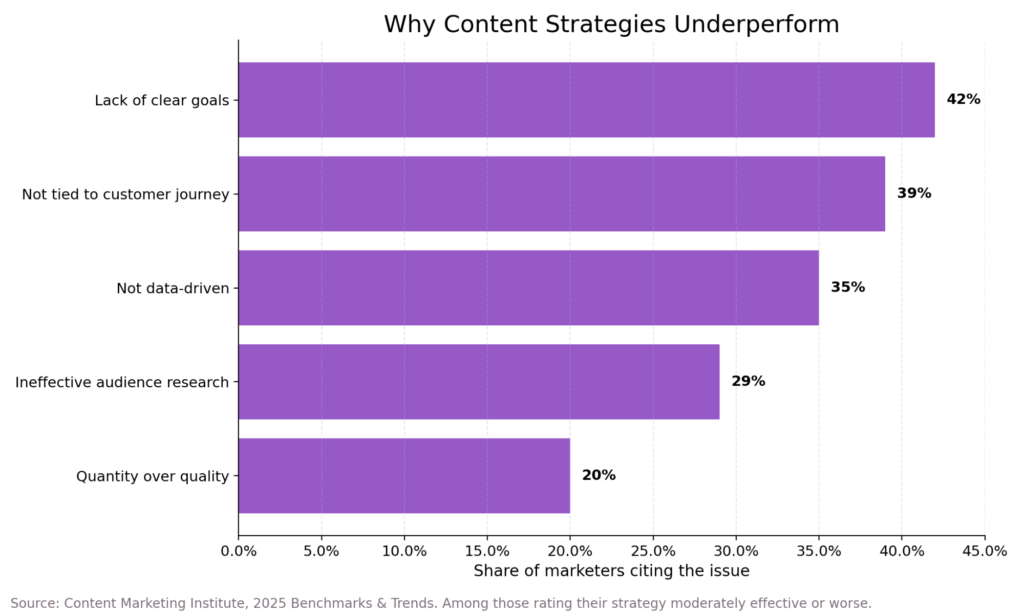
The problem is that many teams still operate without that alignment. Content Marketing Institute found that among B2B marketers who rated their strategy as moderately effective or worse, 42% cited a lack of clear goals, 39% said the strategy was not tied to the customer journey, and 35% said it was not data-driven. Those are not writing problems. They are strategy problems.
The reality check: blogs still matter, but lazy blogs do not
Google’s own guidance is blunt: its systems are designed to prioritize helpful, reliable, people-first content created to benefit people rather than content made to manipulate rankings. Google has also stated that it rewards original, high-quality content that demonstrates experience, expertise, authoritativeness, and trustworthiness (E-E-A-T), regardless of whether AI helped produce it.
That means the old model of publishing thin, keyword-stuffed articles is increasingly weak. The small businesses that win now usually do three things well:
- They target topics that connect to real buyer needs.
- They publish genuinely useful, experience-based content.
- They maintain and improve old content instead of treating publishing as one-and-done.
Ahrefs describes content decay as the gradual decline of a page’s organic traffic and rankings over time. A good blog post strategy plans for that. Publishing is only half the system; updating is the other half.
The strategic foundations of a small-business blog
Before you decide what to write, build the framework underneath the blog.
1) Start with one commercial goal
Every small business blog should begin with one primary business objective for the next 6 to 12 months. Pick one dominant goal before broadening.
Examples:
- Generate more service inquiries
- Rank for location + service terms
- Build email subscribers
- Support ecommerce category sales
- Educate leads before consultations
- Shorten the sales cycle by answering objections
- Increase branded search demand
- Improve retention and repeat purchases
A blog with no commercial direction usually becomes a storage room for disconnected ideas.
2) Define the audience by problems, not only demographics
A useful blog post strategy begins with customer pain, urgency, and decision triggers. Demographics help, but they are not enough.
Instead of:
- Women 25-44 in urban areas
Use:
- First-time homebuyers comparing mortgage options
- Restaurant owners trying to increase weekday bookings
- Parents searching for speech therapy options near them
- SaaS buyers evaluating whether implementation will be difficult
- Ecommerce shoppers comparing ingredients, materials, or product fit
Strong content is built around what the reader is trying to solve, avoid, compare, understand, or justify.
3) Build around search intent and buying stage
Not every post should try to sell directly. But every post should know where it sits in the customer journey.
A practical blog mix includes:
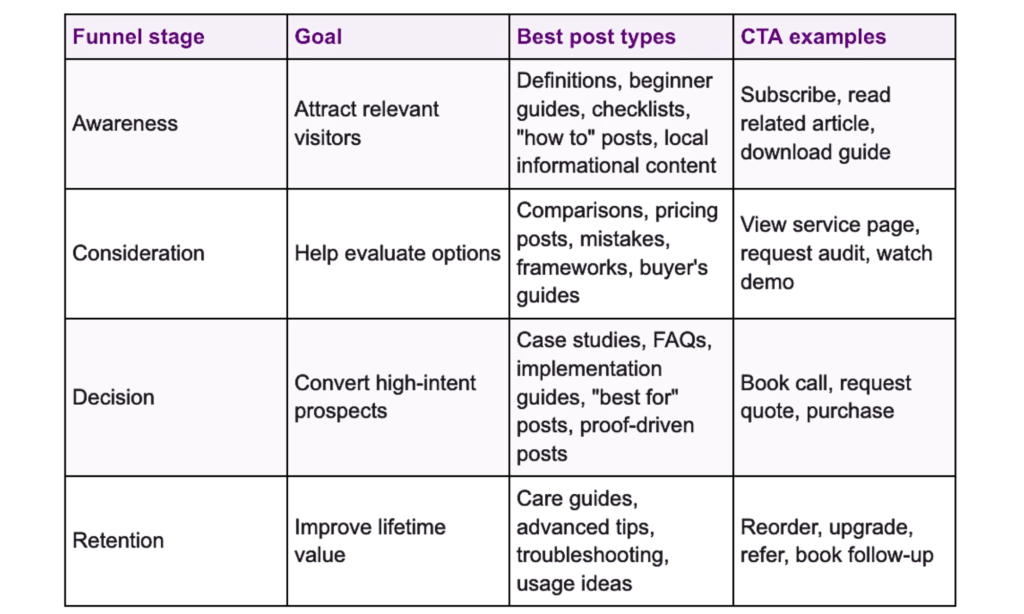
- Top of funnel: educational posts, definitions, beginner guides, local awareness topics
- Middle of funnel: comparisons, cost guides, mistake-avoidance posts, framework posts, checklist posts
- Bottom of funnel: service pages supported by blog posts, case studies, product comparisons, “best for” pages, FAQ posts, implementation guides
- Post-purchase / retention: onboarding tips, care instructions, advanced usage, next-step guides
When small businesses struggle with blog ROI, it is often because they produce too much top-of-funnel content without linking it to middle- and bottom-of-funnel decisions.
The 10-part blog post strategy framework for small businesses
1. Create a keyword universe, then narrow to topic clusters
The heart of a strong blog post strategy is not “what should we post this week?” It is: “Which topics deserve recurring coverage because they match revenue, expertise, and search demand?”
Start with five buckets:
- Core services or product categories
- Customer questions
- Comparison and decision topics
- Local or niche variations
- Objections and misconceptions
For example, a pediatric clinic might build clusters around:
- child nutrition
- vaccination schedules
- developmental milestones
- fever management
- local pediatric care FAQs
A home remodeling company might cluster around:
- kitchen remodeling costs
- timelines
- material comparisons
- permit questions
- contractor selection
A strong cluster usually contains:
- one pillar page or flagship guide,
- several supporting blog posts,
- internal links between related pages,
- and one clear conversion path.
What to prioritize first
Use a scoring model. Rate each topic 1-5 on:
- business relevance,
- search intent quality,
- internal expertise,
- competition realism,
- and repurposing potential.
Then prioritize topics with the highest combined score, not just the highest search volume.
That last point matters more in 2026 than many businesses realize. Ahrefs reports that AI Overviews show more often for informational, longer, and higher-volume queries. Small businesses can often compete more effectively by targeting precise, specific, high-intent searches that larger brands overlook.
2. Choose post formats that small businesses can realistically win with
A successful blog post strategy is format-aware. Some post types are easier for small businesses to rank, share, and convert with than others.
Best-performing post types for many small businesses
How-to guides
Best for: building trust and ranking for instructional searches
Examples:
- How to choose the right CRM for a small sales team
- How to prepare for your first physiotherapy appointment
- How to clean and maintain aluminum windows
Cost and pricing guides
Best for: attracting qualified buyers with commercial intent
Examples:
- How much does wedding photography cost in Indore?
- Website design cost for a restaurant in 2026
- Average cost of a root canal in Bangalore
Comparison posts
Best for: decision-stage searchers
Examples:
- WordPress vs Shopify for a local business website
- Ceramic tint vs regular tint
- Braces vs clear aligners
Mistakes to avoid
Best for: trust, shareability, and lead generation
Examples:
- 9 mistakes homeowners make when replacing balcony glass
- Common Amazon listing optimization mistakes for toy sellers
Local-intent guides
Best for: service businesses and map-pack support
Examples:
- Best neighborhoods in Doha for healthy meal delivery
- What to look for in a pediatric dentist in Bogotá
Case-study or results posts
Best for: bottom-funnel trust
Examples:
- How we improved organic traffic for a local hotel website in 90 days
- How a clinic reduced no-shows with appointment reminder automation
FAQ roundups
Best for: long-tail search and objection handling
Examples:
- 21 questions people ask before installing shower enclosures
- 15 things patients ask before Panchakarma treatment
3. Map every post to one primary CTA
One of the easiest ways to weaken a blog post strategy is to publish articles that attract visitors but never move them forward.
Each post should have one primary next step:
- book a consultation,
- request a quote,
- download a checklist,
- call the business,
- view services,
- shop a category,
- subscribe to email,
- or read a related decision-stage post.
Not every post needs a hard sell. But every post should have conversion intent.
A practical CTA model:
- Top of funnel -> email signup, checklist, related guide
- Middle of funnel -> service page, case study, consultation page
- Bottom of funnel -> quote, booking, demo, purchase
If you want your blog to become a revenue channel, do not treat CTAs as an afterthought added during publishing. Design them while outlining.
4. Set a realistic publishing cadence you can actually sustain
Consistency matters, but “consistent” does not mean daily.
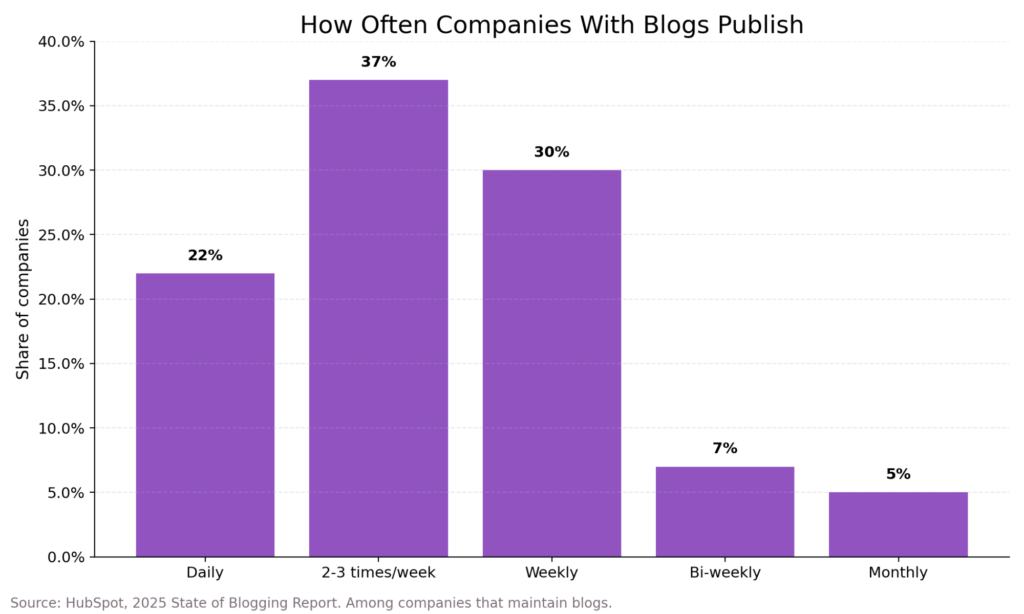
HubSpot’s 2025 state of blogging data found that among companies that maintain blogs, 22% publish daily, 37% publish two to three times per week, 30% publish weekly, 7% publish bi-weekly, and 5% publish monthly. The takeaway is not that small businesses should copy the most aggressive publishers. The takeaway is that cadence should be intentional.
For most small businesses, a good starting cadence is:
- 2 to 4 high-quality posts per month if you have limited capacity
- 1 post per week if you can maintain quality and promotion
1 new post + 1 refresh per week if you already have a content archive
Orbit Media’s data also shows that frequency alone is not the whole story. Marketers publishing multiple times per week were more likely to report strong results, but long-form quality and strong workflows also correlated with performance.
The right cadence is the one you can protect operationally:
- keyword research,
- outline,
- drafting,
- editing,
- visual creation,
- internal links,
- CTA placement,
- promotion,
- and later updates.
A weak weekly plan is worse than a strong bi-weekly plan.
5. Build every post around depth, usefulness, and trust
Google’s people-first guidance should shape your entire editorial process.
A useful small-business blog post typically includes:
- a clear answer early,
- practical specificity,
- original experience or examples,
- visuals that improve understanding,
- references to trustworthy sources when making factual claims,
- internal links to related pages,
- a clear author or brand perspective,
- and a next step for the reader.
The E-E-A-T filter for small businesses
You do not need to be a multinational brand to show trust. You need to prove credibility.
Ways to strengthen E-E-A-T:
- include author bylines with real credentials,
- show original photos, examples, case data, or field experience,
- cite reputable external sources,
- explain methodology when presenting claims,
- keep dates and statistics fresh,
- include business details, location, and contact information,
- align posts with your actual expertise,
- and avoid writing beyond your authority.
This matters even more in YMYL-adjacent categories like health, finance, legal services, and safety-related home services.
We wrote a practical, beginner-friendly digital marketing guide for small businesses. It covers everything from SEO to Paid Ads. Have a quick read & implement to scale your business.
6. Use AI as a workflow accelerator, not a substitute for judgment
AI can help a small team move faster, but a strong blog post strategy still needs human editorial control.
Ahrefs found that 87% of marketers use AI to help create content, 97% edit and review AI content, and only 4% publish pure AI-generated content. That reflects the reality on effective teams: AI can assist with ideation, outlines, research organization, summary extraction, and repurposing – but accuracy, nuance, experience, and trust still need human oversight.
A useful AI workflow:
- use AI to brainstorm angles and FAQs,
- use AI to cluster related questions,
- use AI to generate first-pass outlines,
- use AI to repurpose into email or social captions,
- but manually verify claims, numbers, and examples,
- add firsthand experience,
- add business context,
- and review for differentiation.
Google has explicitly said it focuses on content quality, not how content is produced. So the issue is not whether AI was used. The issue is whether the final page is helpful, original enough, and trustworthy.
7. Invest in visual communication inside the post
This is where many small businesses still underperform.
Good visuals make blog posts easier to understand, easier to skim, easier to remember, and more reusable on social media and email. They also improve the quality of comparison, explanation, and proof.
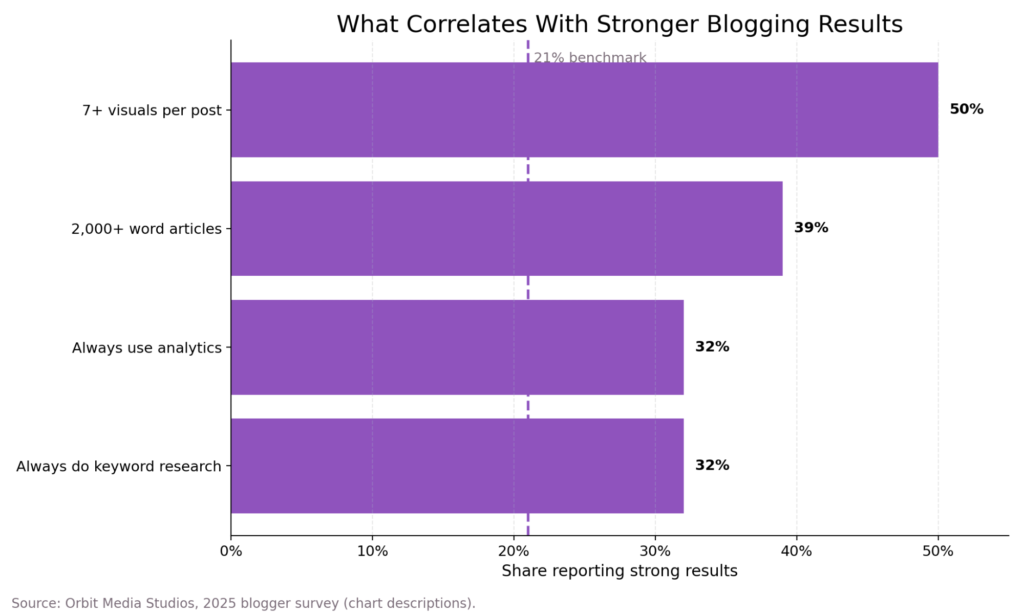
Orbit Media’s 2025 survey found that bloggers who used more visuals per post were more likely to report strong results, reaching 50% strong results for posts with 7+ visuals, versus a 21% benchmark.
For small businesses, visuals do not have to mean expensive design every time. Practical options include:
- annotated screenshots,
- simple process diagrams,
- before/after images,
- tables,
- cost breakdown charts,
- original photos,
- decision trees,
- quote graphics,
- checklists,
- and branded mini-infographics.
A simple visual stack for one strong blog post
For each important article, aim for:
- 1 featured image,
- 1 comparison table,
- 1 chart or infographic,
- 2 to 4 supporting screenshots or photos,
- and 1 CTA graphic or sticky lead magnet block.
That is enough to make most posts dramatically more useful and more repurposable.
8. Design your internal linking on purpose
A strategic blog is not a pile of isolated pages.
Each new article should link to:
- one core service/product page,
- two to four related articles,
- one relevant CTA page,
- and sometimes one proof page such as a case study or testimonial hub.
Internal links help readers continue, help search engines understand topic relationships, and help distribute authority through your site architecture.
A simple rule:
- pillar -> supporting articles
- supporting articles -> pillar
- top-of-funnel article -> mid-funnel article
- mid-funnel article -> service or product page
- all relevant pages -> conversion page
This is one of the highest-leverage improvements for small businesses with existing content.
9. Repurpose every high-value post into a content asset system
A modern blog post strategy should not end at publish.
One good article can become:
- a LinkedIn carousel,
- an Instagram caption series,
- an email newsletter,
- a short video script,
- a sales follow-up resource,
- a downloadable checklist,
- a FAQ section on a service page,
- or talking points for a webinar or consultation.
This is how small teams win: not by creating ten unrelated assets, but by turning one strong article into a week’s or month’s worth of distribution.
A simple repurposing model:
- article -> summary email
- article -> 5 social posts
- article -> short-form video outline
- article -> sales enablement link
- article -> updated FAQ or service page section
When you do this consistently, the economics of blogging improve because each post does more than one job.
10. Build a refresh cycle so old content keeps working
This is the part many businesses skip.
Ahrefs defines content decay as the gradual loss of organic traffic and rankings over time. In practical terms, your best article today may quietly become your underperforming article six months from now if:
- competitors publish something better,
- statistics become outdated,
- intent shifts,
- screenshots age,
- titles lose click appeal,
- or your CTA becomes weak compared with your current offer.
Refresh triggers to watch
Update a post when:
- traffic declines for 2 to 3 months,
- rankings slip for important keywords,
- the SERP has changed,
- the page has impressions but weak CTR,
- the offer has changed,
- links or examples are outdated,
- or the content no longer reflects your best thinking.
What a proper refresh includes
A real refresh is more than changing a date.
It usually includes:
- updating statistics and references,
- improving the introduction,
- tightening search intent alignment,
- adding new sections or FAQs,
- improving visuals,
- strengthening internal links,
- refreshing metadata,
- upgrading CTA placement,
- and republishing with promotion.
For many small businesses, content refreshes are the highest-ROI content activity after service-page optimization.
A practical blog post strategy by funnel stage

The small-business content mix that usually works best
If you only publish one kind of article, your blog becomes fragile.
A healthier monthly mix for many small businesses looks like:
- 30% educational evergreen posts,
- 25% commercial-intent posts,
- 20% comparison/decision posts,
- 15% proof or case-study content,
- 10% retention or community content.
This is not a law. It is a balancing model. Adjust by business type:
- local service businesses should skew more commercial and local,
- ecommerce businesses should skew more product education and comparison,
- B2B services should invest more in thought leadership, case studies, and objection handling,
- healthcare and legal businesses should place a heavier emphasis on trust, safety, and expert review.
At Full Traffic, we specialise in SEO Services – focussed on conversions over rankings. Hit the button below to know more.
How long should small-business blog posts be?
There is no universal number. Search intent should decide.
Still, current benchmarks help. Orbit Media reports the average post in 2025 was 1,333 words. But their survey also found that content programs prioritizing detailed articles were more likely to drive results, with 39% of marketers publishing 2,000+ word articles reporting strong results, versus a 21% benchmark.
The practical takeaway:
- use shorter formats for quick answers, announcements, or simple FAQs,
- use medium-depth posts for clear instructional topics,
- use long-form posts for competitive, high-value queries where depth matters.
Do not chase word count for its own sake. Chase completeness and utility.
Editorial workflow: the small-business system that keeps quality high
A repeatable workflow often matters more than raw writing talent.
Recommended production workflow
Step 1: Topic brief
- target keyword,
- search intent,
- audience problem,
- business relevance,
- CTA,
- related internal links,
- competitor notes.
Step 2: Outline
- H2 and H3 structure,
- examples,
- proof points,
- visuals needed,
- FAQ targets.
Step 3: Draft
- answer early,
- expand with clarity,
- include original insight,
- write for real readers first.
Step 4: Evidence and trust pass
- verify claims,
- add citations,
- include expert or firsthand input,
- add local or business-specific details.
Step 5: SEO pass
- title tag,
- meta description,
- subheads,
- internal links,
- image filenames and alt text,
- schema if relevant,
- CTA placement.
Step 6: Publish and distribute
- email,
- social snippets,
- employee or founder sharing,
- possible paid boost for flagship posts.
Step 7: Review after 30, 60, and 90 days
- impressions,
- ranking movement,
- clicks,
- conversions,
- assisted conversions,
- scroll depth or engagement,
- and next-action decisions.
Metrics that actually matter for a blog post strategy
Small businesses often over-focus on pageviews and under-focus on outcomes.
A better measurement model includes four layers:
1) Visibility metrics
- impressions,
- keyword rankings,
- organic clicks,
- branded search growth,
- referring domains.
2) Engagement metrics
- engaged sessions,
- scroll depth,
- time on page,
- return visitors,
- CTA click rate.
3) Conversion metrics
- form fills,
- consultation bookings,
- quote requests,
- calls,
- product purchases,
- email signups,
- demo requests.
4) Business impact metrics
- assisted conversions,
- customer acquisition cost support,
- sales cycle acceleration,
- lead quality,
- repeat purchase lift,
- close rate by content-assisted leads.
If a blog post attracts less traffic but influences better leads, it may be more valuable than a higher-traffic post with no conversion impact.
One useful KPI dashboard for small businesses
Track monthly:
- new posts published,
- old posts refreshed,
- organic sessions to blog,
- conversions from blog,
- top 10 landing posts,
- posts with declining traffic,
- top assisted-conversion posts,
- top CTA click rates,
- and top internal-link pathways.
Orbit Media also found that using analytics more consistently correlated with stronger results, reaching 32% strong results among marketers who always use analytics, versus 13% among those who use it never/rarely. Measurement is not administrative overhead. It is part of the strategy itself.
A 90-day blog post strategy plan for small businesses
If you want a practical roadmap, use this.
Days 1-15: Strategy and research
- define the primary commercial goal
- identify 3 to 5 topic clusters
- map your audience questions
- collect keyword themes and search intent
- audit existing blog content
- identify pages to refresh, merge, or remove
- define conversion actions
- create editorial templates
Days 16-30: Build the core structure
- finalize the first 8 to 12 topics
- create a pillar-supporting-page map
- draft internal linking rules
- design CTA blocks
- create a lightweight visual style for charts/tables/graphics
- document editorial quality standards
Days 31-60: Publish the first content wave
- publish 4 to 6 strategic posts
- link them to service/product pages
- repurpose each into email and social assets
- submit for indexing where appropriate
- begin performance tracking
- collect sales-team or customer-feedback insights
Days 61-90: Improve and expand
- review performance data
- refresh underperforming introductions and titles
- strengthen internal links
- add FAQs and richer visuals
- create 3 to 5 supporting posts around winners
- publish one proof-based post such as a case study or results story
- build the next 90-day editorial plan using performance data
Common blog strategy mistakes small businesses should avoid
Mistake 1: Publishing around inspiration instead of demand
If a topic is not tied to customer interest, search demand, or business value, it is usually a low-priority topic.
Mistake 2: Writing only top-of-funnel content
Educational traffic is useful, but it will not produce much ROI if you never create comparison, cost, FAQ, and decision-stage content.
Mistake 3: Using AI without fact-checking
Fast content that is generic, inaccurate, or bland is a trust risk.
Mistake 4: Ignoring visuals
Text-only posts are harder to share, harder to skim, and often less persuasive.
Mistake 5: Weak CTA architecture
A blog without next steps becomes a dead end.
Mistake 6: No refresh process
If you never update content, your archive gradually becomes a liability.
Mistake 7: Treating each post as isolated
Without internal links, topic clusters, and service-page support, blog posts rarely compound.
Mistake 8: Chasing volume over fit
More content is not always better. Better-targeted content is better.
What makes a blog post shareable?
A shareable post usually has at least one of these qualities:
- a sharp point of view,
- a practical framework,
- a surprising stat,
- a useful checklist,
- a clear comparison,
- a memorable visual,
- or a specific local/niche angle.
In other words, shareability is rarely about being loud. It is usually about being useful enough that someone wants to pass it on.
If you want more shares:
- lead with a strong promise,
- use skimmable structure,
- add original graphics,
- include quotable lines,
- provide one clear takeaway per section,
- and give readers assets they can reuse in meetings, emails, or decisions.
The future-proof version of a blog post strategy
The best blog post strategy for a small business in 2026 is not “SEO only” and not “social only.” It is an integrated system where each article helps you:
- rank in search,
- train AI systems on your brand expertise,
- support social repurposing,
- answer sales objections,
- improve trust,
- and create a reusable knowledge asset.
BrightEdge notes that even with AI search growing fast, organic search remains the primary driver and delivers the majority of conversions. That is the real strategic lesson: the channel is evolving, but the businesses that consistently publish useful, trustworthy website content still own durable digital ground.
Final Takeaway
A high-performing blog post strategy is not about posting more. It is about publishing with purpose.
For a small business, that means:
- choose topics tied to revenue,
- organize them into clusters,
- match them to funnel stages,
- publish at a sustainable pace,
- build trust through helpful, experience-based writing,
- use visuals and internal links intentionally,
- repurpose intelligently,
- and refresh content before it decays.
Do that consistently and your blog stops being a side project. It becomes a strategic asset.