Share

Ultimate Guide to Digital Marketing for Small Businesses in 2026
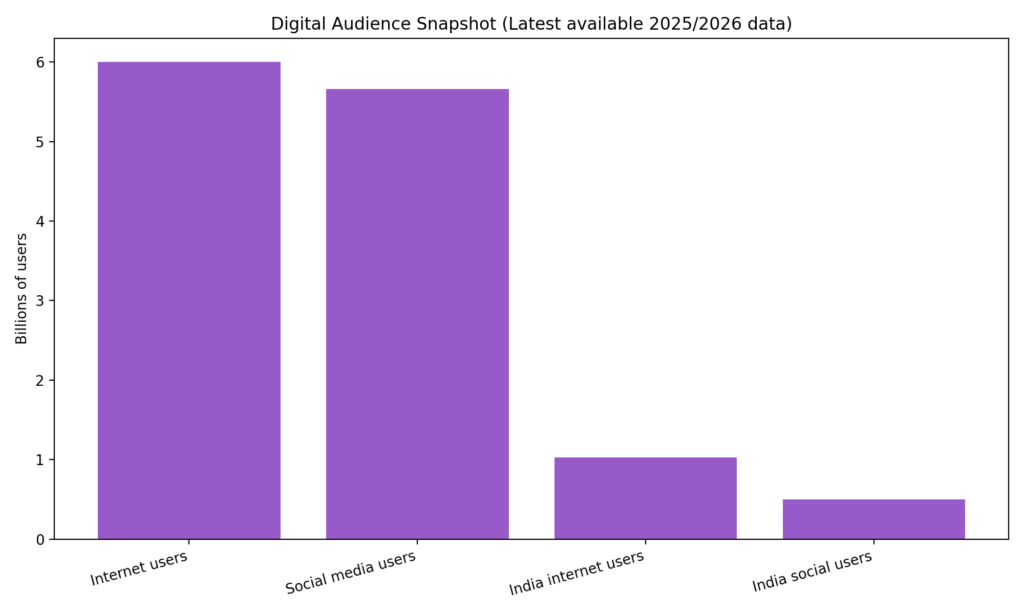
Small-business marketing has changed. Customers no longer move in a straight line from ad to website to sale. They search on Google, compare options on social media, watch a quick video, read reviews, open an email later, and only then decide whether to call, visit, or buy. That complexity can feel overwhelming, but it is also the reason small businesses can compete so effectively online: the businesses that show up consistently across those moments earn trust faster and capture demand sooner. The scale of the opportunity is massive. More than 6 billion people are now online globally, global social media user identities have reached 5.66 billion, and local intent remains especially powerful: 76% of people who search on their smartphones for something nearby visit a business within a day, while 28% of those searches result in a purchase.
That opportunity is especially relevant in India. DataReportal’s latest India figures show roughly 1.03 billion internet users and 500 million social media user identities, which means the addressable digital audience is already enormous and still expanding. For a small business, digital marketing is no longer about “being online.” It is about becoming discoverable, credible, and easy to choose at the exact moment someone is ready to act.
Digital marketing, in practical terms, is the coordinated use of your website, search visibility, local presence, content, social media, email, paid campaigns, analytics, and automation to create a repeatable flow of leads and revenue. If it is working, it should help you do five things well: get found, build trust, capture demand, nurture prospects, and turn results into repeatable growth.
Why digital marketing matters so much for small businesses ?
6 Billion+ People Online
5.66 Billion Social Media IDs
1.03 B+ Internet Users in India
76% Smartphone Searchers Visit Business Pages
28% of Searches Result in Sale
48.6% Marketers Say Shortform Video Delivers
The biggest advantage digital marketing gives a small business is not reach. It is precision. Large brands can buy awareness. Small businesses usually win by showing up when intent already exists. That is why search still matters so much. DataReportal reports that search engines remain the number one source of brand discovery for online adults, and also the primary destination when users research potential purchases. The same dataset shows that social media ads are still a top discovery source too, with more than 30% of adult internet users saying they discover new brands, products, and services via ads on social platforms.
That combination is what makes modern small-business marketing so powerful. Search captures people who already know they need something. Social helps shape awareness and trust before or between those searches. Email helps you follow up after interest has been created. Video helps compress attention and credibility into seconds. The businesses that connect these channels into one system outperform those that treat each channel as a separate experiment.
Your website is the foundation, not an afterthought
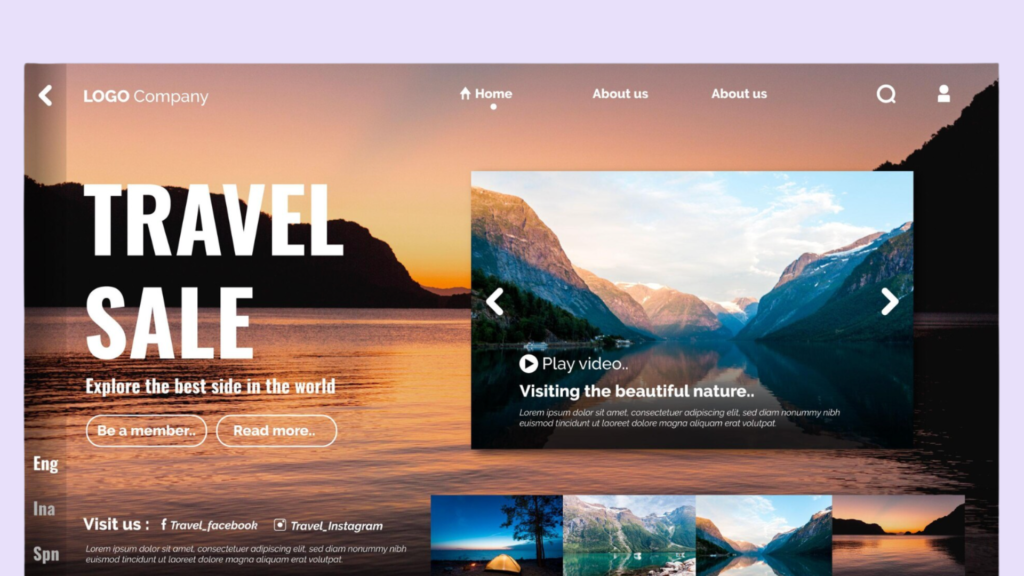
A lot of small businesses still treat their website like a digital brochure. That is a mistake. Your website is your storefront, salesperson, proof engine, and conversion hub. Every other channel eventually points back to it, whether directly or indirectly.
Google’s Search Essentials and SEO Starter Guide make the principle very clear: create helpful, reliable, people-first content; use the words people would actually search for; place those words in prominent places such as the title and main heading; and make your links crawlable so search engines can discover and understand your site structure. In other words, the best-performing business websites are not written to impress the business owner. They are written to reduce friction for the visitor and increase clarity for search engines.
A strong small-business website should answer four questions almost immediately: what do you offer, who is it for, why should someone trust you, and what should they do next? That means your homepage needs a clear value proposition, your services or products need dedicated pages, and your calls to action need to feel obvious rather than hidden. Testimonials, case studies, reviews, FAQs, certifications, guarantees, and location details all matter because they reduce hesitation. A high-performing site does not just look modern. It makes the next step feel safe.
SEO is still one of the highest-leverage channels you can build

SEO remains one of the best long-term bets for small businesses because it captures existing demand. When someone searches for “best CA for startups in Bangalore,” “skin clinic near me,” or “office chairs for small spaces,” they are not passively browsing. They are looking for a solution. That kind of intent is hard to beat.
The right SEO strategy for a small business is not about chasing technical complexity first. It is about matching content to commercial intent. Start with the searches most likely to generate business: service-plus-location pages, product pages, comparison pages, pricing pages, problem-solution content, and well-structured FAQs. Then build supporting content around the questions customers ask before they buy. The key is to create pages that are genuinely useful, commercially relevant, and easy to understand. That aligns with Google’s own guidance on helpful, people-first content.
Small businesses often overcomplicate SEO because the industry makes it sound mysterious. It is not mysterious. It is disciplined clarity. Use the language your customers use. Organize your site so that pages are easy to navigate. Publish genuinely helpful content. Make sure the site loads well on mobile. Then keep improving the pages that already attract qualified traffic.
Local SEO is a growth engine for any geography-based business
For local businesses, digital marketing often succeeds or fails on local visibility. Google Business Profile is one of the most important free assets a small business can own. Google states that a Business Profile lets you manage how your business appears on Search and Maps at no charge, and that a verified profile helps customers find you and build greater trust in your business.
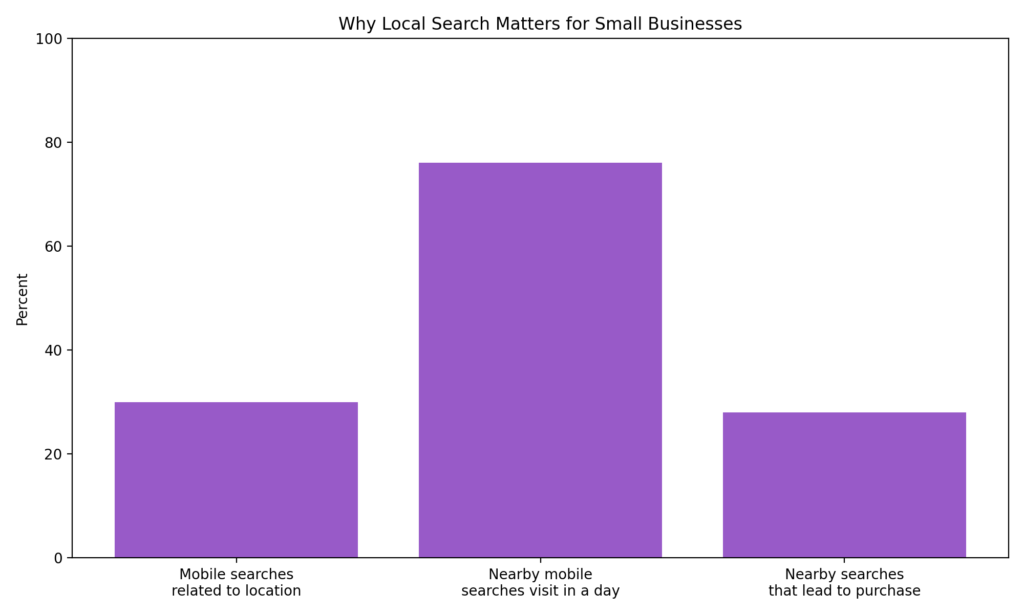
The buying intent behind local search is even more compelling. Google’s Think with Google research shows that 30% of all mobile searches are related to location, 76% of people who search for something nearby on their smartphones visit a business within a day, and 28% of those searches result in a purchase. Those are remarkable numbers because they show that local search is not just about visibility. It is about conversion-ready demand.
That means your Google Business Profile deserves real attention. Claim it, verify it, choose the most accurate primary category, fill out services and products, add business hours, upload real photos, collect reviews consistently, and respond to those reviews thoughtfully. If your business depends on calls, bookings, store visits, or consultations, this work is not optional. It is foundational.
We wrote a practical, beginner-friendly SEO checklist for small businesses. Have a quick read & implement to grow your business organically.
Content marketing compounds when done with intent

One of the biggest differences between weak marketing and strong marketing is whether the business is building assets or just posting things. Content becomes powerful when it compounds. A strong article can keep attracting search traffic for months. A useful FAQ page can reduce objections at scale. A good explainer video can be reused in sales, email, and social.
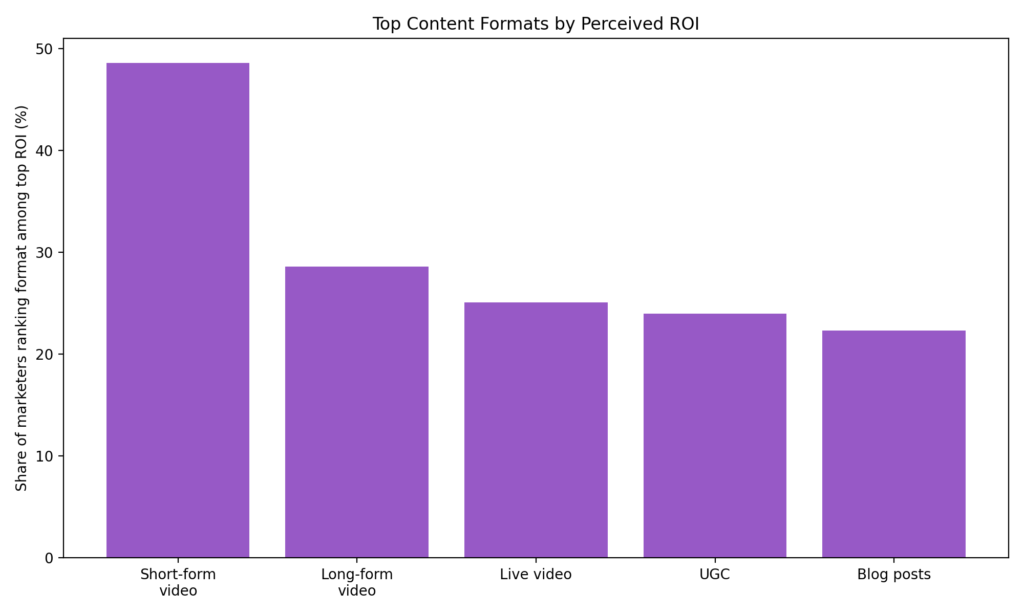
HubSpot’s latest marketing data shows that short-form video is the strongest performer by perceived ROI, while blog posts still remain among the top-performing content formats. That matters because it suggests small businesses should not choose between written content and video. They should use both, but for different jobs. Blogs and landing pages build search equity and capture high-intent visitors. Short-form video expands reach, communicates personality, and compresses trust-building into a format people increasingly prefer.
The right content strategy is not “publish more.” It is “publish what maps to the customer journey.” Bottom-of-funnel content should include service pages, pricing pages, comparisons, case studies, and testimonials. Mid-funnel content should include buying guides, FAQs, webinars, email sequences, and objection-handling content. Top-of-funnel content should educate, entertain lightly, and create brand familiarity. The best small-business content strategy is usually built from real customer conversations, not abstract brainstorms.

Social media should distribute trust, not replace strategy
Social media is vital, but it should not become the entire marketing plan. The strongest small-business brands use social as a distribution layer, trust layer, and relationship layer. They do not confuse posting with strategy.
HubSpot reports that in 2026, organic social media content is leveraged by 40.3% of brands and paid social by 39.4%, while Instagram has become the most leveraged social platform, used by 70% of brands. DataReportal adds another important behavioral layer: the average active global user visits 6.75 different social platforms each month, and the average global user spends 18 hours and 36 minutes per week in social media and social video environments.
For Indian businesses, platform scale is especially meaningful. DataReportal reports that Instagram had 481 million users in India in late 2025, while LinkedIn had 170 million registered members. That does not mean every business should be on both. It means platform selection should be based on customer behavior, not trend-chasing. A B2C beauty brand, home bakery, salon, or fashion label might prioritize Instagram and WhatsApp. A B2B consultant, agency, SaaS firm, or recruiter might prioritize LinkedIn and email. A trust-heavy service business might benefit most from YouTube plus search.
The most effective social content for small businesses usually falls into a few simple buckets: proof, education, behind the scenes, customer stories, founder perspective, and offers. The goal is not to “go viral.” It is to be remembered, understood, and trusted.
Video is no longer optional for most businesses
If there is one format small businesses should stop postponing, it is video. Consumer expectations have moved decisively in that direction. Wyzowl reports that 84% of consumers want to see more video from brands, and 89% say video quality affects their trust in a brand. That does not mean every video needs studio-level production. It means clarity, sound, framing, and credibility matter.
The strategic case is just as strong. HubSpot’s 2026 data shows short-form video leading all formats for perceived ROI at 48.6%, far ahead of long-form video at 28.6%, live-streaming video at 25.1%, user-generated content at 24%, and blog posts at 22.3%. For a small business, that is a strong signal: if your team can consistently produce short, useful, platform-native video, you are working in the format the market is rewarding most right now.
The good news is that useful video formats are simple. Founder explainers, product demos, FAQ clips, customer testimonials, behind-the-scenes footage, before-and-after examples, and short educational reels all work. Small businesses do not need cinematic storytelling to benefit. They need consistency, clarity, and relevance.
Email remains one of the most defensible channels you can own
Email still matters because it is one of the few attention channels you actually control. Social platforms can reduce your reach overnight. Advertising costs can rise fast. Your email list is an owned relationship.
Litmus reports that most marketers see email ROI in the range of 10:1 to 36:1, and that 35% of companies report returns between $10 and $36 for every $1 spent. Mailchimp’s benchmark data provides a useful performance baseline: across all users, average open rate is 35.63% and average click rate is 2.62%. In ecommerce, the average open rate is 29.81% and click rate is 1.74%. Nonprofits and education tend to benchmark higher.
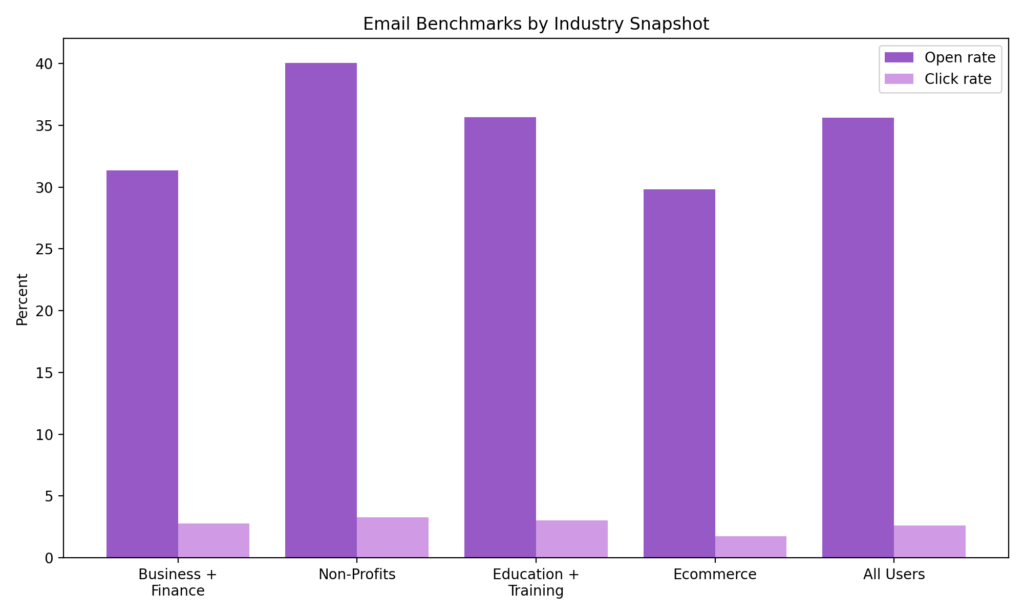
Those benchmarks matter because they help small businesses stop guessing. A smart email strategy is not built on random newsletters alone. It should include a welcome sequence, lead magnet delivery, abandoned inquiry or cart reminders, post-purchase education, review requests, reactivation campaigns, and periodic value-driven newsletters. The best email programs feel helpful and timely rather than constant and generic.
Mailchimp’s guidance on performance is also practical: personalize subject lines where relevant, keep them short, segment audiences instead of blasting everyone the same message, and A/B test subject lines, content, and CTAs. Mailchimp also notes that segmentation and personalized content make campaigns more relevant and can improve engagement and conversion.
Paid advertising works best when it accelerates what already works
A common small-business mistake is trying to use paid ads to rescue a weak offer, unclear landing page, or poor follow-up process. Paid advertising is powerful, but it works best as an accelerator, not a repair tool.
HubSpot’s 2026 investment data shows marketers plan to increase spend most in AI chatbots, paid social media, video marketing, content marketing, and website/blog/SEO. That mix reflects a mature reality: strong performance marketing today is rarely just “run ads.” It is ads plus landing pages plus content plus measurement plus follow-up.
The right role for paid media in a small-business strategy is usually one of four things: capture urgent high-intent demand, retarget visitors who already showed interest, promote offers that are already converting organically, or test audiences and messaging faster than SEO alone can. Search ads are strongest when intent is obvious. Paid social is strongest when creative and offer quality are high. Both become much more profitable when connected to email, CRM, and remarketing.
At Full Traffic, we specialise in Digital Marketing for Small Businesses – focussed on RoI and conversion optimised campaigns. Hit the button below to know more.
Analytics turns activity into a system

A lot of small businesses stay busy but remain unclear on what is actually driving revenue. That usually happens because they measure the wrong things. Views, reach, and likes matter only if they connect to business outcomes.
A useful KPI structure has three layers. The first is visibility: impressions, rankings, reach, views, and profile discovery. The second is engagement: clicks, watch time, calls, email opens, replies, and form starts. The third is business impact: qualified leads, bookings, conversion rate, customer acquisition cost, revenue, repeat purchase rate, and lifetime value. If a channel cannot eventually be tied to the third layer, it should not dominate your strategy.
This is where many small businesses unlock growth. Not by doing more channels, but by identifying which pages, offers, and audiences produce the most qualified action, then putting more energy there.
AI and automation are now part of the small-business toolkit

AI is no longer experimental. It is operational. HubSpot reports that 86.4% of marketing teams now use AI in at least a few marketing areas, and 73.4% of marketers say they see AI working alongside humans rather than replacing them. That is the right mental model for small businesses too.
The best use cases are straightforward: first drafts, ad variations, content outlines, reporting summaries, blog-to-social repurposing, email ideas, and workflow automation. HubSpot also notes that AI tools are making media creation faster and more affordable, while channel-specific adaptation still matters because tailored content performs better than identical cross-posting.
The caution is equally important. AI should not replace brand voice, positioning, empathy, or final judgment. It should reduce execution friction so your team can spend more time on customer understanding, creative quality, and commercial decisions.
A practical 90-day roadmap for small businesses

In the first 30 days, focus on foundation. Clarify your audience and offer, improve your homepage and core service pages, install analytics and conversion tracking, claim and optimize your Google Business Profile, build one strong lead capture flow, and define your core keyword targets.
In days 31 to 60, focus on publishing and distribution. Create bottom-of-funnel pages, publish a cluster of useful articles, start posting consistently on one or two relevant social platforms, create a handful of short FAQ videos, collect reviews actively, and launch a simple welcome email sequence.
In days 61 to 90, focus on optimization and scale. Review which pages, offers, and channels are generating qualified inquiries. Promote top-performing content with paid campaigns. Build retargeting audiences. Improve landing pages. Refine email follow-up. Then double down on the channels producing the best leads, not just the most attention.
What small businesses get wrong most often
The most common mistakes are predictable. They post on every platform instead of choosing the right ones. They run ads to weak landing pages. They ignore Google Business Profile. They publish content that has no real search intent. They send the same email to everyone. They collect attention but fail to follow up. They use AI to create volume without quality. They quit before compounding channels have time to work.
The pattern behind all of these is the same: activity without a system.
Final thoughts
The best digital marketing strategy for a small business is not the loudest one. It is the clearest, most consistent, and most measurable one. Start with discoverability. Strengthen trust. Capture leads. Follow up intelligently. Measure what matters. Then scale only what proves itself.
That is how small businesses win online now: not by chasing every new tactic, but by building a digital system that turns attention into trust and trust into revenue.