Share

AI in SEO: The Complete Guide to Winning Search in the Age of AI
AI in SEO is no longer a side topic for experimentation teams. It is now central to how modern search works, how content is produced, how SERPs are shaped, and how brands earn visibility. Google’s own documentation now treats AI features such as AI Overviews and AI Mode as part of the mainstream search experience, while also making it clear that the fundamentals of SEO still apply: indexable pages, technical accessibility, helpful content, strong page experience, and clear site architecture. In other words, AI SEO is not a replacement for SEO. It is the new operating layer on top of it.
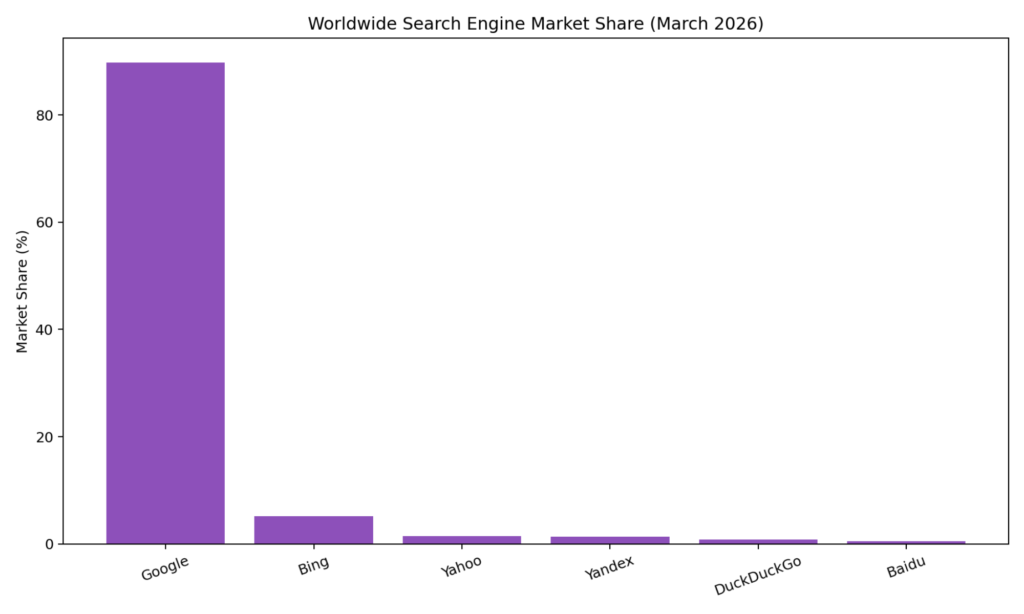
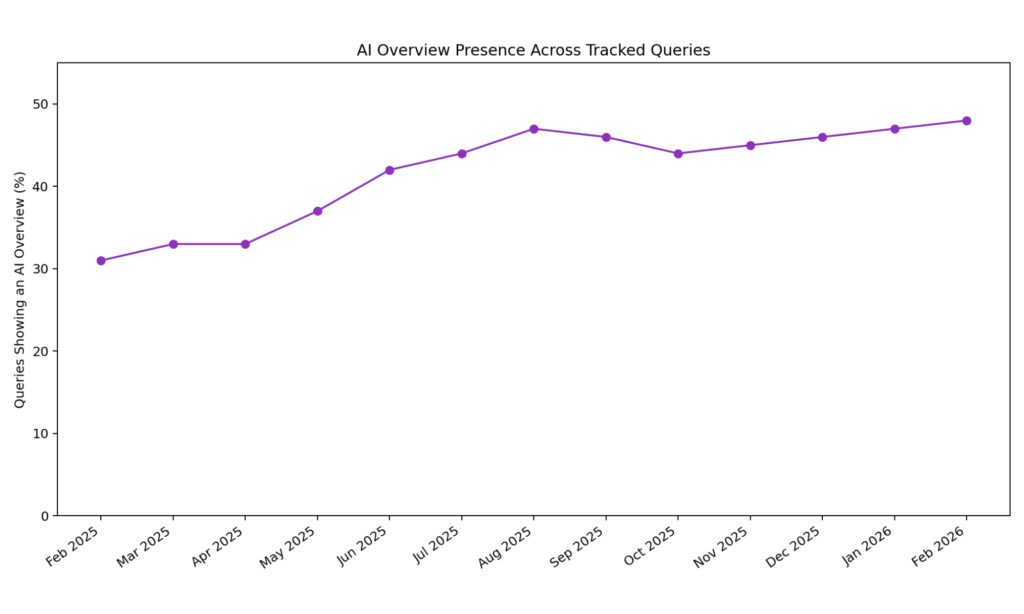
That matters because search is changing fast, but it is not changing evenly. Google still held 89.85% of worldwide search engine market share in March 2026, so the center of gravity for SEO remains overwhelmingly Google-led. At the same time, research firms studying AI Overviews are finding meaningful SERP disruption. Semrush found AI Overviews on 15.69% of the 10M+ keywords it studied in November 2025, while BrightEdge’s tracked query set showed AI Overview presence rising to about 48% by February 2026. Those numbers are not contradictory so much as methodological: different datasets, different keyword universes, different thresholds. The strategic takeaway is simple: AI search features are already material enough that serious SEO teams cannot ignore them.
This shift is also showing up inside marketing organizations. McKinsey reports that 78% of respondents say their organizations use AI in at least one business function, and 71% say they regularly use generative AI in at least one function, with marketing and sales among the most common areas of use. HubSpot’s 2026 marketing data adds another layer: over 92% of marketers say they already use or plan to use SEO optimization for traditional and AI-powered search engines, nearly 24% are exploring updates to SEO for generative AI in search, and nearly 30% report decreased search traffic as consumers turn to AI tools. AI in SEO is no longer a speculative trend. It is a live operational response to how discovery is evolving.
So what does “AI in SEO” actually mean? At a basic level, it means using machine learning and generative AI to improve the speed, scale, and intelligence of SEO work. That includes keyword clustering, search intent analysis, content brief generation, title testing, internal link suggestions, schema validation, log analysis, content refresh prioritization, and SERP-change detection. At a more advanced level, AI SEO means building content and site systems that perform well in search environments where Google may summarize information, compare sources, surface more diverse citations, and reward pages that are genuinely useful rather than merely optimized. Google explicitly says there are no special technical requirements or extra schema types required to appear in AI Overviews or AI Mode; the same foundational SEO best practices remain the path in.
That last point is crucial because a lot of bad advice is circulating. There is no magic “AI Overview schema.” There is no special AI text file you need to upload. Google says you do not need to create new machine-readable AI files or add special schema.org markup to appear in AI features. Your page simply needs to be indexable, eligible to show in Search with snippets, technically accessible, and genuinely useful. Structured data still matters, but not because it unlocks a secret AI ranking switch. It matters because it helps machines understand the content you already have, makes pages eligible for rich results where applicable, and reduces ambiguity when your markup matches what users can actually see on the page.
The best way to understand AI SEO is to split it into two layers: AI for doing SEO, and SEO for AI-shaped search results. The first is about productivity and decision quality. The second is about winning visibility in a world where search engines synthesize information, fan out into related subqueries, and sometimes answer before the click. Google’s documentation on AI features says AI Overviews and AI Mode can use “query fan-out” techniques, issuing multiple related searches across subtopics and data sources in order to develop a response. That means shallow pages written around a single keyword variation are less durable than well-structured pages that cover a topic, supporting subtopics, evidence, and related questions in a coherent way.
Why AI in SEO matters now?
The Strongest Reason
The strongest reason AI in SEO matters is not that AI can write faster. It is that search behavior is becoming more layered. Google says users in AI experiences are asking longer, more specific, and more complex questions, and following up with deeper queries. That changes the shape of winning content. Pages that only target head terms with generic intros are less likely to satisfy layered intent than pages built around expert framing, subtopic completeness, clear answers, and evidence. In short, AI search raises the bar for content usefulness even as it lowers the cost of producing average content.
The Second Strongest Reason
The second reason is SERP real estate. BrightEdge reports that when AI Overviews appear, they average more than 1,200 pixels tall, often pushing standard organic results below the fold on a typical screen. The company also found that only about 17% of AI Overview citations overlap with top-10 organic results in its dataset. That means ranking well is still valuable, but ranking well alone does not guarantee citation visibility inside AI-generated answer layers. SEO teams now need to optimize for both ranking and citation-worthiness.
The Third Strongest Reason
The third reason is traffic quality. Google says clicks from search results pages that include AI Overviews tend to be higher quality, with users more likely to spend more time on site. BrightEdge, however, also found that AI search platforms still accounted for less than 1% of referral traffic in its 2025 dataset, while organic search remained the main driver of conversions. Those two ideas can both be true: AI-shaped search may send fewer but more qualified visits, while classic organic still carries most of the volume and revenue. The implication for AI SEO is that teams should stop evaluating success with clicks alone and start pairing visibility with engagement, leads, assisted conversions, and revenue.
The Basics: Where AI improves everyday SEO work
Research Efficiency
The most immediate gain from AI in SEO is research efficiency. AI systems are very good at taking large keyword lists and grouping them by semantic similarity, search intent, funnel stage, entity relationships, or content format. Instead of spending days manually sorting thousands of keywords into blog, comparison, category, and FAQ buckets, an AI-assisted workflow can create a first-pass clustering model in minutes. The human SEO still has to validate the clusters, merge edge cases, and resolve business relevance, but the time savings are real. This is where AI SEO works best: not as a replacement for judgment, but as a force multiplier for structured thinking.
Improves Content Planning
A strong AI workflow can turn a target topic into an outline, identify missing subtopics, suggest related questions, map internal linking opportunities, surface outdated competitor angles, and produce a brief that actually reflects search intent rather than just keyword density. This aligns directly with Google’s people-first guidance. Google’s documentation says helpful content should be created to benefit people rather than manipulate rankings, and its generative-AI guidance says AI can be useful for research and structuring content, but using it to generate many pages without adding value may violate spam policies on scaled content abuse. That is the line that matters: use AI to sharpen substance, not to mass-produce emptiness.
On-Page Optimisation
On-page optimization is another strong use case. AI tools can analyze a draft against the topic model of the SERP and flag missing definitions, weak introductions, vague headings, thin examples, or poor answer formatting. They can suggest more precise title tags, cleaner H2 structures, concise definition blocks, and semantically aligned related terms. But the best AI SEO teams avoid letting the model over-optimize into sameness. If every article uses the same formulaic headings and the same predictable “what is / benefits / conclusion” flow, differentiation disappears. Google’s own blog advises site owners to focus on unique, non-commodity content that provides original value. AI can help structure content, but it cannot manufacture lived experience, expert interpretation, or a distinctive point of view on its own.
Technical SEO
Technical SEO also benefits from AI in ways that are often underrated. AI can help prioritize crawl anomalies, detect indexation patterns, summarize log-file issues, identify orphan pages, classify template bloat, and find inconsistent canonical or hreflang implementations. It can also act as a QA layer for structured data, helping ensure that markup matches visible content, which Google explicitly recommends. For large sites, AI-assisted classification of indexability issues can save huge amounts of analyst time. That makes AI SEO especially powerful for publishers, ecommerce sites, marketplaces, SaaS knowledge bases, and multi-location businesses with thousands of URLs.
The advanced layer: SEO for AI-shaped search
Citation Mechanics
Advanced AI SEO starts with understanding citation mechanics. If Google’s AI systems can fan out across subtopics and cite a wider range of sources, then pages need to do more than repeat the obvious answer. They need to become citation candidates. In practice, that means building pages that are easy to extract from, easy to trust, and easy to verify. Strong pages tend to define the topic clearly, answer the likely question early, include specifics, use accurate terminology, show supporting evidence, and cover adjacent subquestions without rambling. Think less like a copywriter filling a template and more like an editor building a source document.
Entity Depth
Entity depth matters here. A modern AI SEO strategy should map the main entity, its attributes, related entities, common modifiers, comparative angles, and downstream questions. If the page is about “AI in SEO,” the related entity graph includes search intent, AI Overviews, content generation, technical SEO, search quality, indexing, structured data, CTR, zero-click behavior, analytics, and conversion measurement. This is not about stuffing keywords. It is about demonstrating topic completeness in a way that mirrors how modern search systems retrieve and synthesize information.
Multimodality
Multimodality is another advanced opportunity. Google explicitly recommends supporting text with high-quality images and videos and keeping Merchant Center and Business Profile information up to date where relevant. Google also notes that people increasingly use multimodal search to ask questions using photos and other media inputs. That means the future of AI SEO is not purely textual. Product pages need better imagery, tutorial pages need better screenshots or diagrams, location pages need cleaner business data, and thought leadership pages benefit from charts, original visuals, and expert clips. Rich assets do not just improve UX; they improve machine interpretability and visibility across blended search surfaces.
Source Diversification
Another advanced pattern is source diversification. Semrush found that when AI Overviews appear, video carousels and discussion/forum blocks often coexist with them, and YouTube and Reddit are especially visible in those adjacent surfaces. That suggests an important AI SEO principle: brand visibility may need to be distributed across owned pages, YouTube content, community discussions, review ecosystems, and expert mentions rather than living only on your website. The future winner in AI-shaped discovery is often not the brand with one perfectly optimized article, but the brand that shows up consistently across multiple trusted surfaces around the same topic.
What Google actually says about AI-generated content
One of the most misunderstood questions in AI SEO is whether Google penalizes AI-written content. Google’s answer is more nuanced than many headlines suggest. Google says AI-generated content is not inherently against its guidelines. What matters is quality and purpose. Generative AI can be useful for research and for adding structure to original work. But if AI is used to generate many pages without adding value for users, that can violate Google’s spam policy on scaled content abuse. The standard is not “human-written versus AI-written.” The standard is “helpful, reliable, people-first versus scaled, low-value, ranking-first.”
That distinction should reshape content operations. Good AI SEO teams do not ask, “How can we publish 500 pages this month?” They ask, “Where does AI reduce friction in research, outlining, QA, or updating, while humans still own accuracy, originality, and judgment?” The strongest workflow is usually hybrid: AI for synthesis and speed; humans for claims, expertise, examples, editorial taste, and final accountability. If a sentence carries brand authority or factual risk, a human should own it. If a section depends on first-hand experience, case evidence, or real examples, AI should assist, not invent.
Google also says there are no additional requirements to appear in AI Overviews or AI Mode beyond the usual technical and policy requirements, and it specifically states that you do not need special AI markup. This is why chasing loopholes is the wrong move. The winning approach is boring in the best possible way: excellent technical SEO, strong content design, trustworthy information, well-labeled structure, clean UX, and assets that help both users and machines understand the page.
Good AI SEO teams do not ask, “How can we publish 500 pages this month?” They ask, “Where does AI reduce friction in research, outlining, QA, or updating, while humans still own accuracy, originality, and judgment?”
How to build a practical AI SEO workflow
A practical AI SEO workflow starts before content production.
First, use AI to cluster your keyword universe by intent, entity, and business value.
Second, identify which topics are likely to be disrupted by AI Overviews, answer boxes, forums, or video surfaces. Semrush’s research shows AI Overviews began primarily with informational queries but expanded across commercial, transactional, and navigational terms through 2025. That means you should not assume only top-of-funnel content is exposed to AI answer-layer disruption. Brand terms and comparison terms increasingly matter too.
Third, create briefs that include not just primary keywords but core questions, evidence requirements, entity relationships, internal links, visual opportunities, and conversion intent.
Fourth, draft with AI if useful, but always edit for originality, expertise, and compression.
Fifth, validate technical SEO: indexability, canonical logic, structured data consistency, media optimization, internal link depth, and page experience.
Sixth, measure in Search Console and analytics together. Google says traffic from AI features is included in overall Web search reporting in Search Console, and its documentation explains how clicks, impressions, and position are counted for AI Overviews and AI Mode. That means you cannot rely on Search Console alone to isolate AI-feature performance perfectly; you need pattern analysis, page cohorts, query classes, and downstream behavioral metrics.
One useful mindset shift is to measure page usefulness, not just SERP position. If AI Overviews compress clicks on some queries, then pages should be evaluated on what they do with the traffic they still receive. Google says AI Overview clicks may be more engaged; BrightEdge says organic remains the conversion engine; Ahrefs found that the presence of an AI Overview now correlates with a 58% lower average CTR for the top-ranking page in its December 2025 study. Together, those findings point to a new AI SEO KPI stack: impressions, citation presence where observable, engaged sessions, assisted conversions, lead quality, and revenue per visit.
At Full Traffic, we specialise in Google & LLM SEO Services – focussed on conversions. Hit the button below to know more.
Common mistakes in AI SEO
The most common mistake is using AI to publish more instead of publishing better. Search is already flooded with content that sounds informed but says very little. As AI lowers the cost of generic writing, originality becomes more valuable, not less. That means proprietary data, expert commentary, real examples, product-specific insight, visual explanation, and clear editorial standards become stronger differentiators.
The second mistake is assuming rankings alone equal visibility. BrightEdge’s citation-overlap research suggests many AI Overview citations do not come from the organic top 10 in its dataset. That means SEO teams should not just ask “Do we rank?” but also “Are we structured, specific, and trustworthy enough to be cited?” Pages that bury definitions, hedge every claim, or never give a clean answer are less extractable.
The third mistake is confusing automation with strategy. HubSpot’s 2026 data shows that marketers are broadly embracing AI-powered search optimization, but wide adoption does not guarantee sophistication. Most teams will have access to similar tools. Competitive advantage will come from better inputs, better data, better workflows, and stronger editorial judgment, not from simply owning an AI subscription.
The future of AI in SEO
The future of AI in SEO is not a world where websites stop mattering. Google’s own documentation says AI features surface supporting links to help users explore content they may not have discovered otherwise, and that site owners should continue following the same core SEO practices. BrightEdge’s 2025 research also found that AI search referrals were still less than 1% of traffic while organic remained the dominant conversion driver. Traditional SEO is not dead. But it is being asked to do more: rank, earn citations, support multimodal discovery, and convert a smaller but often better-informed visitor.
In practical terms, AI SEO is heading toward five realities. Search will become more conversational. Content will need stronger entity coverage. Visual and video assets will matter more. Measurement will shift from raw clicks to visit quality and business outcomes. And the best-performing brands will combine machine scale with human authority. The teams that win will not be the ones that automate the most. They will be the ones that build the clearest, most trustworthy, most useful information systems on the web.
Conclusion
AI in SEO is best understood as an evolution, not a rupture. The foundations remain the same: technical accessibility, clear information architecture, strong internal linking, compelling page experience, and genuinely helpful content. What has changed is the environment around those fundamentals. Search engines now summarize, synthesize, compare, fan out, and sometimes answer before the click. That means AI SEO requires a dual skill set: using AI to make SEO operations faster and smarter, and building pages that remain visible, citable, and valuable inside AI-shaped search experiences.
The winning strategy is not “publish more with AI.” It is “use AI to produce better SEO decisions, and use human expertise to create better web pages.” Brands that understand that difference will not just survive the AI transition in search. They will gain market share from competitors still chasing shortcuts.
We wrote a practical, beginner-friendly digital marketing guide for small businesses. It covers everything from SEO to Paid Ads. Have a quick read & implement to scale your business.