👋
Blog Post
AI for SEO: Best Practices and Tips for 2026
Actionable ways to use AI for content creation, search visibility, technical SEO, ranking prioritization, and behavior analysis.
Share

AI for SEO: Best Practices and Tips for 2026
SEO in 2026 is no longer just about “ranking pages.” It is about winning visibility across blended search experiences that include AI Overviews, richer SERP features, more aggressive answer extraction, and tougher competition for the click. Google has expanded AI Overviews to more than 100 countries and says the feature reaches more than 1 billion global users every month. Google also says people are increasingly asking longer, more complex, and multimodal questions in Search, while AI Overviews now use Gemini 3 as the default model globally.
That changes the job of an SEO team in three important ways.
First, you need AI-assisted workflows just to keep up with the speed of change. That includes clustering keywords, building content briefs, finding decaying pages, generating schema drafts, spotting internal-link gaps, and summarizing behavior signals from analytics tools. Second, you need human-added value more than ever. Google’s guidance remains clear: it focuses on the quality and usefulness of content, not the fact that AI helped produce it. At the same time, scaled, low-value content created mainly to manipulate rankings can violate Google’s spam policies. Third, you need to measure SEO by traffic quality and business outcomes, not raw clicks alone. Recent studies suggest AI Overviews can materially reduce click-through rates for top-ranking pages, especially on informational queries.
The practical implication is simple: in 2026, the winning AI-for-SEO strategy is not “publish more with AI.” It is use AI to create better research, better prioritization, better page experiences, and better editorial judgment.
This guide shows you how.
The new reality of SEO in 2026
There are a few facts every modern SEO strategy needs to absorb.
Google says AI Overviews now reach more than 1 billion users every month and are available in more than 100 countries. In 2025, Google also said search behavior was shifting toward more complex, longer, and multimodal queries. In January 2026, Google said Gemini 3 became the default model for AI Overviews globally and that users can now continue into conversational follow-ups directly from AI Overviews.
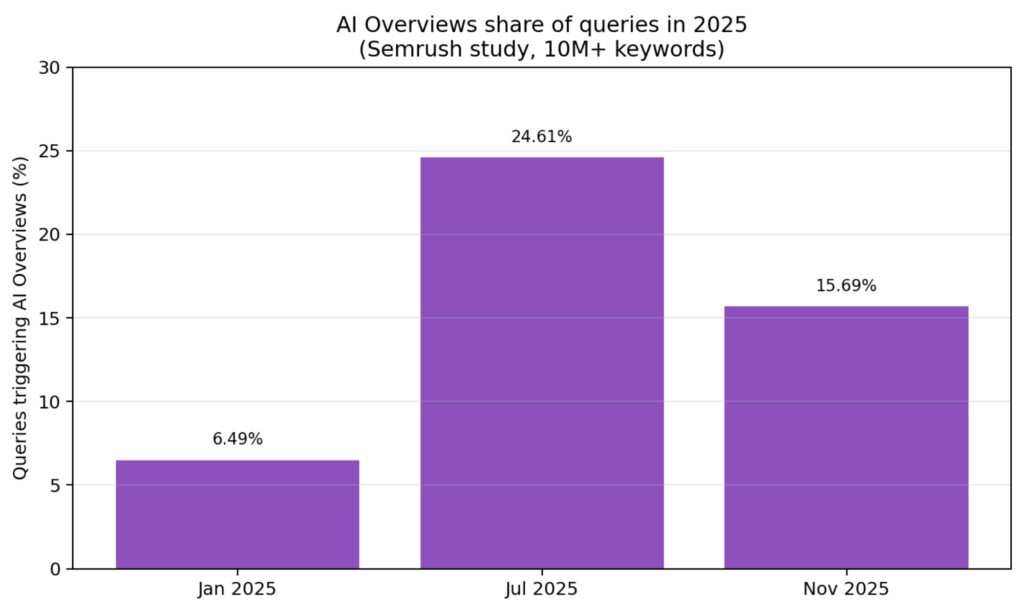
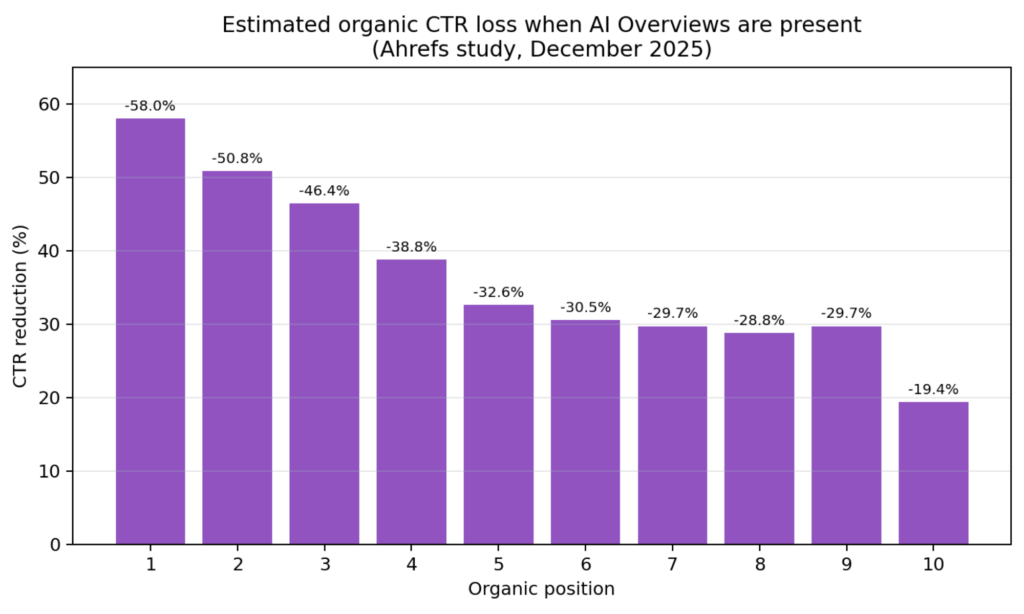
At the same time, Semrush’s 2025 analysis of more than 10 million keywords found that AI Overviews appeared for 6.49% of queries in January 2025, peaked at 24.61% in July, and settled at 15.69% in November. The same study found AI Overviews increasingly showing up on lower-funnel query types: commercial intent rose from 8.15% to 18.57%, transactional from 1.98% to 13.94%, and navigational from 0.84% to 10.33%. Ahrefs’ February 2026 update, based on 300,000 keywords and aggregated Search Console data, estimated that AI Overviews reduced click-through rate for position-one content by about 58% in December 2025. Semrush also reported that by October 2025, Google Ads appeared on 25.56% of AI Overview SERPs, up from 5.17% in March—a 394% increase that made those result pages even more crowded.
That does not mean SEO is dead. It means the SEO operating system has changed.
The old system rewarded volume, marginal updates, and incremental on-page tweaks. The 2026 system rewards:
- Originality and information gain
- Clear topical organization
- Machine-readable page structure
- Excellent UX and engagement signals
- Smart prioritization around where clicks still matter
- Fast refresh cycles on pages that are slipping
The teams that win will be the ones that use AI to compress cycle time while increasing editorial quality.
The most important rule: use AI to improve quality, not to mass-produce junk
“AI can accelerate production, but a human must add judgment, evidence, and originality.”
One of the biggest misconceptions in SEO is that Google “penalizes AI content.” That is not what Google says. Google’s guidance states that its ranking systems aim to reward original, high-quality content and that its focus is on content quality rather than how the content is produced. Google’s newer guidance on generative AI says AI can be useful for research and for adding structure to original content, but using generative AI to create many pages without adding value may violate spam policies on scaled content abuse. Google’s spam policies define scaled content abuse as generating many pages primarily to manipulate search rankings rather than help users.
That means your AI content policy should be:
- Allowed: research assistance, outline generation, headline alternatives, schema drafting, internal-link suggestions, content refresh support, summarizing customer interviews, data extraction from transcripts, FAQ generation from real support logs.
- Not allowed: mass page generation for long-tail permutations, city-page spam, lightly rewritten competitor content, fake expertise, auto-generated comparison pages with no firsthand testing, and infinite programmatic pages with no added value.
A good internal rule is: AI can accelerate production, but a human must add judgment, evidence, and originality.
That is the difference between “AI-assisted SEO” and “search spam with a chatbot.”
What AI should actually do inside an SEO program
The best 2026 SEO teams treat AI as a system of assistants, not a single magic button. Here is where it creates the most leverage.
1) Research and opportunity sizing
Use AI to classify thousands of queries by intent, funnel stage, entity, audience, and content type. This is faster and often more consistent than doing it manually. Pair Search Console with Google Analytics or GA4 exports so you can prioritize pages by impressions, clicks, engagement, and conversions together. Google explicitly recommends using Search Console and Google Analytics together to understand how people discover and experience your site.
2) Brief creation
AI is exceptionally good at turning SERP observations, support tickets, transcripts, and existing page data into briefs. That is a better use case than asking it for a final blog post on the first pass. A strong brief should include:
- primary intent
- target audience
- required entities/subtopics
- internal links to include
- original proof points to add
- schema opportunities
- risk notes about claims or YMYL sensitivity
3) Refreshing decaying content
AI is useful for identifying which sections of a page are stale, which topics competitors now cover, and what new questions users ask. It is also good at finding gaps between your page and the evolving SERP. That helps editors update pages faster without rewriting from scratch.
4) Technical SEO drafts
AI can generate first-pass schema, alt-text suggestions, redirect maps, hreflang checklists, title-link candidates, and QA scripts. It should not be trusted blindly, but it can cut production time dramatically.
5) UX and behavior analysis
AI becomes powerful when you feed it behavioral data. GA4 predictive metrics, Search Console performance, and tools like Microsoft Clarity can expose not only where users arrive from, but where they get confused, hesitate, or leave. GA4 offers predictive metrics such as purchase probability, churn probability, and predicted revenue for eligible properties. Microsoft Clarity surfaces frustration signals like rage clicks, dead clicks, excessive scrolling, and quick backs.
Best practice #1: Build AI-assisted topic maps instead of keyword lists
A keyword list is not a strategy. In 2026, you need a topic system.
Google’s ranking systems use many factors and signals to evaluate relevance and usefulness. That means pages perform better when they clearly cover a topic space with coherent subtopics, intent alignment, and supporting context—not when they merely repeat exact-match keywords.
How to do it
Use AI to group queries into clusters based on:
- dominant intent
- topical similarity
- user task
- funnel stage
- page type required to win
- likelihood of triggering AI Overviews or rich results
Then create a topic map with three layers:
Pillar pages
Your broad, authoritative guides that define the category.
Supporting pages
Focused pages for specific use cases, questions, or comparisons.
Proof pages
Case studies, benchmarks, original data, expert interviews, test results, templates, or tools that create information gain.
Why it works
This structure gives search engines clearer topical signals and gives AI systems more context to cite or summarize. It also makes internal linking easier and reduces cannibalization.
Practical tip
Ask AI to classify each query into one of five intent buckets:
- learn
- compare
- solve
- buy
- navigate
Then map each bucket to a page template. This keeps your content architecture consistent.
Best practice #2: Use AI to generate briefs first, drafts second
One of the fastest ways to damage SEO quality is to ask AI for a full article before you know what the article needs to accomplish.
A better workflow is:
- Export top queries and top landing pages from Search Console.
- Pull engagement and conversion data from GA4.
- Feed both into an LLM.
- Ask it to produce a content brief, not a final draft.
A good AI-generated brief should answer:
- What is the searcher really trying to do?
- What subtopics are essential?
- Which questions are likely to appear in PAA, FAQs, or AI-generated summaries?
- What proof is missing from the current top results?
- What internal pages should support this asset?
- Which assets need structured data?
- What sections should appear above the fold?
Editorial rule
Do not publish an AI-first draft until it contains at least two of the following:
- first-party data
- a quote from a real subject-matter expert
- a real example or case study
- a contrarian point of view
- tested screenshots, steps, or workflows
- unique visuals or benchmarks
That is how you create information gain instead of generic paraphrase.
Best practice #3: Add original evidence or you will sound like the model
The biggest weakness of generative AI content is sameness. If everybody is using similar models trained on similar public web content, then generic pages converge toward the same surface-level summary.
This is why many AI-generated articles feel polished but forgettable.
Google’s content systems reward originality and usefulness, and its guidance on people-first content points site owners toward self-assessing content from an E-E-A-T perspective—even though Google also says E-E-A-T itself is not a direct ranking factor and search raters do not directly determine rankings.
What original evidence looks like in practice
- survey data from your audience
- internal benchmark data
- expert commentary
- screenshots from real workflows
- test results from your own experiments
- pricing comparisons maintained by your team
- customer questions summarized from sales calls
- proprietary templates
- annotated examples of “good vs bad”
Actionable standard
Require every major money page or flagship informational page to answer:
What will a reader get here that they could not get from a generic AI summary?
If the answer is “not much,” the page is vulnerable.
Best practice #4: Optimize for citation, not just blue-link ranking
A lot of SEO advice still assumes the main objective is position one in traditional organic search. That matters less when the answer can be synthesized above the fold.
The new objective is broader:
- rank where rankings still drive clicks
- become eligible for rich results
- become understandable enough to be cited or summarized
- earn the click when a user wants deeper information than a summary can provide
How AI-assisted citation optimization works
Use AI to review top pages and your own content for:
- concise answer blocks near the top
- definitions in plain language
- step-based formatting
- FAQ-style structures
- explicit entities and relationships
- tables that compare options clearly
- source citations
- strong visual annotations
- modular section headings that match user tasks
Think of it this way: AI systems and rich SERP features prefer cleanly extractable content units.
That does not mean writing robotic copy. It means making your expertise easier to parse.
Practical formatting moves
- Put the clearest answer in the first 150 words.
- Follow with expandable depth.
- Use descriptive subheads that mirror the searcher’s task.
- Add comparison tables where useful.
- Add a concise takeaway box after complex sections.
- Include definitions, examples, and caveats close together.
Best practice #5: Use structured data aggressively but correctly
Structured data is still underused relative to its upside.
Google says structured data helps it understand page content and can make search results more engaging through rich results. Google’s documentation cites case studies including Rotten Tomatoes measuring a 25% higher CTR on pages enhanced with structured data, Food Network seeing a 35% increase in visits, and Nestlé measuring an 82% higher click-through rate on pages appearing as rich results. For articles specifically, Google says `Article` markup can help it show better title text, images, and date information in search results. For ecommerce, Google says `Product` markup can expose price, availability, review ratings, shipping information, and more.
What AI should do here
Use AI to generate draft schema for:
- Article
- FAQPage (when appropriate and eligible)
- Product
- Organization
- Breadcrumb
- VideoObject
- HowTo
- Dataset
- Review snippets where compliant
Then validate every implementation.
Important guardrails
- Do not mark up content that is not visible on the page.
- Do not add schema just because a plugin can.
- Match markup to the page’s actual purpose.
- Monitor Search Console rich-result reports for errors and warnings.
The 2026 opportunity
As search becomes more machine-mediated, anything that makes your pages easier for machines to interpret becomes strategically more valuable. Schema is not a silver bullet, but it reduces ambiguity.
Best practice #6: Use AI to improve the ranking systems you control
“Most SEO teams waste time because they work on the loudest pages, not the highest-return pages. AI is useful when it improves prioritization discipline.”
You cannot tune Google’s ranking systems. Google uses many automated systems and signals, and it does not expose a dial you can turn. What you can improve are the ranking and prioritization models inside your own SEO operation.
This is one of the smartest ways to use AI in SEO.
Build an internal opportunity model
Create a scoring framework for every page or keyword cluster using inputs like:
- current impressions
- current CTR
- average ranking position
- conversion value
- business priority
- content freshness
- AI Overview presence
- competitive intensity
- required effort to improve
- page quality score
- UX health score
Then ask AI to classify or score pages on variables that are usually messy to do by hand:
- intent mismatch
- cannibalization risk
- outdated claims
- missing comparisons
- missing schema
- weak answer-first formatting
- low information gain
- unclear conversion path
Example internal formula
Opportunity score = (visibility upside × business value × confidence) – effort
AI helps because it can produce the “confidence” and “effort” estimates faster across hundreds or thousands of pages.
Why this matters
Most SEO teams waste time because they work on the loudest pages, not the highest-return pages. AI is useful when it improves prioritization discipline.
Best practice #7: Combine Search Console, GA4, and behavioral tools for a complete picture
Search Console tells you how users found you in Google Search. Google Analytics tells you what they did on your site. Google explicitly recommends using them together to understand discovery and on-site experience.
That is table stakes now. In 2026, add a third layer: behavioral friction tools.
GA4 offers predictive metrics such as purchase probability, churn probability, and predicted revenue for eligible properties, and Google says these can be used in audiences and explorations. Microsoft Clarity highlights behavioral patterns and frustration signals like dead clicks, rage clicks, excessive scrolling, and quick backs, which help teams connect KPIs to observable user behavior.
A practical measurement stack
Search Console
- impressions
- clicks
- CTR
- average position
- query-level changes
- landing-page visibility
GA4
- engaged sessions
- conversions
- assisted conversions
- event completion
- predictive audiences
- user lifetime patterns
Behavior tools (Clarity or similar)
- rage clicks
- dead clicks
- scroll depth
- quick backs
- CTA interaction zones
- form hesitation
What AI can do with this data
Feed all three data sources into an LLM and ask:
- Which landing pages have high impressions but weak engagement?
- Which pages have decent rankings but poor conversion rates?
- Which pages show user frustration near a CTA?
- Which pages are likely to improve revenue fastest if rewritten?
- Where is the page failing: intent, clarity, layout, or trust?
This is where AI starts to feel genuinely strategic, because it helps turn disconnected dashboards into decisions.
We created a checklist that helps you dominate Google and LLMs in 2026. The checklist has practical SEO tips that the top SEOs use daily. Get it for FREE.
Best practice #8: Use heatmaps and frustration signals to rescue “ranking-but-not-performing” pages
A common SEO problem in 2026 looks like this:
The page ranks. Impressions are solid. Maybe clicks are acceptable. But conversions are weak, or users bounce, or they never reach the key information.
This is usually a page experience problem, not a ranking problem.
Google says Core Web Vitals measure loading, interactivity, and visual stability, and recommends good CWV for success in Search. The current “good” thresholds are LCP within 2.5 seconds, INP under 200 milliseconds, and CLS under 0.1. Microsoft Clarity’s heatmap and insight tools can then show whether the content layout supports the user’s goal once the page loads. Clarity’s guidance highlights scroll, click, area, and conversion heatmaps and recommends using dead-click and rage-click views to find broken or misleading page elements.
High-leverage page fixes AI can help you identify
- oversized hero sections pushing answers below the fold
- CTA blocks appearing after major drop-off zones
- paragraphs that are too abstract before the reader gets the answer
- misleading visual elements that attract dead clicks
- important comparisons buried too deep
- weak call-to-action copy
- FAQ clutter that distracts from the primary task
Fast workflow
- Use Search Console to find pages with high impressions but low CTR.
- Use GA4 to find pages with traffic but poor conversion or engagement.
- Use Clarity to inspect rage clicks, dead clicks, and scroll behavior.
- Use AI to summarize the friction patterns and suggest layout changes.
- A/B test the revised version.
This is a much stronger workflow than “rewrite the intro and hope.”
Best practice #9: Make page experience part of your AI SEO workflow, not an afterthought
AI is often used heavily on content and barely at all on UX. That is a mistake.
Search is increasingly answer-centric, which means users who do click expect the page to deliver immediately. Google’s documentation connects Core Web Vitals and broader page experience to what its ranking systems seek to reward.
Use AI for page experience in five ways
1. Content compression
Summarize long introductions and move the useful answer up.
2. Above-the-fold audits
Ask AI to review a screenshot of the page and tell you what a first-time visitor probably thinks the page is about within five seconds.
3. CTA sequencing
Analyze whether the CTA appears before or after trust-building evidence.
4. Link clarity
Find anchor text that is vague, repetitive, or misleading.
5. Mobile-first refinement
Rewrite headings, bullets, and tables to remain useful on smaller screens.
A strong 2026 default
Every important page should have:
- a clear answer near the top
- proof nearby
- a visible next step
- mobile-friendly formatting
- a fast, stable experience
Best practice #10: Use AI for internal linking at scale
Internal linking remains one of the most underexploited SEO levers because it is operationally tedious. AI is perfect for this.
What AI can do well
- identify semantically related pages
- recommend missing contextual links
- spot orphaned or underlinked pages
- suggest stronger anchor text variation
- find pages that deserve more authority flow
- detect internal cannibalization patterns
A practical internal-linking system
Create three rules:
- Every new page must link to at least two supporting pages and one higher-authority hub.
- Every hub page must link down to its key supporting assets.
- Every refresh cycle includes an internal-link audit.
AI can generate suggestions, but editors should approve final anchors. The goal is not to maximize link count. It is to make the site structure clearer for users and crawlers.
Best practice #11: Turn AI into a refresh engine, not a publication factory
For many sites, the fastest SEO wins in 2026 come from updating old pages, not publishing net-new ones.
Why refreshes work
- they already have authority
- they already have some rankings
- they often need less effort than new pages
- they can capture demand shifts quickly
- they can become more citable if upgraded with better evidence and structure
AI refresh workflow
Ask AI to compare:
- your current page
- top SERP competitors
- current Search Console query mix
- any major feature changes in the product/topic
- user behavior issues from analytics
Then have it produce a refresh brief with:
- outdated sections to remove
- new sections to add
- weak claims to tighten
- examples to replace
- FAQs to update
- schema to add or fix
- internal links to insert
- title and meta testing ideas
This workflow is especially useful for software, e-commerce, and fast-moving service categories.
Best practice #12: Build transparent editorial governance for AI content
As more brands use AI, trust becomes a competitive advantage.
Google’s generative AI guidance suggests giving users context about how content was created when it makes sense. You do not need a dramatic AI disclaimer on every page, but you should have internal standards.
A strong AI editorial policy includes
- which tasks AI is allowed to handle
- which tasks require human review
- when SME signoff is mandatory
- how factual claims are verified
- how citations are preserved
- how AI hallucination risk is handled
- how sensitive topics are escalated
- how pages are reviewed before publishing
Human checkpoints that matter most
- claim verification
- source quality
- product accuracy
- legal/compliance review where needed
- first-hand expertise
- editorial point of view
This is how you keep output fast without letting quality drift.
Best practice #13: Measure SEO by qualified outcomes, not vanity traffic
Raw clicks are becoming less dependable as the main KPI. If AI Overviews answer more questions on the SERP, some informational clicks will disappear even when your brand remains visible.
That means your SEO dashboard should shift toward:
- assisted conversions
- engaged sessions
- lead quality
- revenue per landing page
- branded search lift
- returning organic visitors
- pipeline contribution
- visibility on strategic queries
- retention of rankings on high-value pages
Practical KPI framework
Visibility KPIs
- impression growth
- ranking distribution
- AI Overview presence
- rich-result eligibility
Engagement KPIs
- CTR
- engaged sessions
- scroll depth
- return visits
Quality KPIs
- schema health
- CWV pass rate
- indexation errors
- content freshness rate
Revenue KPIs
- leads
- demo requests
- email signups
- assisted revenue
- organic-influenced pipeline
The point is not to stop caring about traffic. The point is to care about useful traffic.
Best practice #14: Create pages that deserve the click after the summary
If AI systems answer more top-of-funnel questions directly, then the pages that still win clicks will usually do one of four things better than the summary:
- Show the workflow
- Provide proof
- Reduce risk
- Enable action
That is why the strongest SEO content in 2026 often includes:
- calculators
- templates
- checklists
- screenshots
- comparison tables
- benchmark data
- examples
- downloadable assets
- decision frameworks
AI can help draft all of these. But the real advantage comes from the fact that your team knows the audience and can make the asset genuinely useful.
Best practice #15: Use AI to scale testing, not assumptions
SEO teams are often too slow because every decision becomes a debate.
AI helps when it speeds up the path from hypothesis to test.
High-value tests to run
- title and meta-description variants
- answer-first intros
- CTA placement
- comparison-table placement
- FAQ ordering
- trust-element placement
- author bio visibility
- schema additions
- internal-link density
- section reordering on long pages
A useful AI prompt
“Given this page, its query mix, bounce points, and click heatmap behavior, generate five UX or content hypotheses most likely to improve CTR, engagement, or conversion. Rank them by expected impact and effort.”
That is how AI becomes an experimentation partner rather than a writing shortcut.
A practical AI-for-SEO workflow you can implement now
Here is a lightweight operating model that works for most digital marketing teams.
Weekly
- Pull Search Console winners, losers, and emerging queries
- Pull GA4 landing page engagement and conversion changes
- Review behavior friction on top commercial pages
- Use AI to create refresh briefs and test ideas
- Update or relink 3–5 pages
Monthly
- Recluster the query universe
- Update opportunity scores
- Audit schema coverage and Search Console enhancements
- Review page templates for above-the-fold clarity
- Identify pages likely to lose clicks to AI Overviews
- Decide which assets need stronger proof or deeper conversion content
Quarterly
- Publish original data or benchmark content
- Rebuild one major pillar page
- Review internal linking at cluster level
- Audit AI content quality against editorial policy
- Reassess KPIs and attribution windows
This cadence is realistic, repeatable, and much better than ad hoc publishing.
90-day action plan
Days 1–30: Build visibility and control
- Audit your current AI use in SEO
- Define your AI editorial policy
- Connect Search Console, GA4, and behavior tools into one reporting workflow
- Identify the 20 pages with the highest visibility-to-revenue opportunity
- Implement or validate core schema on priority templates
- Benchmark CWV on money pages
Days 31–60: Improve quality and structure
- Use AI to build or rebuild topic maps
- Refresh the 10 highest-opportunity pages
- Add original data, SME input, or examples to flagship assets
- Improve above-the-fold answer clarity
- Audit internal linking within top clusters
- Create templates for briefs, refreshes, and content QA
Days 61–90: Measure and scale
- Launch title, layout, and CTA tests
- Start a recurring refresh sprint
- Build an opportunity score for all key pages
- Create one original benchmark or downloadable asset
- Report on traffic quality, not just visits
- Document the workflow so it becomes repeatable
Common mistakes to avoid
Mistake 1: Publishing AI drafts with no original insight
This creates generic pages that are vulnerable to both users and search systems.
Mistake 2: Treating E-E-A-T like a direct ranking factor
Google explicitly says it is not.[5] Use it as a quality lens, not as magical jargon.
Mistake 3: Measuring success only by traffic
In a zero-click environment, high impressions and low clicks may still mean strong visibility. Tie SEO to business outcomes.
Mistake 4: Ignoring structured data
As search becomes more machine-mediated, ambiguity is expensive.
Mistake 5: Using AI for words but not for workflows
The biggest gains often come from prioritization, QA, internal linking, refreshes, and analytics synthesis.
Mistake 6: Forgetting UX
A ranking is not a win if the page frustrates users after the click.
Reusable prompts for SEO teams
Prompt 1: Query clustering
“Cluster these search queries by intent, audience, funnel stage, and likely page type. Highlight any cannibalization risk and recommend one primary page per cluster.”
Prompt 2: Content brief generation
“Using this SERP summary, Search Console data, and current page copy, create a content brief that includes target intent, required sections, missing evidence, recommended internal links, schema opportunities, and conversion suggestions.”
Prompt 3: Refresh brief
“Compare this aging page against current top-ranking results and recent query trends. Tell me what to delete, rewrite, move up, expand, or support with examples.”
Prompt 4: UX diagnosis
“Review this landing page screenshot, heatmap summary, and engagement metrics. Explain the most likely user-friction points and recommend five changes ranked by impact and effort.”
Prompt 5: Internal linking
“Identify contextually relevant internal links for this page using semantic similarity and funnel logic. Suggest anchor text options that improve clarity without over-optimizing.”
Final takeaway
The right way to use AI for SEO in 2026 is not to replace strategists, editors, or subject-matter experts. It is to make them faster, sharper, and more consistent.
Use AI to:
- find opportunities faster
- turn messy data into decisions
- generate stronger briefs
- scale structured data and internal linking
- detect UX friction
- refresh content before it decays
- prioritize work by business impact
Do not use AI to flood your site with interchangeable pages.
Search is moving toward blended discovery, summarized answers, and higher expectations for what happens after the click. The brands that grow will be the ones that build an AI-assisted SEO engine around quality, proof, usability, and speed.
That is the practical play for 2026.