Share
How AI Is Changing SEO: The Practical Playbook for 2026
AI is changing SEO faster than any update in the last decade. Here is what has changed, what still matters, and how to adapt your content, technical SEO, brand, and measurement strategy for AI Overviews, AI Mode, and answer engines.
SEO is not dead. It is being re-priced.
For years, the SEO playbook was simple: rank in the blue links, win the click, convert the visit. AI has changed each step of that equation. Search engines now answer more questions directly, AI summaries sit above traditional listings, and discovery is spreading beyond Google into assistants like ChatGPT, Gemini, Perplexity, and others. That does not make SEO obsolete. It makes it broader, more brand-led, and more dependent on trust, structure, and genuinely useful information.
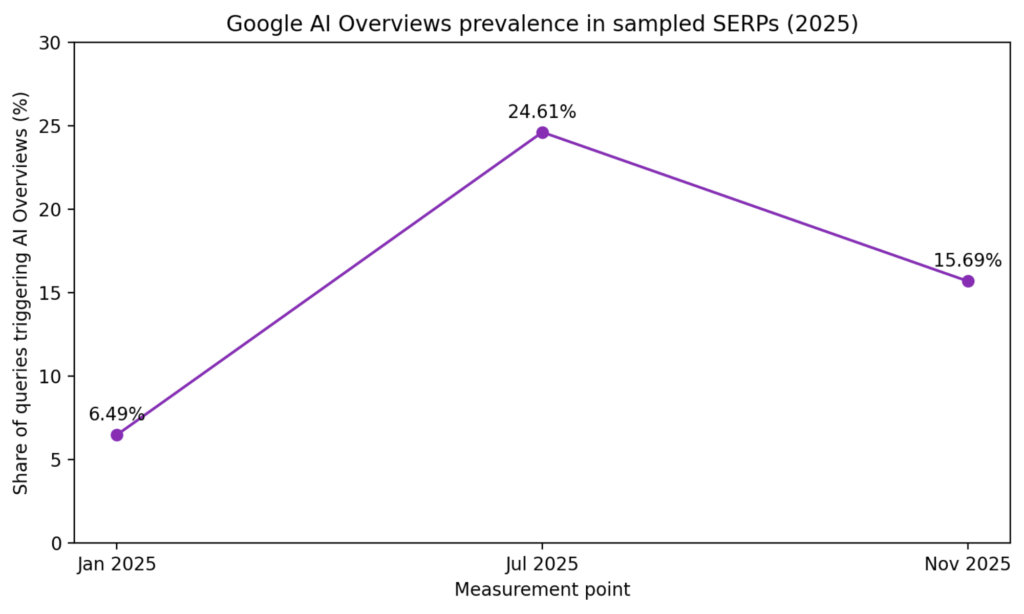
Google now says AI Overviews reach 1.5 billion monthly users across 200 countries and territories, and in markets like the U.S. and India, the query types that show AI Overviews are driving more than 10% more usage. Semrush’s 2025 study found AI Overviews appeared for 6.49% of sampled queries in January, surged to 24.61% in July, and settled at 15.69% by November. Meanwhile, Ahrefs, Amsive, and Seer all reported meaningful CTR pressure when AI Overviews appear.
That combination is the new SEO environment: more AI answers, more search activity, and fewer guaranteed clicks. The important shift is not “SEO is over.” The shift is that ranking alone is no longer the whole prize.
AI is shifting SEO from ranking to visibility
The old mental model was “win position one.” The new model is “be the source an AI system trusts enough to cite, summarize, recommend, or send traffic to.”
Google’s own documentation is clear that the same SEO fundamentals still apply to AI Overviews and AI Mode. Google says there are no additional technical requirements, no special schema, and no separate optimization layer required just to be eligible. But Google also explains that AI features can use query fan-out to run multiple related searches and assemble a broader set of supporting links than a classic results page.
That is a subtle but massive change. SEO used to be mostly about ranking a page for a query. Now it is also about being present in the answer layer that sits above or around the ranked results. Position still matters, but citation-quality visibility matters more than it used to.
The first thing AI changed: clicks
“The old assumption that “better rank = roughly proportional traffic upside” is breaking down. In an AI SERP, rank can remain stable while traffic economics deteriorate.”
The most immediate SEO effect of AI is click compression.
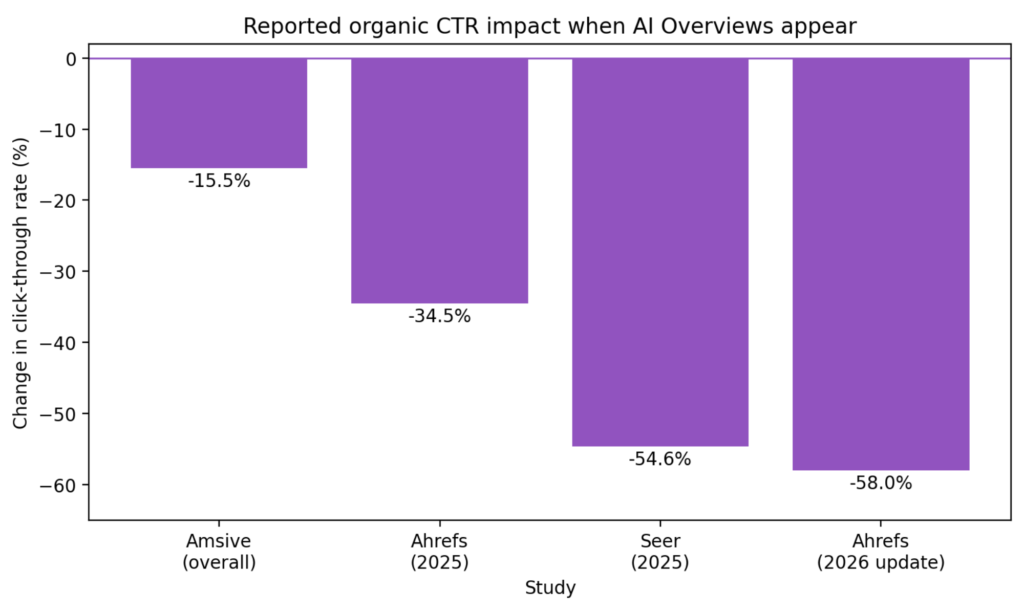
Ahrefs’ 2025 study of 300,000 keywords estimated that AI Overviews reduced CTR to the top-ranking page by roughly 34.5% on comparable informational queries. Ahrefs’ 2026 update pushed that estimate to 58% for position-one content by December 2025. Amsive’s 700,000-keyword study found an average CTR decline of 15.49% across AI Overview-triggered keywords, with non-branded terms hit harder and lower-ranking pages hit hardest. Seer Interactive found organic CTR dropped from 1.41% to 0.64% on its tracked query set when AI Overviews were present.
That does not mean SEO stops working. It means the old assumption that “better rank = roughly proportional traffic upside” is breaking down. In an AI SERP, rank can remain stable while traffic economics deteriorate.
Why Google and publishers seem to disagree, and why both may be right
Google says clicks from AI-enhanced search experiences can be higher quality. In Search Central, Google says users who click through from pages with AI Overviews are more likely to spend more time on the site. Google also says people are using Search more often for more complex questions as AI features expand.
At the same time, third-party studies clearly show that many publishers lose CTR on affected queries.
Both claims can coexist. AI can reduce total clicks while improving the average intent quality of the clicks that remain. In practical terms, many sites should expect less traffic, but not necessarily less value per visit. That is why the right response is not panic. It is segmentation: which pages lost top-of-funnel clicks, which pages are now being cited, and which query classes still convert well despite lower traffic.
AI is accelerating the zero-click trend, not inventing it
SEO can no longer be evaluated only as a traffic acquisition channel. It increasingly functions as a visibility channel, a brand reinforcement channel, and a conversion-assist channel.
Before AI Overviews, Google was already moving toward answer-first behavior. SparkToro and Datos found that in 2024, 58.5% of U.S. Google searches and 59.7% of EU Google searches ended without a click. In the U.S., only 360 clicks out of every 1,000 Google searches went to the open web.
AI does not create zero-click search. It intensifies it.
That matters because SEO can no longer be evaluated only as a traffic acquisition channel. It increasingly functions as a visibility channel, a brand reinforcement channel, and a conversion-assist channel. Sometimes the win is a click. Sometimes it is a cited mention inside an AI answer. Sometimes it is the branded search or direct visit that happens later.
AI is changing which keywords are worth targeting
One of the biggest strategic shifts is not only how much traffic a keyword can send, but what kind of keyword is still economically attractive.
Semrush found that AI Overviews started 2025 overwhelmingly informational, then spread into more commercial, transactional, and navigational territory. In January, 91.3% of queries triggering an AI Overview were informational. By October, that share had dropped to 57.1%. Navigational AI Overviews rose from 0.74% in January to 10.33% in October.
That matters because a lot of classic content SEO was built around publishing scalable informational pages. Those pages can still be useful, but many are now easier for Google to summarize directly in the SERP. Decision-stage content often holds value better because users still need proof, comparison, implementation detail, risk reduction, pricing context, or next steps.
The practical takeaway is simple: stop treating all search volume as equal. A thousand visits on a query that AI mostly resolves may be worth less than 200 visits on a query where the user still needs human judgment.
We created a checklist that helps you dominate Google and LLMs in 2026. The checklist has practical SEO tips that the top SEOs use daily. Get it for FREE.
Brand has become an SEO moat again
AI search is brutal to interchangeable content. It is much kinder to brands users already recognize.
Amsive found that only 4.79% of branded keywords triggered AI Overviews in its study, and when branded queries did trigger AI Overviews, CTR increased by 18.68% on average. At the same time, Semrush shows navigational AI Overviews are rising, so branded search is not immune. But brand familiarity still appears to be one of the best buffers against AI-driven click erosion.
Why? Because when a system compresses the web into a shortlist, it tends to favor sources that are already known, cited, and searched for. In an AI-heavy SERP, you are not only competing for rank. You are competing for memory, mentions, and preference.
AI-generated content is not the problem, low-value content is
A common SEO myth is that Google “penalizes AI content.” Google’s own guidance is more nuanced.
Google says it focuses on content quality rather than production method, and that AI-generated content is not inherently against policy. What can violate policy is using automation, including AI, to generate pages primarily to manipulate rankings, especially when those pages add little originality or value. Google’s documentation explicitly warns that using generative AI to produce many pages without adding value for users can violate its spam policies on scaled content abuse.
Google’s people-first content guidance reinforces the same standard. It asks whether content adds original information, reporting, research, or analysis, whether it provides substantial extra value beyond rewriting other sources, and whether it demonstrates expertise and trustworthiness.
That is the real AI-era content rule: AI can help you produce faster, but it does not help you deserve rankings or citations unless you add something that was not there before. As summary content becomes cheap, what becomes scarce is original data, first-hand experience, strong sourcing, methodology, expert review, and useful point of view.
Technical SEO still matters, and in some ways it matters more
AI has not made technical SEO obsolete. It has made technical clarity more important.
Google says a page must still be indexed and eligible to appear with a snippet to be shown as a supporting link in AI Overviews or AI Mode. Google also says the same best practices still matter: crawlability, strong internal linking, important content in text form, high-quality images and videos where relevant, and structured data that matches the visible page.
Google also says AI features in Search are governed through the same content control framework as Search, including directives like nosnippet, data-nosnippet, max-snippet, and noindex. For some non-Search AI uses, Google points site owners to Google-Extended.
There is another practical change here: AI and search crawling are rising. Cloudflare found that combined AI and search crawler traffic grew 18% from May 2024 to May 2025, with Googlebot up 96% and GPTBot up 305% over that period in its observed cohort. That makes log-file analysis, bot policy, and crawl governance more relevant than many SEO teams have treated them in the last few years.
So the technical question is no longer just “can Google crawl this page?” It is also “is this page easy for search and AI systems to understand, and have we decided what we want them to reuse?”
SEO is broadening beyond Google, even if Google is still dominant
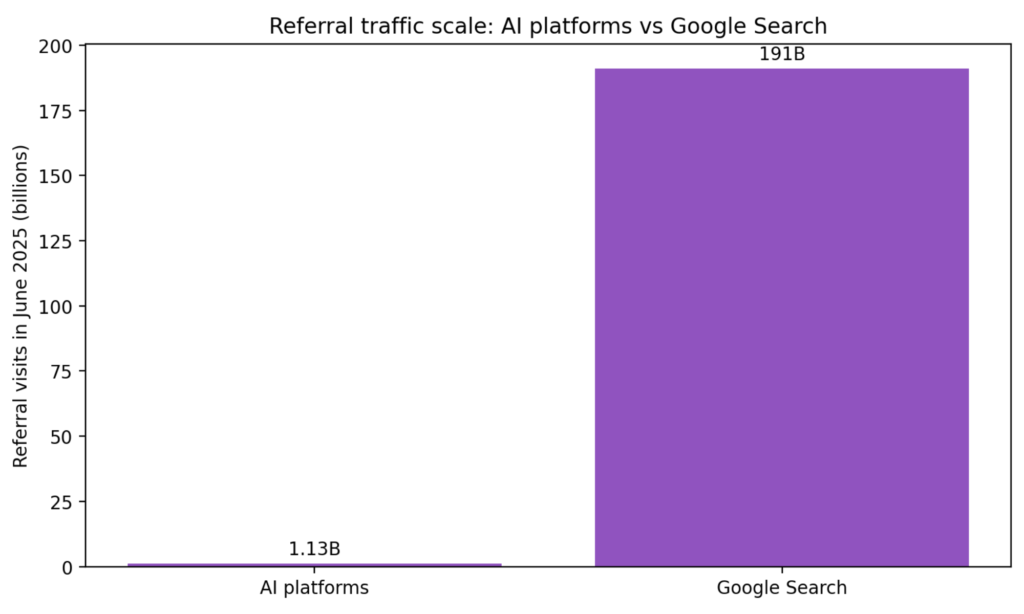
Google Search remains vastly larger than AI assistants as a referral source. Similarweb estimated that AI platforms generated 1.13 billion referral visits in June 2025, while Google Search generated roughly 191 billion in the same month.
But the growth rate matters. Similarweb says AI referrals were up 357% year over year in June 2025, while average monthly visits to generative AI platforms rose 76% year over year and app downloads grew 319%. Adobe found traffic from generative AI tools to U.S. retail sites jumped 693.4% year over year during the 2025 holiday season, even though the absolute base remained modest.
The right conclusion is not that LLMs will replace search next quarter. The right conclusion is that discovery is fragmenting. Search is still the biggest channel by far, but AI assistants are becoming a meaningful second layer for research, recommendations, and shopping discovery.
SERPs are getting more crowded, not simpler
AI has not necessarily made SERPs cleaner. In many cases, it has made them denser.
Semrush found that on AI Overview SERPs, People Also Ask appeared alongside AI Overviews about 90% of the time and related searches over 95% of the time. Video carousels and discussion/forum blocks remained common. Semrush also found Google Ads on AI Overview SERPs rose from 5.17% in March 2025 to 25.56% in October 2025, a 394% increase.
That means the modern SERP is often an AI summary plus ads plus video plus discussion results plus classic listings. So visibility now depends on more than your website. It increasingly rewards brands that also show up in YouTube, forums, communities, and other surfaces that Google repeatedly displays or cites.
AI is increasing the value of citations, evidence, and quotable structure
Google says there is no special schema required for AI features. That does not mean structure is irrelevant. It means the old rules of clarity matter more than ever.
Pages that get reused well by AI systems tend to be easy to parse: direct answers near the top, clear headings, comparisons, definitions, tables, visible sources, strong author signals, and language that clearly separates fact from opinion. That is not a new writing principle. It is just newly rewarded.
Seer’s finding is especially useful here: pages cited in an AI Overview got 35% more organic clicks than pages that were not cited on the same query set. In AI-heavy search, the target is no longer only “rank high.” It is also “be one of the sources the answer layer chooses.”
Measurement is now the hardest part of SEO
SEO used to have a simple performance story: rankings, clicks, visits, conversions.
AI has complicated all four.
Google says traffic from AI features is included in Search Console’s standard Web search type rather than broken out separately. Google also recommends combining Search Console with Analytics and watching downstream engagement and conversions, especially because AI-related clicks may be higher quality.
That means modern SEO teams need a broader reporting model. At minimum, they should track classic SEO metrics, query intent segmentation, brand vs non-brand performance, page-type performance, AI citation visibility, assisted demand signals, and traffic quality. The teams that adapt fastest will stop asking only “how many clicks did SEO send?” and start asking “where are we visible across the decision journey, and which pages still create business value even when the click comes later?”
The practical playbook: how to adapt now
First, keep technical SEO boring and excellent. Make sure important pages are crawlable, indexable, internally linked, rich in visible text, and supported by accurate structured data. Google’s documentation has not changed on those basics because the basics still matter.
Second, publish fewer commodity pages and more defensible assets. The AI era favors original studies, benchmark reports, proprietary data, expert explainers, tools, comparison frameworks, implementation guides, and pages with obvious first-hand value. That is exactly where Google’s quality guidance points as well.
Third, design pages for extraction. Use answer-first openings, explicit subheads, comparison tables, concise definitions, source-backed claims, and visible author or reviewer details. You are writing for humans first, but you are also making it easier for answer engines to trust and reuse you.
Fourth, treat brand building as SEO infrastructure. The more people search for you by name, recognize you, and see you cited across channels, the harder it is for AI systems to collapse your value into a generic summary. The AI era rewards known entities.
Fifth, prioritize high-intent and decision-stage content more aggressively. Broad top-of-funnel content still matters, but it now needs stronger economics and a clearer role in brand building. Queries tied to choosing, comparing, buying, implementing, or switching often hold up better.
Sixth, diversify beyond your website. The modern SERP repeatedly surfaces video, forums, and community content. Your discoverability strategy should reflect that.
A practical 90-day plan
In the first 30 days, audit your keyword portfolio. Split it by branded vs non-branded and by informational, commercial, transactional, and navigational intent. Then find pages with steady impressions but falling CTR. Those are often early AI-affected candidates.
In days 31 to 60, rebuild your highest-value pages. Improve intros, add direct answers, strengthen headings, add tables and comparisons, refresh citations, add author and reviewer signals, and make the page easier to quote.
In days 61 to 90, expand beyond the site. Strengthen YouTube, expert commentary, digital PR, and community visibility. At the same time, build a dashboard that combines Search Console, analytics, ranking data, and AI citation visibility.
That will not “beat AI.” It will make your content harder to replace and easier to cite.
So, is AI killing SEO?
No. AI is ending lazy SEO.
It is ending the idea that search traffic belongs to whoever publishes the most acceptable summary at scale. It is ending the comfort of measuring success only by sessions. It is ending the assumption that ranking and visibility are the same thing.
But the discipline itself is becoming more valuable, not less. Every AI system still needs source material. Every answer engine still needs content it can extract from. Every user still needs proof before making a decision. And every business still needs discoverability, trust, and conversion.
The sites that win from here will do four things consistently: publish original value, make that value technically accessible, build brand demand beyond search, and measure SEO as a visibility system instead of only a click channel.
We wrote a practical, beginner-friendly digital marketing guide for small businesses. It covers everything from SEO to Paid Ads. Have a quick read & implement to scale your business.