👋
Blog Post
AI Content Generation Tools: The Future of Writing SEO Content
How AI content tools like Jasper and Copy.ai are changing SEO content creation, from blog writing to meta descriptions, social posts, workflows, risks, and best practices.
Share

AI Content Generation Tools: The Future of Writing SEO Content
AI content generation tools are changing SEO content creation in the same way CMS platforms changed publishing and marketing automation changed email. The biggest shift is not just that AI can “write faster.” The real shift is that AI can now help marketers research, outline, draft, optimize, repurpose, personalize, and measure content across the entire content lifecycle.
That is why tools such as Jasper, Copy.ai, ChatGPT, Claude, Writesonic, Frase, Surfer, Grammarly, and other AI content platforms are becoming part of the modern SEO stack. Jasper positions itself as a marketing AI platform for end-to-end workflows, while Copy.ai describes its platform as a GTM AI system that can power SEO, thought leadership, use cases, social content, localization, brand voice, and workflow automation.
But here is the important truth for SEO teams: AI does not replace strategy. AI multiplies strategy. A weak SEO strategy with AI becomes weak content at scale. A strong SEO strategy with AI becomes faster research, better briefs, sharper drafts, more consistent metadata, and smarter content repurposing.
Google’s own guidance is clear: generative AI can be useful for research and structuring original content, but using AI tools to generate many pages without adding value may violate Google’s scaled content abuse policy.
“AI content does not win because it is AI-generated. It wins when it is more useful, more accurate, more original, and better matched to search intent than the competing result.”
AI Content Generation Market: Why This Topic Matters Now
The AI content boom is backed by real market growth. Grand View Research estimated the global generative AI in content creation market at $14.84 billion in 2024, projected it to reach $19.62 billion in 2025, and forecasts it to reach $80.12 billion by 2030, growing at a 32.5% CAGR from 2025 to 2030. The same report notes that text generation had the largest revenue share in 2024, which directly connects this market to SEO writing, blogging, social content, and metadata generation.
Visualization: Generative AI in Content Creation Market Growth
Global Generative AI in Content Creation Market
2024 -> $14.84B
2025 -> $19.62B
2030 -> $80.12B
2024 -> $14.84B
2025 -> $19.62B
2030 -> $80.12B
Marketing adoption is also mainstream. HubSpot’s 2026 State of Marketing report says 61% of marketers believe AI is causing marketing’s biggest disruption in 20 years, and 80% of marketers use AI for content creation.
Content teams are also putting budget behind this shift. Content Marketing Institute’s 2025 B2B research found that 40% of B2B marketers expected increased investment in AI for content optimization/performance, while 39% expected increased investment in AI for content creation.
Visualization: Where B2B Marketers Expected More Investment in 2025
Expected Increased Investment by B2B Marketers
Video content -> 61%
Thought leadership content -> 52%
AI for content optimization -> 40%
Paid advertising -> 40%
AI for content creation -> 39%
In-person events -> 35%
Webinars -> 32%
Online community -> 27%
Digital events -> 21%
Audio content -> 20%
Video content -> 61%
Thought leadership content -> 52%
AI for content optimization -> 40%
Paid advertising -> 40%
AI for content creation -> 39%
In-person events -> 35%
Webinars -> 32%
Online community -> 27%
Digital events -> 21%
Audio content -> 20%
This is why AI content tools are no longer experimental toys. They are becoming core infrastructure for agencies, SaaS companies, ecommerce brands, media teams, local businesses, and enterprise marketing departments.
What Are AI Content Generation Tools?
AI content generation tools are software platforms that use generative AI, natural language processing, large language models, templates, workflows, and brand data to create or assist with written content.
They can help with:
| Content task | What AI can do | Human role |
|---|---|---|
Keyword research |
Cluster topics, map intent, create question lists |
Validate demand, difficulty, business value |
Content briefs |
Generate outlines, SERP questions, headings, entity suggestions |
Add positioning, expertise, examples, conversion goal |
Blog writing |
Draft introductions, sections, FAQs, summaries |
Add original insight, verify facts, edit for quality |
Meta descriptions |
Generate page-specific descriptions at scale |
Check accuracy, CTR angle, duplication |
Social media posts |
Repurpose blogs into LinkedIn, Instagram, X, Facebook posts |
Add brand personality, timing, offer, creative direction |
Product descriptions |
Create variants by audience, feature, benefit, tone |
Ensure claims, specifications, compliance |
Email copy |
Draft newsletters, nurture sequences, CTAs |
Match segmentation, offer, campaign goal |
Content refreshes |
Identify outdated sections and rewrite them |
Verify new data and preserve ranking intent |
Localization |
Translate and adapt copy for different regions |
Review cultural nuance and local terminology |
A tool like Jasper includes AI writing generators for blogs, ads, emails, Instagram captions, LinkedIn summaries, meta descriptions, FAQ schema, sentence rewriting, and more. Copy.ai offers content creation workflows for SEO, thought leadership, social content, ABM, localization, and brand voice.
How AI Tools Are Changing SEO Content Creation
1. From Blank Page to Structured Draft in Minutes
Before AI, many content teams lost hours in the early stages of writing: topic brainstorming, SERP review, outline creation, intro drafting, subheading development, and first-draft writing.
AI content tools compress that process. A writer can now enter a keyword, target audience, search intent, brand tone, examples, and desired structure, then generate a workable first draft. This does not mean the article is ready to publish. It means the writer starts from a structured draft instead of a blank page.
The best use case is not “write me a full SEO article and publish it.” The best use case is:
Research → Brief → Outline → Draft → Edit → Fact-check → Optimize → Publish → Refresh
AI accelerates the middle of the workflow, but humans still own the judgment.
2. From One Article to a Complete Content System
Modern SEO is not about publishing isolated blog posts. It is about building topical authority. AI tools help by turning one core topic into a full content ecosystem:
Pillar Page
├── Supporting Blog Posts
├── FAQs
├── Comparison Pages
├── Glossary Pages
├── Social Posts
├── Email Newsletter
├── YouTube Script
├── LinkedIn Carousel
├── Meta Titles
├── Meta Descriptions
└── Internal Linking Suggestions
├── Supporting Blog Posts
├── FAQs
├── Comparison Pages
├── Glossary Pages
├── Social Posts
├── Email Newsletter
├── YouTube Script
├── LinkedIn Carousel
├── Meta Titles
├── Meta Descriptions
└── Internal Linking Suggestions
This is where AI becomes powerful for agencies and content teams: it helps convert one strategic idea into multiple channel-ready assets.
3. From Manual Metadata to Scalable SEO Snippets
Meta descriptions are a perfect AI use case because they are short, structured, and repetitive. Google says meta descriptions should be unique, descriptive, relevant to the page, and useful as a pitch to users; it also notes that programmatic generation can be appropriate for large sites when descriptions are human-readable and diverse.
AI meta description generators can create multiple variations for every page. Jasper offers an AI-powered meta description generator where users provide page information and a target keyword to create SEO-friendly descriptions. Copy.ai’s meta description generator explains that these tools can use NLP and machine learning to analyze page content, generate relevant summaries, customize length and tone, and produce multiple options for review.
Example: AI-assisted meta descriptions
Page: SEO ROI Calculator
Primary keyword: SEO ROI calculator
Option 1:
Estimate your SEO returns in seconds. Use our free SEO ROI Calculator to forecast traffic, leads, revenue, and monthly SEO investment.
Option 2:
Want to know if SEO is worth it? Calculate estimated traffic, leads, and revenue with our free SEO ROI Calculator for business owners.
Option 3:
Use this SEO ROI Calculator to estimate monthly investment, expected organic traffic, lead value, and potential revenue growth.
Estimate your SEO returns in seconds. Use our free SEO ROI Calculator to forecast traffic, leads, revenue, and monthly SEO investment.
Option 2:
Want to know if SEO is worth it? Calculate estimated traffic, leads, and revenue with our free SEO ROI Calculator for business owners.
Option 3:
Use this SEO ROI Calculator to estimate monthly investment, expected organic traffic, lead value, and potential revenue growth.
The human SEO still needs to check whether the promise matches the page. A misleading meta description may attract clicks but damage trust and engagement.
4. From One Blog Post to Social Media Distribution
AI tools are also changing distribution. Instead of writing a blog and then manually creating social snippets, marketers can repurpose the article into LinkedIn posts, Instagram captions, X threads, YouTube Shorts scripts, newsletters, and carousel outlines.
Copy.ai says its social media use case can generate hundreds of on-brand social posts with a few clicks. Jasper’s social media content guidance describes AI social media generators as tools that transform campaign briefs, product information, or content ideas into platform-ready posts for LinkedIn, Instagram, Facebook, X, and TikTok.
Example: Blog-to-social repurposing
Original blog:
AI Content Generation Tools: The Future of Writing SEO Content
Repurposed assets:
1 LinkedIn thought leadership post
1 Instagram carousel
1 X thread
1 YouTube Shorts script
1 email newsletter
3 quote graphics
5 FAQ snippets
1 lead magnet checklist
AI Content Generation Tools: The Future of Writing SEO Content
Repurposed assets:
1 LinkedIn thought leadership post
1 Instagram carousel
1 X thread
1 YouTube Shorts script
1 email newsletter
3 quote graphics
5 FAQ snippets
1 lead magnet checklist
This is a major advantage for small teams. A business owner or agency can publish one strong article and use AI to extract weeks of promotional content from it.
The AI SEO Content Flywheel
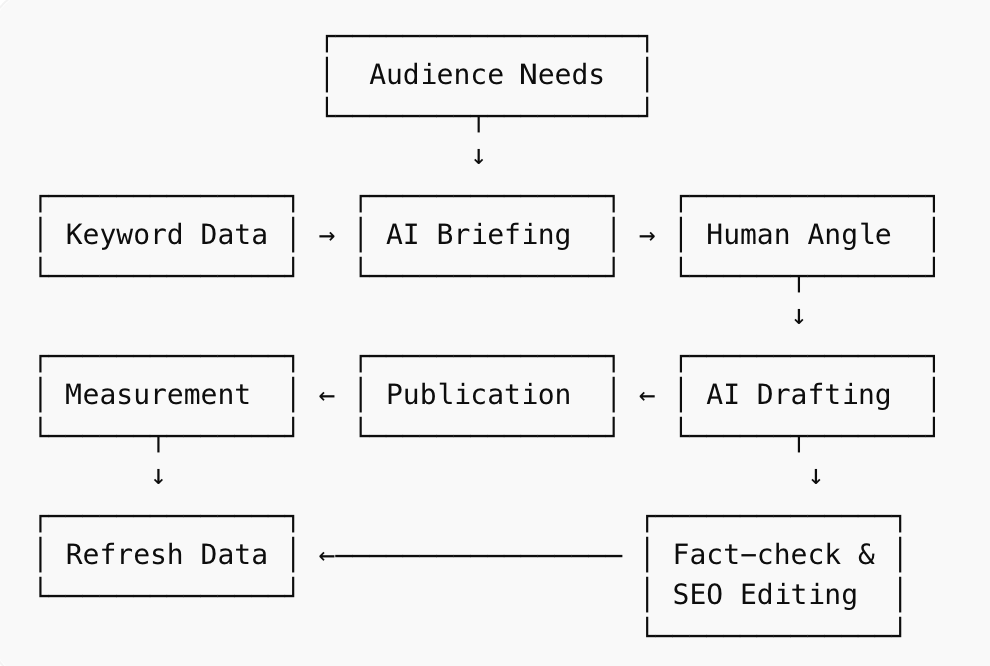
The winning workflow is not “AI writes, human publishes.” The winning workflow is “AI assists, human improves, data validates.”
AI Blog Writing: What It Can and Cannot Do
What AI does well
AI tools are very useful for:
| Blog writing stage | AI advantage |
|---|---|
Ideation |
Generates topic angles, headline ideas, FAQs, and content clusters |
Outlining |
Builds H2/H3 structures based on search intent |
Drafting |
Creates first drafts quickly |
Rewriting |
Improves clarity, tone, structure, and readability |
Summarizing |
Converts long research into brief notes |
Repurposing |
Turns blogs into social posts, scripts, and emails |
Localization |
Adapts content for different markets |
Content refresh |
Helps update stale articles with new sections |
What AI does poorly without human help
AI tools can still struggle with:
| Risk | Why it matters |
|---|---|
Generic output |
Many AI drafts sound similar and lack lived experience |
Hallucinated facts |
AI may generate plausible but incorrect claims |
Weak differentiation |
AI often summarizes what already exists |
Thin examples |
It may invent examples or use shallow ones |
Over-optimization |
It may repeat keywords unnaturally |
Brand mismatch |
Output may not match your company’s real tone |
Compliance issues |
Risky for finance, health, legal, or regulated industries |
No business context |
AI may not understand your offer, margins, ICP, or sales process |
Microsoft warns that AI-generated writing may present speculation as fact, misinterpret data due to hallucination, or omit crucial context; it recommends checking AI-generated facts against authoritative sources. OpenAI has also described hallucinations as instances where models confidently generate answers that are not true, noting that reliability remains a challenge even as models improve.
“Never publish AI-generated claims, statistics, legal advice, medical advice, financial claims, pricing, or case studies without verification.”
What Google Actually Says About AI Content
There is a lot of confusion around AI content and SEO. The most important point is this:
Google is not against AI content by default. Google is against low-value content created primarily to manipulate rankings.
Google’s helpful content guidance says its ranking systems are designed to prioritize helpful, reliable information created to benefit people, not content created to manipulate search rankings. Google also says that its systems look for signals that content demonstrates experience, expertise, authoritativeness, and trustworthiness, commonly called E-E-A-T.
Google’s spam policy defines scaled content abuse as generating many pages primarily to manipulate rankings and not help users. The policy explicitly says this can include generative AI content, scraping, stitching content from other pages, creating many low-value pages, or creating pages that contain keywords but make little sense to readers.
Safe AI SEO Content vs Risky AI SEO Content
| Safe AI-assisted SEO content | Risky AI-generated SEO content |
|---|---|
Written for a real audience |
Written only to target keywords |
Based on original expertise |
Rewritten from top-ranking pages |
Fact-checked before publishing |
Published without review |
Includes examples, data, screenshots, experience |
Generic, repetitive, vague |
Clear author, brand, purpose |
Anonymous mass content |
Helps users make decisions |
Exists only to rank |
Updated regularly |
Created once and abandoned |
Uses AI as assistant |
Uses AI as replacement for editorial judgment |
Calculate estimated return from SEO using SEO RoI Calculator
Jasper, Copy.ai, and Other AI Content Tools: What They Are Best For
Jasper
Jasper is positioned as a marketing-focused AI platform. Its website says it helps teams orchestrate intelligent agents for end-to-end marketing workflows, and its tools library includes generators for blogs, ads, emails, Instagram captions, FAQ schema, meta descriptions, rewriting, summaries, and more.
Jasper also emphasizes brand voice management. Its brand voice page says teams can fine-tune voice, tone, style, and visual guidelines so outputs sound like the brand.
Best for:
| Use case | Why Jasper fits |
|---|---|
Brand-controlled marketing content |
Strong focus on brand voice and marketing workflows |
Blog drafts |
Templates and long-form writing support |
Social media copy |
Dedicated social and caption generation tools |
Meta descriptions |
SEO description generation |
Campaign messaging |
Useful for multi-channel content creation |
Agencies |
Brand voice and repeatable workflows can support client work |
Copy.ai
Copy.ai has evolved from a copywriting tool into a broader GTM AI platform. Its website highlights content creation for SEO, thought leadership, use cases, social, and more, with drafts delivered quickly. It also includes workflows, agents, tables, actions, chat, Infobase, and brand voice features.
Best for:
| Use case | Why Copy.ai fits |
|---|---|
GTM workflows |
Strong focus on sales and marketing processes |
SEO and thought leadership drafts |
Content creation workflows |
Social media at scale |
On-brand social post generation |
Meta descriptions |
Dedicated meta description generator |
Localization |
Translation and localization workflows |
ABM content |
Account and persona-specific content assets |
ChatGPT / Claude / Gemini
General-purpose AI assistants are flexible and strong for ideation, research summarization, drafting, editing, and strategic thinking. They are especially useful when you build your own prompts, feed them your content, and use them as creative collaborators. However, they typically require more manual workflow design than specialized marketing platforms.
Surfer, Frase, Clearscope, MarketMuse
These tools are more focused on SEO content optimization, topic coverage, SERP analysis, content scoring, briefs, and entity recommendations. They are often used alongside writing tools rather than as full replacements.
Grammarly / Writer
These tools help with editing, clarity, tone, governance, compliance, and consistency. For larger teams, this layer matters because publishing more content creates more quality-control pressure.
AI Content Tool Comparison Matrix
| Tool type | Examples | Best use | SEO value | Human review needed |
|---|---|---|---|---|
AI writing platforms |
Jasper, Copy.ai, Writesonic |
Drafting blogs, ads, emails, social posts |
High for speed and volume |
Yes |
General AI assistants |
ChatGPT, Claude, Gemini |
Strategy, outlines, drafts, editing, repurposing |
High if prompted well |
Yes |
SEO optimization tools |
Surfer, Frase, Clearscope, MarketMuse |
SERP analysis, briefs, topical coverage |
High for on-page optimization |
Yes |
AI metadata tools |
Jasper, Copy.ai, AIOSEO, Rank Math AI |
Titles, meta descriptions, snippets |
High for scaling metadata |
Yes |
Editing tools |
Grammarly, Writer |
Tone, grammar, consistency, governance |
Medium to high |
Yes |
Visual/content repurposing tools |
Canva AI, Adobe Firefly, Descript |
Graphics, video, carousels, reels |
Indirect SEO and distribution value |
Yes |
Read Why We are the Best SEO Agency in Hyderabad
The Future of SEO Writing: Human + AI, Not Human vs AI
The future of SEO content is not a fight between human writers and AI writers. It is a workflow shift.
Old workflow
Keyword → Writer → Draft → SEO edit → Publish
New workflow
Audience research
↓
Keyword and intent mapping
↓
AI-assisted content brief
↓
Human positioning and expert input
↓
AI-assisted draft
↓
Human editing and fact-checking
↓
SEO optimization
↓
Brand voice review
↓
Publishing
↓
AI-assisted repurposing
↓
Performance measurement
↓
Content refresh
↓
Keyword and intent mapping
↓
AI-assisted content brief
↓
Human positioning and expert input
↓
AI-assisted draft
↓
Human editing and fact-checking
↓
SEO optimization
↓
Brand voice review
↓
Publishing
↓
AI-assisted repurposing
↓
Performance measurement
↓
Content refresh
McKinsey’s 2025 State of AI survey found that revenue increases from AI are most commonly reported in marketing and sales, strategy and corporate finance, and product/service development use cases. It also found that organizations seeing the greatest impact are more likely to redesign workflows rather than simply add AI on top of old processes.
This matters for SEO. AI content success does not come from asking a tool to “write 100 blog posts.” It comes from redesigning the content operation so every stage is faster, more informed, and more accountable.
Practical AI SEO Content Workflow for Agencies and Businesses
Step 1: Start with the business goal
Before using AI, define what the content must achieve.
| Goal | Content type |
|---|---|
Generate leads |
Service pages, comparison pages, problem-aware blogs |
Build topical authority |
Pillar pages and cluster articles |
Improve CTR |
Meta titles and descriptions |
Support sales |
Case studies, FAQs, objection-handling pages |
Grow social reach |
Blog repurposing, LinkedIn posts, reels scripts |
Improve conversions |
Landing page copy, CTAs, trust sections |
Step 2: Map search intent
For every keyword, classify intent:
| Intent | Searcher wants | AI content angle |
|---|---|---|
Informational |
Learn something |
Educational guide |
Commercial |
Compare options |
“Best tools,” comparison, checklist |
Transactional |
Buy or sign up |
Landing page, product page |
Navigational |
Find a brand/page |
Brand-specific page |
Local |
Find nearby service |
Local service page |
Step 3: Build an AI-ready content brief
A strong AI prompt starts with a strong brief.
Keyword: AI content generation tools
Audience: SEO managers, business owners, content marketers
Intent: Commercial + informational
Goal: Educate and generate leads for SEO/AI SEO services
Tone: Authoritative, practical, non-hype
Must include:
– Google guidance on AI content
– Jasper and Copy.ai examples
– Blog writing, meta descriptions, social posts
– Risks: hallucinations, generic content, scaled content abuse
– Human review workflow
– Data visualizations
– FAQs
Do not:
– Claim AI content automatically ranks
– Recommend mass publishing without review
– Use fake statistics
Audience: SEO managers, business owners, content marketers
Intent: Commercial + informational
Goal: Educate and generate leads for SEO/AI SEO services
Tone: Authoritative, practical, non-hype
Must include:
– Google guidance on AI content
– Jasper and Copy.ai examples
– Blog writing, meta descriptions, social posts
– Risks: hallucinations, generic content, scaled content abuse
– Human review workflow
– Data visualizations
– FAQs
Do not:
– Claim AI content automatically ranks
– Recommend mass publishing without review
– Use fake statistics
Step 4: Use AI to create a first draft, not the final version
AI should create a structure and draft. The editor should add:
| Human addition | Why it improves SEO |
|---|---|
Original examples |
Builds experience and differentiation |
Real screenshots |
Makes content more useful |
Case studies |
Adds proof and trust |
Expert quotes |
Improves authority |
Verified data |
Improves reliability |
Internal links |
Strengthens topical authority |
Brand POV |
Makes content memorable |
Conversion CTAs |
Turns traffic into leads |
Step 5: Fact-check every claim
Use this fact-checking checklist:
[ ] Are all statistics linked to original or credible sources?
[ ] Are product features current?
[ ] Are Google SEO claims based on official Google documentation?
[ ] Are screenshots or examples accurate?
[ ] Are tool capabilities described without exaggeration?
[ ] Are legal, financial, medical, or compliance claims reviewed?
[ ] Are outdated dates removed?
[ ] Are all citations relevant?
[ ] Are product features current?
[ ] Are Google SEO claims based on official Google documentation?
[ ] Are screenshots or examples accurate?
[ ] Are tool capabilities described without exaggeration?
[ ] Are legal, financial, medical, or compliance claims reviewed?
[ ] Are outdated dates removed?
[ ] Are all citations relevant?
Step 6: Optimize for search and humans
AI can help improve readability and structure, but SEO editors should check:
| Element | Best practice |
|---|---|
H1 |
One clear title with primary topic |
H2/H3 |
Logical structure matching intent |
Intro |
Quickly explains value |
Keywords |
Natural use, no stuffing |
Entities |
Covers related concepts |
Internal links |
Connects to relevant pages |
External links |
Cites trusted sources |
FAQs |
Answers real search questions |
Schema |
Add Article, FAQ, HowTo where relevant |
CTA |
Clear next step |
Step 7: Repurpose the content
Once the article is published, AI can convert it into:
- 10 LinkedIn posts
- 5 Instagram carousel ideas
- 3 short video scripts
- 1 newsletter
- 1 infographic outline
- 1 checklist
- 1 sales enablement one-pager
- 1 webinar outline
This is where AI produces a major ROI advantage. You are not just creating content faster; you are extracting more value from each strategic asset.
Real-World Example: AI Can Reduce Production Costs, But Only With Process
A major example of AI changing marketing operations is Klarna. Reuters reported that Klarna said generative AI helped cut marketing costs by about $10 million annually, including savings in image production and external marketing suppliers, while reducing image development cycles from six weeks to seven days.
This example is important because it shows the real business impact of AI is not just “faster copy.” It is:
Faster production
Lower external costs
More campaign variations
Shorter creative cycles
More personalization
More frequent testing
Lower external costs
More campaign variations
Shorter creative cycles
More personalization
More frequent testing
For SEO teams, the same principle applies. AI helps most when it shortens the distance between strategy, production, testing, and improvement.
View our Local SEO Services
Where AI Content Tools Help Most in SEO
1. Automated blog writing
AI can generate:
| Blog component | AI output |
|---|---|
Topic ideas |
“10 AI SEO tools for small businesses” |
Headline variants |
“Best AI Content Tools for SEO Teams in 2026” |
Outlines |
H2/H3 structure |
Intros |
Multiple opening angles |
Section drafts |
First-draft body copy |
FAQs |
Question-answer blocks |
Summaries |
TL;DR sections |
Conclusion |
CTA-focused ending |
Schema |
FAQ schema draft |
But the best articles still need human expertise. A fully AI-written article that only repeats common information will struggle to stand out.
2. Meta descriptions
AI is excellent for generating unique descriptions at scale.
Example prompt:
Write 5 meta descriptions for this page.
Page topic: SEO proposal cost calculator
Primary keyword: SEO proposal cost calculator
Audience: business owners comparing SEO agency pricing
Tone: clear, helpful, conversion-focused
Limit: 150–160 characters
Avoid hype.
Page topic: SEO proposal cost calculator
Primary keyword: SEO proposal cost calculator
Audience: business owners comparing SEO agency pricing
Tone: clear, helpful, conversion-focused
Limit: 150–160 characters
Avoid hype.
Example output:
Estimate your monthly SEO investment with our free SEO Proposal Cost Calculator. Compare site size, competition, and growth goals in seconds.
Google recommends unique, descriptive, relevant meta descriptions and says programmatic generation can be appropriate for larger sites when descriptions are human-readable and diverse.
3. Social media posts
AI can convert a long blog into multiple formats:
| Platform | AI-assisted format |
|---|---|
LinkedIn |
Thought leadership post |
Instagram |
Carousel outline |
X |
Thread |
YouTube Shorts |
45-second script |
Facebook |
Educational post |
Newsletter |
Summary + CTA |
WhatsApp |
Short promotional message |
Example LinkedIn post generated from this article:
AI content tools are not replacing SEO strategy.
They are exposing weak strategy.
If your keyword targeting is poor, AI helps you create poor content faster.
If your positioning is generic, AI helps you sound generic at scale.
If your content has no original insight, AI will not magically create authority.
The winning SEO workflow is:
Research → Brief → AI draft → Human expertise → Fact-check → SEO edit → Publish → Refresh.
AI is the accelerator. Strategy is still the engine.
4. Content refreshes
AI can help refresh existing content by:
– Finding outdated sections
– Suggesting new headings
– Rewriting weak introductions
– Adding FAQs
– Creating comparison tables
– Updating meta descriptions
– Improving readability
– Turning long paragraphs into skimmable sections
– Suggesting new headings
– Rewriting weak introductions
– Adding FAQs
– Creating comparison tables
– Updating meta descriptions
– Improving readability
– Turning long paragraphs into skimmable sections
But humans should still verify new facts, dates, features, pricing, and search intent changes.
5. Programmatic content support
For ecommerce, SaaS, real estate, education, travel, directories, and marketplaces, AI can help create structured page templates. But this is also where risk increases. Google’s scaled content abuse policy specifically warns against generating many pages without adding value to users.
Safe programmatic AI content must include:
- Unique data
- Useful filters
- Real inventory or listings
- Page-specific information
- Human-readable summaries
- Helpful comparisons
- Original insights
- Clear purpose
Unsafe programmatic AI content looks like:
- City + keyword spun pages
- Thin location pages
- Copied product descriptions
- AI-generated doorway pages
- Generic “best X in Y” pages with no real data
- Scraped and rewritten pages
The Biggest Risks of AI SEO Content
Risk 1: Publishing generic content at scale
The internet is filling with similar-sounding AI articles. If your AI content does not include original experience, examples, screenshots, opinions, comparisons, data, or clear positioning, it becomes easy to ignore.
Risk 2: Hallucinated facts
AI can generate false statistics, fake citations, outdated product details, or inaccurate statements. Microsoft recommends verifying AI-generated claims with authoritative sources, especially for news, research, and factual content.
Risk 3: Search-first content instead of people-first content
Google says its systems are designed to prioritize helpful, reliable content created for people, not content created to manipulate rankings.
Risk 4: Brand voice dilution
If every competitor uses similar prompts, content starts sounding the same. Brand voice systems in tools like Jasper and Copy.ai help, but human editing is still necessary to make content sound like a real company.
Risk 5: Legal, compliance, and trust issues
AI-generated content can overpromise, make unsupported claims, or create compliance risks. This matters especially for finance, healthcare, legal, SaaS security, supplements, education, and YMYL topics.
How to Make AI Content Rank: The E-E-A-T Upgrade Framework
Use AI to create a draft, then upgrade it with E-E-A-T.
| E-E-A-T element | What to add |
|---|---|
Experience |
Real examples, screenshots, results, mistakes, lessons |
Expertise |
Expert explanations, frameworks, technical accuracy |
Authoritativeness |
Author bio, credentials, citations, case studies |
Trust |
Sources, transparency, dates, disclaimers, review process |
We created a checklist that helps you dominate Google and LLMs in 2026. The checklist has practical SEO tips that the top SEOs use daily. Get it for FREE.
AI Content Governance: The SOP Every SEO Team Needs
If your business or agency uses AI content tools, create a simple governance system.
1. Define allowed use cases
Allowed:
– Outlines
– Drafts
– Social repurposing
– Meta descriptions
– Content refresh suggestions
– Grammar and clarity improvements
– FAQ generation
– Internal linking suggestions
Requires human approval:
– Statistics
– Product comparisons
– Legal/medical/financial claims
– Case studies
– Pricing
– Tool feature claims
– Technical tutorials
Not allowed:
– Publishing AI drafts without review
– Fake citations
– Fake author expertise
– Fake case studies
– Mass doorway pages
– Copying competitor content and rewriting it
2. Create a review checklist
AI SEO Content Review Checklist
Content quality:
[ ] Does this answer the search intent better than competing pages?
[ ] Does it include original insight or examples?
[ ] Does it avoid generic filler?
[ ] Is the structure clear and skimmable?
SEO:
[ ] Is the primary keyword used naturally?
[ ] Are related topics covered?
[ ] Are internal links included?
[ ] Is the meta title compelling?
[ ] Is the meta description unique?
Trust:
[ ] Are facts verified?
[ ] Are sources cited?
[ ] Is the author credible?
[ ] Is the publish/update date visible?
Conversion:
[ ] Is the CTA relevant?
[ ] Does the content lead users to the next step?
[ ] Are objections answered?
3. Track AI content performance separately
Measure AI-assisted content against human-only or older content.
| Metric | Why it matters |
|---|---|
Indexation rate |
Shows whether pages are crawlable and accepted |
Impressions |
Shows search visibility |
CTR |
Shows title/meta effectiveness |
Average position |
Shows ranking improvement |
Engagement time |
Shows content usefulness |
Scroll depth |
Shows readability |
Assisted conversions |
Shows business value |
Lead quality |
Shows whether traffic matches ICP |
Refresh impact |
Shows whether updating content works |
AI Content Prompts You Can Use
Prompt 1: SEO content brief
Create an SEO content brief for the keyword: [keyword].
Audience: [audience]
Business goal: [lead generation / education / sales support]
Search intent: [informational / commercial / transactional]
Brand tone: [tone]
Target country: [country]
Include:
– Search intent summary
– Suggested H1
– H2/H3 outline
– Questions to answer
– Related entities
– Internal link suggestions
– External source suggestions
– CTA angle
– E-E-A-T elements to include
– What not to include
Audience: [audience]
Business goal: [lead generation / education / sales support]
Search intent: [informational / commercial / transactional]
Brand tone: [tone]
Target country: [country]
Include:
– Search intent summary
– Suggested H1
– H2/H3 outline
– Questions to answer
– Related entities
– Internal link suggestions
– External source suggestions
– CTA angle
– E-E-A-T elements to include
– What not to include
Prompt 2: AI blog draft
Write a first draft based on this content brief.
Requirements:
– Write for humans first, SEO second.
– Use clear H2 and H3 headings.
– Avoid fluff and generic statements.
– Add examples where possible.
– Do not invent statistics.
– Mark any claim that needs verification as [VERIFY].
– End with a practical conclusion and CTA.
Requirements:
– Write for humans first, SEO second.
– Use clear H2 and H3 headings.
– Avoid fluff and generic statements.
– Add examples where possible.
– Do not invent statistics.
– Mark any claim that needs verification as [VERIFY].
– End with a practical conclusion and CTA.
Prompt 3: Meta description generator
Write 10 unique meta descriptions for this page.
Page topic: [topic]
Primary keyword: [keyword]
Audience: [audience]
Value proposition: [value]
Tone: [tone]
Character limit: 150–160 characters
Rules:
– Do not keyword stuff.
– Make each version page-specific.
– Include a benefit.
– Avoid exaggerated claims.
Page topic: [topic]
Primary keyword: [keyword]
Audience: [audience]
Value proposition: [value]
Tone: [tone]
Character limit: 150–160 characters
Rules:
– Do not keyword stuff.
– Make each version page-specific.
– Include a benefit.
– Avoid exaggerated claims.
Prompt 4: Social repurposing
Repurpose this blog article into:
– 5 LinkedIn posts
– 3 Instagram carousel outlines
– 1 X thread
– 1 email newsletter
– 3 short video scripts under 45 seconds
Audience: [audience]
Tone: [tone]
CTA: [CTA]
Avoid repeating the same hook.
– 5 LinkedIn posts
– 3 Instagram carousel outlines
– 1 X thread
– 1 email newsletter
– 3 short video scripts under 45 seconds
Audience: [audience]
Tone: [tone]
CTA: [CTA]
Avoid repeating the same hook.
Prompt 5: E-E-A-T upgrade
Review this AI-assisted article and suggest improvements for E-E-A-T.
Focus on:
– Where to add first-hand experience
– Where claims need citations
– Where examples are too generic
– Where expert commentary is needed
– Where trust signals are missing
– Where the content sounds AI-generated
Focus on:
– Where to add first-hand experience
– Where claims need citations
– Where examples are too generic
– Where expert commentary is needed
– Where trust signals are missing
– Where the content sounds AI-generated
AI Content Strategy for Different Business Types
For SEO agencies
AI can help agencies produce more consistent briefs, metadata, service page drafts, local SEO pages, client reports, blog clusters, and social repurposing. The risk is publishing too much generic client content. Agencies should build client-specific knowledge bases, brand voice files, case studies, and approval workflows.
For local businesses
AI can help create service pages, FAQs, Google Business Profile posts, location-specific content, and review response templates. The key is to add real local experience, photos, service areas, pricing context, customer questions, and proof.
For ecommerce brands
AI can help create product descriptions, category copy, buying guides, comparison pages, FAQs, and email campaigns. The content must include accurate specifications, real product details, size guides, shipping details, reviews, and use cases.
For SaaS companies
AI can help create use-case pages, feature pages, comparison content, onboarding emails, help docs, changelog summaries, and product-led SEO pages. The human team must add product screenshots, workflows, use cases, integrations, customer quotes, and technical accuracy.
For media and publishers
AI can help summarize research, generate headlines, create newsletters, repurpose stories, and assist with editing. However, fact-checking, editorial standards, disclosure, and human review are essential.
The Best AI Content Strategy: Fewer Better Pages, Not More Average Pages
AI makes it tempting to publish hundreds of articles quickly. But SEO is moving in the opposite direction: toward helpfulness, originality, authority, and trust.
Instead of publishing 100 generic AI articles, create:
- 10 authoritative pillar pages
- 30 strong supporting cluster articles
- 20 high-intent comparison/service pages
- 50 refreshed existing pages
- 100 social posts repurposed from proven content
This approach is safer, more strategic, and more likely to create business results.
Read also: Important SEO Metrics to Track in 2026
30-60-90 Day AI Content Implementation Plan
First 30 days: Build the foundation
– Choose 1–2 AI content tools
– Create brand voice guidelines
– Create prompt templates
– Build a content quality checklist
– Select 10 existing pages to refresh
– Test AI-generated meta descriptions
– Create one AI-assisted blog with full human review
– Create brand voice guidelines
– Create prompt templates
– Build a content quality checklist
– Select 10 existing pages to refresh
– Test AI-generated meta descriptions
– Create one AI-assisted blog with full human review
Days 31–60: Build repeatable workflows
– Create SEO brief templates
– Build topic clusters
– Create blog-to-social repurposing workflows
– Add internal linking prompts
– Train writers/editors on fact-checking
– Track AI-assisted content performance separately
– Build topic clusters
– Create blog-to-social repurposing workflows
– Add internal linking prompts
– Train writers/editors on fact-checking
– Track AI-assisted content performance separately
Days 61–90: Scale carefully
– Publish only reviewed AI-assisted content
– Refresh underperforming pages
– Create content templates for recurring formats
– Build a content knowledge base
– Use AI for social distribution
– Measure leads, conversions, and rankings
– Refresh underperforming pages
– Create content templates for recurring formats
– Build a content knowledge base
– Use AI for social distribution
– Measure leads, conversions, and rankings
Future Trends in AI SEO Content
1. AI agents will handle more workflow steps
Jasper and Copy.ai already use language around agents, workflows, and end-to-end marketing operations. This points toward a future where AI does not just generate copy but coordinates content tasks across research, drafting, approval, repurposing, and publishing.
2. Brand voice will become a competitive advantage
As AI content becomes common, brand voice and original point of view will matter more. Tools can help maintain tone, but the real differentiator will be what the brand actually believes, knows, and has experienced.
3. Human proof will matter more
Screenshots, original data, expert quotes, personal experience, case studies, customer stories, and real examples will separate useful AI-assisted content from generic AI output.
4. AI content will become more personalized
Content will increasingly adapt by persona, funnel stage, industry, geography, and behavior. This will affect landing pages, email sequences, sales enablement, and product-led SEO.
5. Search engines will reward trust, not volume
Google’s guidance continues to emphasize helpful, reliable, people-first content and policies against scaled low-value content. The safest long-term strategy is to use AI to improve quality and efficiency, not to flood the web.
Read also: AI SEO Tools for 2026
Final Verdict: Are AI Content Generation Tools the Future of SEO Writing?
Yes. But not in the simplistic “AI will write everything” way.
AI content generation tools are the future of SEO writing because they help teams move faster across the entire content lifecycle: research, outlines, drafts, meta descriptions, social posts, repurposing, localization, content refreshes, and workflow automation.
But the brands that win will not be the ones publishing the most AI content. They will be the ones using AI to produce the most useful, original, accurate, and conversion-focused content in their niche.
The winning formula is:
AI speed
+ human expertise
+ verified data
+ original examples
+ SEO strategy
+ brand voice
+ continuous improvement
= scalable content that can rank, earn trust, and drive leads
+ human expertise
+ verified data
+ original examples
+ SEO strategy
+ brand voice
+ continuous improvement
= scalable content that can rank, earn trust, and drive leads
AI is not the replacement for SEO content strategy. It is the multiplier.

Frequently Asked Questions
01
AI content generation tools are platforms that use generative AI to help create written content such as blogs, meta descriptions, social media posts, product descriptions, email copy, ad copy, and content briefs. Examples include Jasper, Copy.ai, ChatGPT, Claude, Writesonic, Frase, Surfer, and Grammarly.
02
AI-assisted content can rank if it is helpful, reliable, original, and created for users. Google’s concern is not AI by itself; its concern is low-value content created at scale to manipulate rankings.
03
AI content is bad for SEO when it is generic, inaccurate, unedited, duplicated, keyword-stuffed, or mass-produced without adding value. AI content can be good for SEO when it is fact-checked, improved by experts, aligned with search intent, and genuinely useful.
04
Jasper and Copy.ai are strong options for marketing workflows, brand voice, blogs, metadata, and social content. General AI assistants like ChatGPT, Claude, and Gemini are flexible for ideation, drafting, editing, and strategy. SEO optimization tools such as Surfer, Frase, Clearscope, and MarketMuse are useful for briefs, topical coverage, and on-page optimization.
05
Yes. AI is very useful for generating unique, page-specific meta descriptions. Google recommends descriptions that are unique, descriptive, relevant, human-readable, and specific to the page.
06
Yes. AI tools can repurpose blog articles into LinkedIn posts, Instagram captions, X threads, Facebook posts, YouTube Shorts scripts, and newsletter snippets. Human review is still needed to match the brand voice, platform context, offer, and audience.
07
No. Publishing AI-written blogs without editing creates risks around accuracy, originality, brand voice, trust, and SEO quality. AI drafts should be reviewed, fact-checked, optimized, and improved with human expertise before publishing.
08
Add first-hand experience, examples, screenshots, customer insights, original data, expert commentary, strong opinions, brand-specific language, and practical frameworks. AI can draft the structure, but humans must add the substance.
09
The safest workflow is: research the keyword, create a human-approved brief, use AI for a first draft, add expert insight, fact-check claims, optimize for SEO, review brand voice, publish, measure, and refresh.
10
AI will replace some low-value writing tasks, but strong SEO writers, editors, strategists, and subject-matter experts become more valuable. The future belongs to professionals who can combine AI speed with human judgment, original insight, and business strategy.