👋
Blog Post
LinkedIn Lead Generation Strategies
The Definitive Guide to Turning LinkedIn Into a Predictable Pipeline Engine
Share
LinkedIn Lead Generation Strategies: The Definitive Guide to Turning LinkedIn Into a Predictable Pipeline Engine
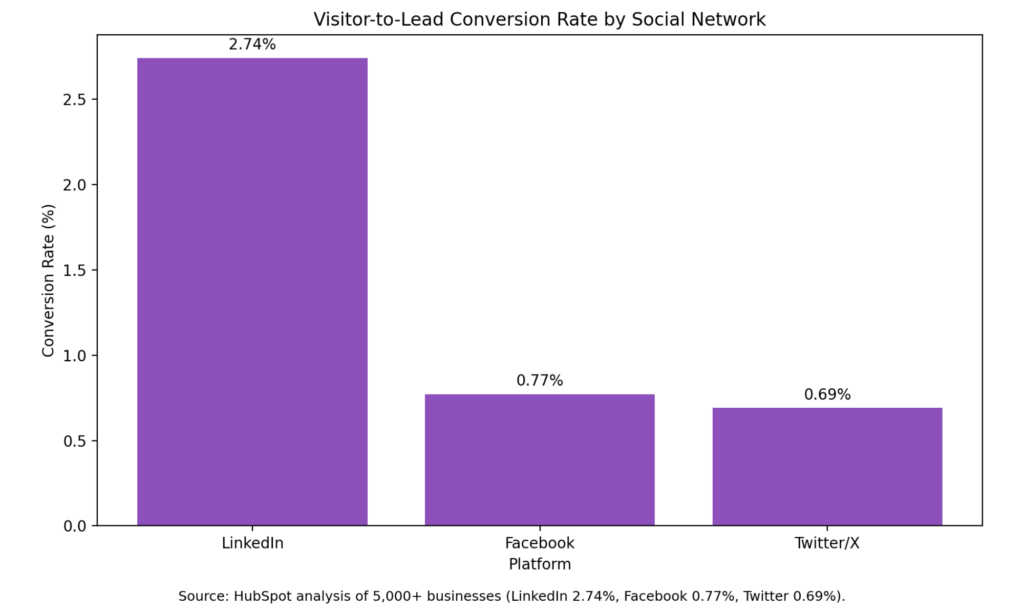
LinkedIn is no longer just a digital résumé platform. It is one of the clearest places on the internet where business intent, professional identity, and buying influence overlap. LinkedIn says it has more than 1 billion members across 200+ countries and territories, and HubSpot reports that 42% of marketers used LinkedIn in their marketing strategy in 2025. Even more important, HubSpot’s classic conversion analysis found LinkedIn traffic converted to leads at 2.74%, versus 0.77% for Facebook and 0.69% for Twitter/X. That is why serious B2B brands treat linkedin lead generation as a system, not a side tactic.
This article gives you that system. It covers profile optimization, audience targeting, content strategy, outreach, Sales Navigator workflows, paid acquisition, retargeting, measurement, and the mistakes that quietly kill performance. It is written to be practical enough for founders and consultants, but rigorous enough for agencies and in-house marketers building repeatable demand generation. And because long-form content still matters, remember that HubSpot says blog posts were among the top five highest-ROI content formats for marketers, while LinkedIn and Edelman’s B2B thought-leadership research shows that strong thought leadership can move buyers even when most of the market is not actively shopping.
Why LinkedIn is uniquely powerful for lead generation?
The reason linkedin lead generation works is not just reach. It is context. People on LinkedIn are there in a professional mindset, and LinkedIn’s own marketing materials emphasize professional targeting by job title, seniority, skills, company, industry, and more. HubSpot also notes that four out of five LinkedIn members drive business decisions. In practice, that means LinkedIn lets you reach both the official decision-maker and the hidden influencers around them: managers, operators, technical evaluators, and internal champions.
That matters because B2B buying is usually not linear. Edelman and LinkedIn’s 2024 B2B Thought Leadership Impact Report notes that 95% of business clients are not actively seeking goods or services at any given moment, and buyers increasingly prefer self-directed digital discovery. So the goal of linkedin lead generation is not just to “capture demand.” It is also to create familiarity, credibility, and memory before the buyer enters market. When they are ready, your brand is already known.
The real goal of linkedin lead generation
Too many marketers define lead generation as “get form fills.” That is too narrow. High-quality linkedin lead generation should do four things:
- Put your brand in front of the right accounts and roles.
- Build trust through content and conversation.
- Capture intent when it appears.
- Move leads into a nurture sequence that turns attention into pipeline.
This is why LinkedIn’s lead-generation resources repeatedly connect audience targeting, useful content, distribution planning, and ROI measurement. The platform works best when content, outreach, ads, and CRM follow-up are connected.
Strategy 1: Start with a profile that converts, not just a profile that looks good
For founder-led brands, consultants, coaches, agencies, and sales-led companies, your personal profile is often the first landing page in the funnel. If someone sees your post, comment, ad, or connection request, they click your profile before they reply. That profile must answer three questions in seconds: who you help, what outcome you create, and why someone should trust you. LinkedIn’s own small-business guidance stresses the importance of headline clarity, a strong summary, and profile completeness because these elements help visitors understand your professional story fast.
A converting profile usually has:
- a headline framed around audience + outcome,
- a banner that reinforces positioning,
- an about section written like a buyer-focused landing page,
- featured proof such as case studies, lead magnets, webinars, or testimonials,
- and a call to action that tells the visitor what to do next.
The mistake is making the profile self-centered. Buyers do not care first about your awards, your passion, or your company history. They care whether you understand their problem. The strongest linkedin lead generation profiles sound less like résumés and more like problem-solution pages. That is also consistent with the broader B2B shift toward buyer education and self-guided discovery.
Strategy 2: Define a narrow ICP before you touch content or outreach
Weak lead generation usually starts with weak targeting. You do not need “SMBs” or “founders” as your audience. You need a tightly defined ICP: company size, geography, industry, department, seniority, maturity stage, and buying trigger. LinkedIn’s ad targeting and Matched Audiences tools are designed around this precision, and its best-practice guidance warns against hyper-targeting with too many filters while still encouraging account, job title, and seniority-based refinement.
A good ICP for linkedin lead generation looks like this:
“US-based B2B SaaS companies with 20–200 employees, Series A to Series C, where the VP Marketing or Head of Demand Gen is under pressure to improve pipeline efficiency without increasing paid spend.”
That kind of definition improves everything: your content angle, your connection requests, your ad creative, your lead magnet, and your sales conversation. It also makes reporting cleaner because you can evaluate lead quality against a known target, not just volume. HubSpot’s latest marketing stats reinforce this by showing that lead quality and MQLs are among the most important metrics marketers use to judge success.
Strategy 3: Build a content engine around buyer problems, not brand updates
Most LinkedIn content fails because it is too internal. “We’re excited to announce…” is not lead generation content. It is company news. Effective linkedin lead generation content is built around buyer tension: wasted spend, slow sales cycles, low conversion rates, messy attribution, hiring bottlenecks, compliance risk, poor retention, or whatever pain your buyer lives with. LinkedIn’s lead-generation guidance emphasizes valuable content and a distribution plan, while the Edelman-LinkedIn research shows thought leadership works when it makes business leaders rethink their challenges.
The simplest content mix is:
- Problem-aware posts that name pains and missed opportunities.
- Point-of-view posts that challenge common assumptions.
- Proof posts with case-study snippets, before/after metrics, or lessons from real campaigns.
- Framework posts that make your expertise easy to understand and share.
- Conversion posts that point to a lead magnet, webinar, audit, demo, or consultation.
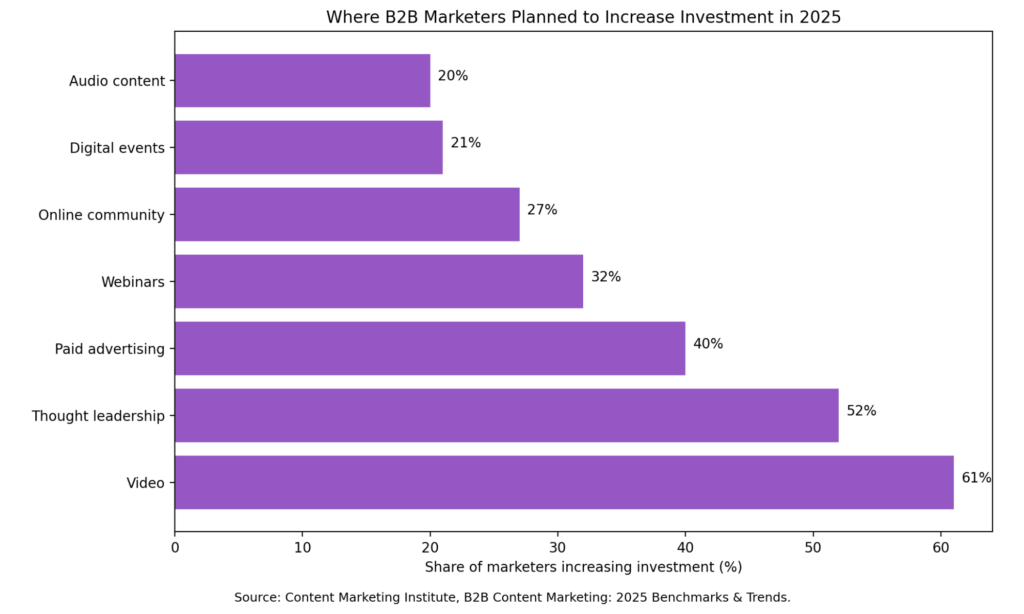
This is where many brands underinvest. Content Marketing Institute found that 52% of B2B marketers planned to increase investment in thought-leadership content in 2025, and 61% planned to increase video investment. That signals where attention is going: more expertise, more authority, more visual storytelling.
Strategy 4: Use native formats that reduce friction
LinkedIn rewards ease. The less friction there is between attention and action, the better your odds. That is why native content and pre-filled forms are so effective. LinkedIn’s own Lead Gen Forms product highlights that forms are pre-filled with members’ profile data, enabling people to submit professional details in just a couple of clicks. It also lets marketers measure cost per lead, form fill rate, and leads by professional segment.
For organic linkedin lead generation, the same principle applies. Carousels, documents, short native videos, text posts with strong hooks, and event promotion often outperform content that immediately sends users off-platform. That does not mean “never link out.” It means earn attention first, then introduce the next step. A good rhythm is value first, CTA second. Teach, then invite. Provoke interest, then offer the deeper asset.
Strategy 5: Turn comments into a lead source
One of the most overlooked linkedin lead generation strategies is comment-led distribution. If your team publishes strong content but never engages in comments across your niche, you are leaving reach and trust on the table. Comments work because they put your expertise in front of warm, contextual audiences. They also feel less intrusive than cold outreach.
A high-quality comment does not say “great post.” It adds a missing angle, a contrarian insight, a mini case study, or a useful example. Over time, this creates profile visits, inbound connection requests, DMs, and branded search. Since B2B buyers increasingly self-educate before talking to sales, visible expertise inside relevant conversations becomes part of the funnel.
Strategy 6: Use outbound outreach like a researcher, not a spammer
Cold outreach is still useful on LinkedIn, but most of it is terrible. Bad outreach tries to close on contact one. Good outreach identifies fit, references context, and opens a natural conversation. LinkedIn Sales Navigator is specifically positioned by LinkedIn as a way to find new leads, research them, and engage them. That order matters: find, research, engage.
A simple outbound flow for linkedin lead generation looks like this:
- Save a focused lead list in Sales Navigator.
- Review recent activity, role, company changes, and shared context.
- Send a short connection request only when there is a relevant reason.
- After acceptance, continue the conversation with insight, not a pitch.
- Offer a useful asset, observation, or invitation only after interest appears.
The big rule is relevance. HubSpot’s broader marketing data shows 93% of marketers report that personalization improves leads or purchases. On LinkedIn, personalization should not mean fake friendliness or over-researched creepiness. It should mean the message clearly matches the recipient’s role, company situation, and likely priorities.
Strategy 7: Combine Sales Navigator with account-based thinking
The best linkedin lead generation programs are not random lists of people. They are account maps. If you sell to mid-market or enterprise companies, stop thinking in terms of one lead and start thinking in terms of buying groups. Use Sales Navigator to identify multiple stakeholders within a target account: economic buyer, functional owner, technical evaluator, and internal influencer. LinkedIn’s Matched Audiences product also explicitly supports account-based marketing by letting advertisers target companies and decision-makers.
This matters because B2B purchases are social inside the company even when the form fill is individual. A lead might download your guide, but the deal depends on alignment across several people. That is why content should be multi-threaded too: strategic POV for executives, practical how-to content for operators, and proof content for skeptics.
We wrote a practical, beginner-friendly digital marketing guide for small businesses. It covers everything from SEO to Paid Ads. Have a quick read & implement to scale your business.
Strategy 8: Use LinkedIn Ads for precision, not vanity reach
Paid linkedin lead generation becomes expensive fast when the offer is weak or the targeting is messy. But when it is done well, LinkedIn Ads are extremely useful because the audience filters are strong and the platform is built around professional identity. LinkedIn’s ad guide emphasizes job title, industry, skills, and similar professional attributes, while Lead Gen Forms reduce submission friction by pre-filling business data.
The best paid offers on LinkedIn are usually:
- benchmark reports,
- calculators,
- webinars,
- templates,
- diagnostic checklists,
- mini-audits,
- industry-specific playbooks,
- and strong point-of-view assets.
Do not send cold traffic to a generic “book a demo” page unless the audience already knows you or has obvious purchase intent. Top-of-funnel paid campaigns should educate and qualify. Mid-funnel campaigns should prove value. Bottom-funnel campaigns should remove risk and invite action.
Strategy 9: Use Lead Gen Forms when speed matters, landing pages when qualification matters
This is one of the biggest tactical choices in linkedin lead generation. LinkedIn’s Lead Gen Forms are ideal when you want convenience, mobile completion, and clean CRM capture. Because the form is pre-filled, completion friction is lower than most landing pages. LinkedIn also supports CRM and marketing automation integrations, which makes follow-up faster.
But ease can come with trade-offs. Sometimes a landing page qualifies better because the visitor has to spend more effort and consume more context. The smart choice depends on the offer. For lightweight assets like checklists, templates, webinar registrations, or short reports, Lead Gen Forms often make sense. For high-consideration offers such as demos, assessments, pricing requests, or implementation consultations, a dedicated landing page may produce fewer leads but stronger intent. The point is to optimize for pipeline quality, not just lead volume.
Instagram search has become far more important than many brands realize. Keyword relevance now matters in your profile, captions, on-screen text, and post framing.
Strategy 10: Retarget warm audiences with Matched Audiences
One of the strongest multipliers in linkedin lead generation is retargeting. LinkedIn’s Matched Audiences lets you retarget website visitors, reach contact lists, target account lists, and connect CRM data with platform targeting. This is essential because most people do not convert on first touch, especially in B2B.
A strong retargeting sequence could look like this:
- Ad 1: educational asset or benchmark report
- Ad 2: proof-oriented content such as case study or customer result
- Ad 3: webinar, audit, consultation, or demo invitation
This sequencing aligns with the 95:5 buying reality from Edelman and LinkedIn. If most of your market is out-of-market today, retargeting helps you stay present long enough for timing to change.
Strategy 11: Keep your audience broad enough to learn
LinkedIn’s own targeting guidance warns against over-constraining audience size. It recommends keeping target audiences above 50,000 for Sponsored Content and Text Ads, and above 15,000 for Message Ads. That guidance matters because small audiences often inflate costs, reduce delivery, and make optimization harder.
This is where many marketers sabotage linkedin lead generation. They layer industry + title + seniority + function + skills + company size + geography + group membership until the audience is too tiny to scale. Start with the fewest filters that still define fit. Then refine using results, not assumptions. Broad-enough targeting plus strong creative often beats hyper-specific targeting plus mediocre creative.
Strategy 12: Build a follow-up machine outside LinkedIn
LinkedIn can create demand and capture leads, but it should not be your entire system. Once a lead arrives, they need fast, structured follow-up. LinkedIn Lead Gen Forms support downloads and CRM integrations, which makes handoff easier. HubSpot’s latest data also shows marketers care deeply about lead quality, lead-to-customer conversion rate, ROI, and CAC, which means post-capture process is not optional.
A simple nurture system after a LinkedIn lead capture might include:
- immediate email delivery of the promised asset,
- a 3–5 email sequence expanding on the topic,
- retargeting ads with proof and use cases,
- sales outreach for high-fit leads,
- and remarketing to re-engage non-responders.
In other words, linkedin lead generation works best when LinkedIn starts the relationship and your CRM deepens it.
Strategy 13: Lean into video and thought leadership
If you want to future-proof linkedin lead generation, invest where the market is already moving. Content Marketing Institute found that 61% of B2B marketers planned to increase video investment in 2025, and 52% planned to increase thought-leadership investment. That aligns neatly with what works on LinkedIn: concise expert videos, founder opinion, data-led carousels, sharp frameworks, and research-backed perspectives.
Why does this matter so much? Because out-of-market buyers are not asking for demos yet. They are evaluating who sounds credible, who teaches clearly, and who seems to understand what is changing in their world. Thought leadership is not fluff when it is evidence-based and specific. It is pre-sales trust building.
Strategy 14: Measure the right metrics

The wrong way to measure linkedin lead generation is to obsess over impressions and likes while ignoring lead quality. The right way is to track the full path from audience to revenue. LinkedIn itself suggests measuring cost per lead, lead form fill rate, and leads by audience segment. HubSpot’s current marketing data adds that lead quality, lead-to-customer conversion rate, ROI, CAC, and lead volume are among the top metrics marketers care about.
A practical LinkedIn measurement stack includes:
- profile views and follower growth for early signal,
- engagement rate and saves for content resonance,
- CTR for ad and post efficiency,
- CPL and form fill rate for paid capture,
- MQL rate for fit,
- sales-accepted lead rate for relevance,
- meeting-booked rate for intent,
- pipeline value and closed revenue for business impact.
This is the difference between being “active on LinkedIn” and running a real lead-generation program.
At Full Traffic, we specialise in Linkedin Lead Generation – focussed on RoI. Hit the button below to know more.
Common mistakes that kill linkedin lead generation
The first mistake is treating LinkedIn like a broadcast channel. You post, you disappear, and you expect leads to show up. Real performance comes from publishing, engaging, following up, and retargeting together. LinkedIn’s own lead-generation materials frame success as a connected distribution system, not a single tactic.
The second mistake is chasing volume over quality. A flood of weak leads can destroy sales trust in marketing. HubSpot’s data makes clear that lead quality is one of the most important success metrics in modern marketing.
The third mistake is using generic offers. Nobody needs another vague “ultimate guide.” Strong offers have specificity, urgency, and business relevance: “2026 CAC Benchmark for B2B SaaS,” “LinkedIn Ad Audit Checklist for Agencies,” or “Enterprise SEO Dashboard Template for In-House Teams.” Specificity signals value.
The fourth mistake is asking for too much too soon. Cold traffic should not always be pushed to a demo. Many buyers need education and proof before they want a conversation. That is especially true in B2B categories with longer sales cycles and committee-based decisions.
The fifth mistake is neglecting speed. A lead captured through LinkedIn is perishable. If follow-up is slow, interest decays. LinkedIn’s native integrations exist for a reason: capture, sync, act.
A practical 30-day linkedin lead generation plan
In week one, tighten your ICP, rewrite your personal and company positioning, update your profile assets, and define one core offer.
In week two, publish three to five posts around buyer pain, proof, and point of view. Start daily comment engagement in your niche.
In week three, build a Sales Navigator list, send thoughtful connection requests, and launch a simple retargeting or lead-gen campaign if budget allows.
In week four, review lead quality, message response, content engagement, and CRM conversion. Double down on what brought qualified conversations, not just traffic. This cadence matches LinkedIn’s product design: targeted discovery, relevant engagement, low-friction capture, and measurable follow-through.
Final verdict
The best linkedin lead generation strategy is not a hack. It is a compounding system built on authority, audience precision, useful content, respectful outreach, low-friction capture, and disciplined follow-up. LinkedIn gives you unusual advantages: verified professional context, strong B2B targeting, native lead forms, account-based options, and a space where thought leadership still influences buying behavior. Add a clear ICP, stronger offers, and proper measurement, and LinkedIn becomes more than a social channel. It becomes a reliable source of pipeline.