👋
Blog Post
Local SEO Checklist 2026
How to Optimise for Local Search and Win More Nearby Customers
Share
Local SEO Checklist : How to Optimise for Local Search and Win More Nearby Customers
If you want to optimise for local search in 2026, stop thinking of local SEO as “just Google Maps.”
Today, local visibility is created by a connected system: a complete and accurate Google Business Profile, fresh reviews, useful location or service-area pages, consistent business data across the web, locally relevant backlinks, fast mobile UX, and disciplined performance tracking. Google’s own guidance still points to the same foundation — relevance, distance, and prominence — but the practical meaning of those signals has widened. More reviews, better profile completeness, clearer website structure, and stronger authority all reinforce one another.
Industry data shows just how concentrated the opportunity is. A current summary of Whitespark’s 2026 Local Search Ranking Factors report places Google Business Profile signals at 32% of Local Pack influence, review signals at 20%, and on-page signals at 15%. BrightLocal’s 2026 consumer survey shows 92% of consumers care about star ratings, 74% only care about reviews from the last three months**, and 47% will not use a business with fewer than 20 reviews. At the same time, discovery is fragmenting: SOCi reports that Gen Z now uses an average of 3.6 different apps to find and choose a local business, while social discovery rose to 73% and 95% of consumers still trust human validation over AI recommendations.
That means a serious local SEO checklist now has to do three jobs at once:
- Help search engines understand you
- Help nearby customers trust you
- Help ready-to-buy visitors convert fast
This guide shows how to do all three.
Why local search matters more than ever
Local SEO is the practice of improving a business’s visibility for searches tied to a specific geography. Those assets include your website, local listings, backlinks, reviews, social profiles, and other media. Google’s own local ranking guidance makes the framework clear: local results are primarily influenced by relevance, distance, and prominence. Relevance depends on how well your profile and website match the search; distance depends on proximity to the searcher or the place named in the query; prominence depends on how well-known and trusted your business appears, including signals like links and reviews.
That sounds simple, but the execution is not.
In practice, local search now appears in at least three different surfaces:
- The Local Pack / Map Pack, where Google often shows a map and a few business listings at the top of the results
- Local organic results, where location pages, service pages, and helpful content compete below the map
- Search-everywhere discovery, where people cross-check businesses across Google, Google Maps, Facebook, Instagram, TikTok, Yelp, Apple Maps, AI tools, and brand websites before choosing
The businesses that win local search today are rarely the businesses with the most “SEO tricks.” They are usually the businesses that look the most complete, trusted, current, useful, and easy to buy from.
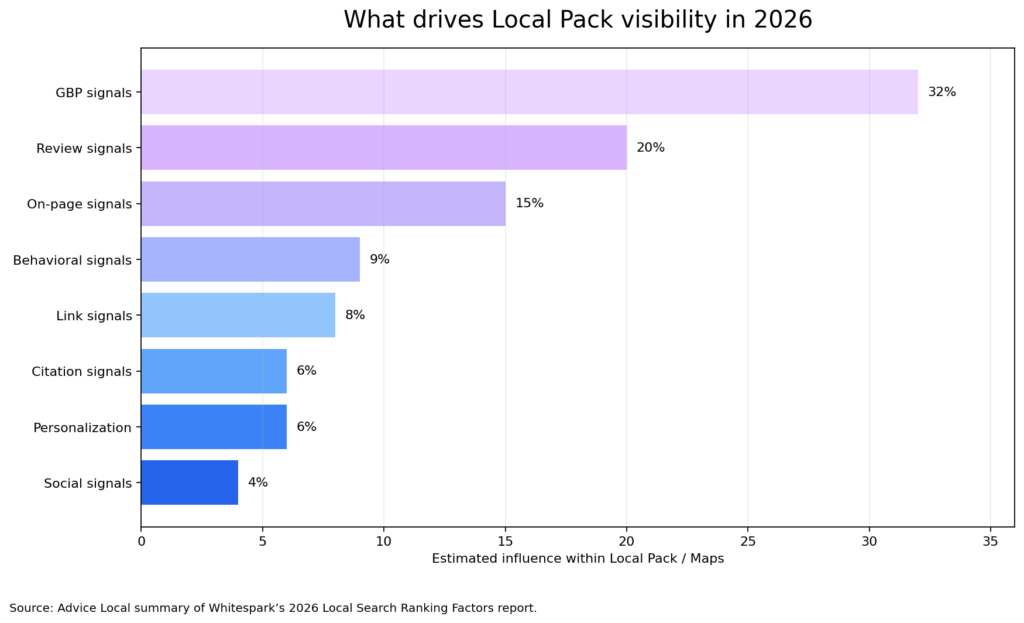
The practical takeaway from the latest factor weighting is not that citations or links have become unimportant. It is that your Google Business Profile and your review system deserve the first block of effort, while your website, local pages, and authority signals must support them.
What local search optimisation actually means in 2026
A modern local SEO checklist is not a one-time setup project. It is an operating system.
You are optimising:
- Business data so Google can trust your identity and surface accurate information
- Reputation signals so searchers see proof, recency, and responsiveness before they compare prices
- Website relevance so local pages can rank organically and convert visitors once they arrive
- Technical quality so your site is fast, crawlable, mobile-friendly, and strong on page experience
- Measurement loops so you can improve what actually drives calls, bookings, direction requests, form fills, and revenue
If even one of those pillars is weak, performance caps out quickly.
The definitive local SEO checklist
1) Claim, verify, and fully own your Google Business Profile
This is the first item on any credible local SEO checklist for a reason.
Google explicitly states that businesses with complete and accurate information are more likely to show up in local results, and that verification helps Google understand that you are authorised to represent the business. Backlinko’s local SEO and GBP guides also reinforce that the profile is a primary input into how businesses appear in Search, Maps, and the Local Pack.
What to do:
- Claim or create the profile
- Complete verification
- Ensure ownership is controlled internally, not by a third party who can disappear
- Standardise your business name so it matches your real-world brand usage
- Review your main category, secondary categories, service areas, and contact details
Do not treat profile setup as administrative housekeeping. Your profile is one of the strongest relevance and conversion assets you own.
2) Choose the right primary category before you do almost anything else
Categories shape relevance.
A fully completed profile helps, but the wrong category can still suppress visibility for the searches that matter most. Search Engine Land’s local audit guide highlights GBP categories as a core audit field, and multi-location guidance shows that keyword research should inform the categories you choose for each branch.
Best practice:
- Pick the single most commercially important primary category
- Add only genuinely relevant secondary categories
- Revisit category choices if your service mix changes
- Check whether category changes correlate with visibility gains or drops over time
For many local businesses, getting the primary category right is a faster win than writing another blog post.
3) Make your profile complete, specific, and conversion-ready
Google recommends keeping business information complete and detailed, including address, phone number, business type, hours, and additional attributes. It also allows richer profile content including services, products, attributes, FAQs, booking information, posts, photos, and videos.
A complete profile improves both discoverability and conversion readiness because it reduces uncertainty. Users should be able to answer basic buying questions without leaving the SERP.
Your profile should include, where relevant:
- Business name, address, phone number, website
- Primary and secondary categories
- Regular hours and special hours
- Services or menu items
- Products
- Attributes (parking, accessibility, Wi-Fi, payment options, etc.)
- Booking or appointment links
- Fresh photos and videos
- Questions and answers
- A concise, accurate description
The rule is simple: if a customer might need it before calling or visiting, put it in the profile.
4) Keep hours, contact details, and service areas obsessively accurate
This sounds basic, but it is one of the highest-leverage actions in the entire local SEO checklist.
Google explicitly says that keeping hours up to date helps customers know when they can visit, and that complete, accurate information makes it more likely your business appears in relevant local results. Search Engine Land’s audit workflow includes listing accuracy as one of the first things to assess, alongside Maps visibility, categories, and review trends.
Critical accuracy checks:
- Regular opening hours
- Holiday and special hours
- Main phone number
- Landing page URL
- Service area coverage
- Closed or moved locations
- Duplicate profiles or outdated listings
An inaccurate listing does not just create SEO issues. It creates real-world disappointment, negative reviews, lower conversion rates, and weaker trust.
5) Add fresh, high-quality photos and videos
Google recommends adding photos and videos to show customers what you offer and to tell your business story. In local SEO, visuals do more than decorate a listing: they increase confidence, clarify expectations, and make your profile look “alive.”
For local businesses, strong media helps answer subconscious buying questions:
- Does this place look trustworthy?
- Does it look busy, clean, modern, and credible?
- Can I picture myself buying from this business?
Use a recurring image plan:
- Exterior photos so users can recognise the location
- Interior photos so the setting feels real
- Team photos to humanise the brand
- Product or service photos
- Before-and-after proof where relevant
- Short videos showing process, atmosphere, or results
Fresh media is not a substitute for reviews or on-page SEO, but it amplifies both.
We wrote a practical, beginner-friendly digital marketing guide for small businesses. It covers everything from SEO to Paid Ads. Have a quick read & implement to scale your business.
6) Build a review engine, not a review campaign
This is where many local businesses underperform.
Semrush’s local SEO checklist recommends managing reviews as an ongoing process: add your business to relevant review platforms, decide which review platform matters most, ask customers for reviews, and respond quickly and strategically. Google adds that replies are public, should be professional and helpful, and that honest, balanced reviews help potential customers decide.
BrightLocal’s 2026 survey makes the commercial importance unmistakable:
- 92% care about star ratings
- 74% only care about reviews from the last three months
- 85% are more likely to use a business after reading positive reviews
- 77% are deterred by negative reviews
- 47% will not use a business with fewer than 20 reviews
That means your review strategy cannot be “ask once in a while when someone remembers.” It needs to be operational.
Turn review generation into a system:
- Ask soon after a successful experience
- Use email, SMS, QR codes, receipts, packaging, and follow-up sequences
- Train frontline staff to request reviews naturally
- Direct customers to the platform that matters most for your niche
- Keep requests compliant and honest
- Never buy or fake reviews
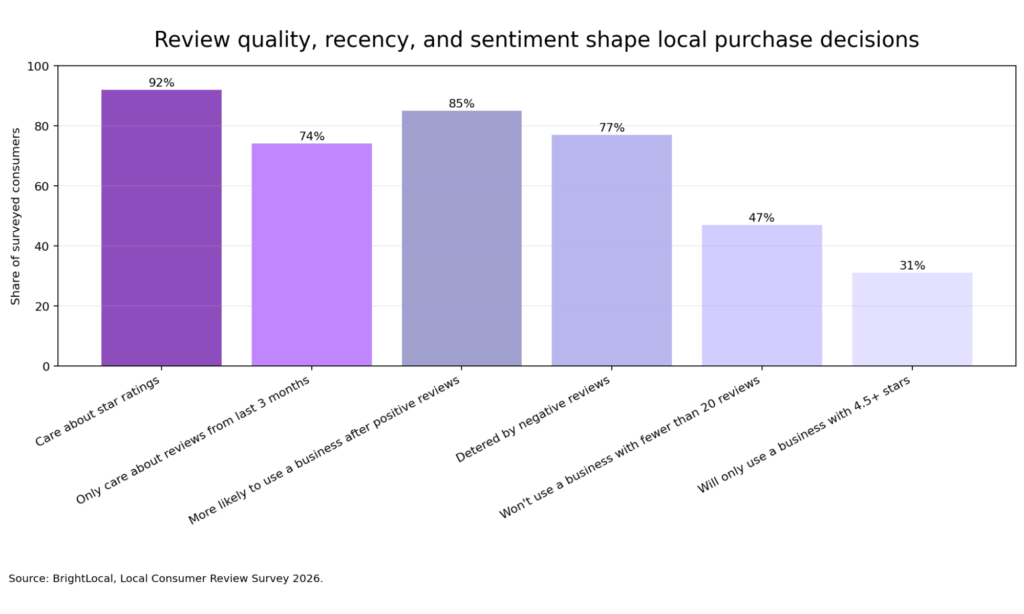
The most important insight here is not only that reviews matter. It is that **review freshness and review volume matter alongside average rating**. A dormant profile with an old 4.8 average is weaker than many businesses assume.
7) Reply to reviews with the right tone and the right cadence
Google states that responding to reviews shows that you value customer feedback, and that positive reviews plus helpful replies can help your business stand out. Its review guidance also recommends keeping replies short, clear, relevant, conversational, and non-promotional.
A reply is not there to “win” an argument or squeeze in extra keywords. It is there to show future customers that your business listens.
For positive reviews:
- Thank the customer by name when appropriate
- Reference something specific from their review
- Reinforce the result or experience
- Keep it warm, not templated
For negative reviews:
- Stay calm
- Acknowledge the issue
- Offer a path to resolution
- Avoid defensive essays
- Flag reviews that violate platform policies
This is not just reputation management. It is visible conversion support.
8) Expand your review presence beyond Google, but prioritise where your buyers actually decide
Google is usually the most important platform, but not always the only one that matters.
Semrush recommends identifying the platform most likely to drive results for your business and then focusing your strategy around it. BrightLocal’s 2026 survey shows that consumers also write reviews on Facebook, Yelp, Apple Maps, Tripadvisor, and BBB, with Google still leading.
Your best platform mix depends on your market:
- Restaurants / hospitality: Google, Tripadvisor, Instagram, TikTok
- Home services: Google, Facebook, niche trade directories
- Healthcare / legal: Google plus category-specific review sites
- Tourism: Google, Tripadvisor, Apple Maps, social video platforms
The smart move is not to spread yourself thin everywhere. It is to be strong where trust is actually built in your category.
9) Standardise your local citations and keep NAP consistency tight
Semrush defines local citations as online mentions of your business name, address, and phone number on third-party websites and directories, and notes that the key is consistency across all platforms. These structured and unstructured mentions help search engines verify that your business is legitimate.
Even if citations no longer dominate Local Pack weighting the way they once did, they remain foundational. A recent summary of Whitespark’s 2026 research still shows citation signals in the mix, and notes that they remain especially important for broader visibility and data trust.
Your citation checklist should include:
- Business name
- Address
- Phone number
- Website URL
- Hours
- Categories
- Descriptions
- Images where supported
Audit for problems like:
- Old phone numbers
- Old URLs
- Suite number inconsistencies
- Moved locations still listed
- Duplicate directory profiles
- Slight brand-name variations across platforms
Think of citations as identity infrastructure. They are rarely glamorous, but when they are messy, local SEO gets noisy fast.
10) Create location pages that deserve to rank
If you have more than one storefront, location pages are not optional.
Search Engine Land describes location landing pages as pages representing different branches of a business and explains that high-quality location pages extend well beyond basic NAP information into genuinely helpful local experiences. They support both visibility and conversions because they help users quickly find the nearest relevant branch and understand what is unique about it.
A strong location page should include:
- The branch name, address, phone, and hours
- A unique title tag and H1
- Localised service descriptions
- Embedded map or directions
- Parking, access, and neighbourhood notes
- Local photos
- Reviews or testimonials relevant to that branch
- FAQs specific to the location
- Staff, inventory, events, or proof points unique to that branch
- Internal links from the main site and nearby related pages
The biggest mistake multi-location brands make is publishing dozens of thin pages that differ only by city name. Search Engine Land is clear that location pages work when they are useful and distinctive, not templated shells.
11) Build service-area pages without creating doorway-page risk
Service-area businesses need a slightly different version of the local SEO checklist.
Search Engine Land’s service-area guidance explains that these pages represent the customer’s location rather than the location of a physical storefront, and that they can earn organic rankings for local-intent queries when they are genuinely helpful and unique. It also warns against doorway abuse: creating many substantially similar pages aimed at specific cities that simply funnel users to one destination.
If you serve multiple towns or neighbourhoods:
- Create pages only for meaningful service areas
- Make each page useful as a final destination
- Add original local proof, FAQs, examples, and practical information
- Avoid swapping only the city name
- Link each relevant GBP or directory profile to the appropriate page where possible
Usefulness and uniqueness should guide every service-area page you publish.
12) Optimise your on-page local signals properly
Local SEO is never just a listing problem. Your website must confirm what your profile implies.
That is one reason on-page signals still rank so highly in both local pack and local organic frameworks. Backlinko also notes that local SEO involves optimising for both the map pack and the regular “blue link” results, not one or the other.
At minimum, optimise these on-page elements:
- Title tag with core service + location where appropriate
- H1 that clearly matches intent
- Opening paragraph that explains the offer and geography naturally
- Unique local FAQs
- Service schema or local business schema where relevant
- Internal links from top-level service pages, blog content, and navigation
- Strong calls to action
- Click-to-call and appointment options on mobile
Avoid stuffing city names unnaturally. Local relevance should feel credible, not manufactured.
13) Add LocalBusiness structured data correctly
Google’s Search Central documentation explains that LocalBusiness structured data can tell Google about hours, reviews, departments, and more, and can support rich local displays such as knowledge panels and related business carousels.
Structured data is not magic. It does not replace authority, links, or reviews. But it does help search engines parse your information more reliably.
Use structured data to mark up, where applicable:
- Business name
- Address
- Phone number
- Opening hours
- URL
- Department information
- Service information
- Review content on your site where eligible
After implementation, validate it with Google’s Rich Results Test and keep it aligned with the visible content on the page.
At Full Traffic, we specialise in SEO Services – focussed on conversions over rankings. Hit the button below to know more.
14) Earn locally relevant links and mentions
Google’s description of prominence specifically notes that links to your business and reviews contribute to local ranking strength. Search Engine Land and Backlinko both reinforce the role of website authority and link health in local performance.
The local SEO version of link building is not about chasing irrelevant high-metric links. It is about building local authority signals that make geographic sense.
High-value local link opportunities include:
- Chambers of commerce
- Trade associations
- Local newspapers and community sites
- Sponsorships
- Event pages
- Nonprofits and schools
- Local partner businesses
- Supplier or vendor pages
- Award lists and “best of” roundups
- Niche directories with editorial standards
The best local links improve both rankings and referral trust. If a link can send a qualified lead, it is usually the right kind of link.
15) Make your mobile experience fast, frictionless, and obvious
Google recommends strong Core Web Vitals and says they align with what its ranking systems seek to reward as part of page experience. The same documentation recommends targeting LCP within 2.5 seconds and INP below 200 milliseconds.
That matters because local search is often urgent. Users checking opening hours, directions, services, or availability are not in the mood for slow pages, broken forms, or buried phone numbers.
Your local UX checklist should include:
- Mobile-first layout
- Fast page load
- Clear tap targets
- Sticky click-to-call button where appropriate
- Direction links
- Visible hours
- Fast-loading maps or lightweight map embeds
- Short forms
- Clear trust elements near CTAs
Google’s Search Console Performance report can also help you compare queries, CTR, pages, and mobile behaviour so you can improve weaker pages over time.
16) Track the metrics that connect visibility to revenue
Google Business Profile Performance gives you visibility into views, clicks, and other customer interactions on Search and Maps. Search Console’s Performance report shows changes in search traffic, top queries, mobile queries, CTR, pages, and average position. Search Engine Land’s local SEO audit guide recommends tracking a broader operational checklist that includes Local Pack visibility, Maps visibility, listing accuracy, average star rating, review count, sentiment trends, citation health, user behaviour, website health, and AI visibility.
This is where many local SEO programs fail: they track rankings but not business outcomes.
The local SEO metrics that actually matter are:
- GBP views
- Website clicks from GBP
- Calls from GBP
- Direction requests
- Branded vs non-branded search visibility
- Local Pack rank by location grid
- Organic traffic to location/service-area pages
- Form fills
- Phone call quality
- Booking completions
- Store visits or offline lead quality where measurable
- Review velocity and average rating
- CTR on local organic pages
If a metric cannot eventually connect to revenue, treat it as secondary.
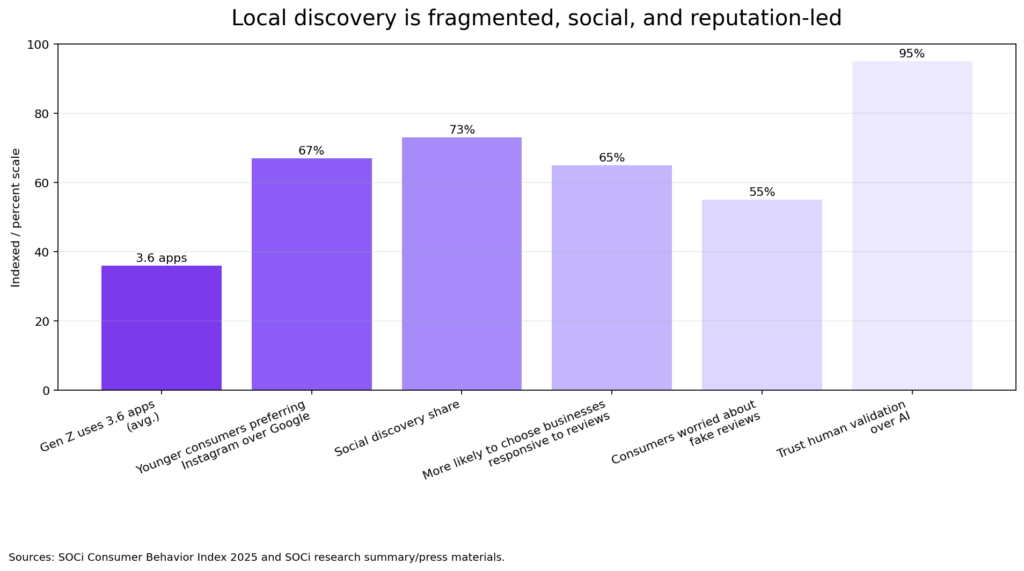
This is why “optimise for local search” no longer means “optimise only for Google.” Your local presence has to hold up across reviews, social proof, AI summaries, directory data, and your own website.
17) Audit quarterly instead of reacting randomly
Search Engine Land notes that change is constant in local SEO because Google launches and removes features, competitors appear, and ranking updates affect both local and organic performance. That is why a quarterly audit cadence is more productive than emotional daily checking.
Quarterly audit areas:
- Profile completeness
- Category accuracy
- Review count, recency, and sentiment
- Photo freshness
- Duplicate listings
- Citation consistency
- Local page content quality
- Internal linking
- Structured data validity
- Core Web Vitals
- Query and CTR changes
- Conversion drop-offs[12]
The goal of the audit is not just “find problems.” It is to identify the highest-leverage next actions.
18) Build a local SEO operating rhythm, not a backlog
The most successful businesses do not “finish” local SEO. They repeat the right actions.
A strong ongoing rhythm looks like this:
Weekly
- Add or refresh profile photos
- Respond to reviews
- Check profile questions
- Watch for listing edits or spam
Monthly
- Review GBP performance
- Review Search Console local queries and CTR
- Request new reviews systematically
- Refresh one local page or FAQ block
- Check citations and hours
Quarterly
- Run a full local audit
- Review category choices
- Update structured data
- Evaluate link opportunities
- Compare locations, service areas, or neighbourhood performance[3][5][12]
Consistency beats intensity in local SEO.
A practical 90-day local SEO rollout plan
Days 1–30: Fix foundations
- Claim and verify GBP
- Standardise NAP
- Correct hours and special hours
- Choose primary and secondary categories
- Add key services, attributes, and booking links
- Audit and fix top citations
- Add click-to-call and key local CTAs to the site
- Benchmark current rankings, calls, clicks, and direction requests
Days 31–60: Build trust and relevance
- Launch a review request workflow
- Respond to all recent reviews
- Upload fresh photos and short videos
- Improve title tags, H1s, and local copy on core pages
- Build or upgrade location pages / service-area pages
- Implement LocalBusiness structured data
- Identify 10–20 realistic local link opportunities
Days 61–90: Scale what works
- Review GBP and Search Console data
- Expand location-specific FAQs
- Add more branch or service-area proof
- Earn local links and mentions
- Publish one useful local resource or community-focused asset
- Compare top-performing and weak-performing pages
- Tighten conversion flows on pages with traffic but weak lead quality

Common local SEO mistakes that hold businesses back
Treating GBP like a set-and-forget asset
A profile that is technically complete but operationally stale rarely performs like one that shows review activity, fresh media, current hours, and active management.
Publishing thin city pages
If your local pages are largely duplicate, they can underperform or even create doorway-page risk.
Chasing generic backlinks while ignoring local authority
A relevant local mention from the right regional source can outperform an irrelevant “SEO link” for local trust and conversions.
Ignoring review recency
A strong average rating is not enough when most consumers care about recent feedback.
Measuring visibility without measuring outcomes
Impressions do not pay the bills. Calls, bookings, visits, and qualified leads do.
Optimising only for Google
Customers increasingly discover and verify businesses across multiple platforms before they convert.
Final Takeaway
The businesses that dominate local search are not always the biggest brands or the ones with the most content.
They are the businesses that make it easy for search engines to trust them and easy for customers to choose them.
If you remember only one thing from this guide, remember this:
A winning local SEO checklist is not a list of hacks. It is a system that makes your business easier to find, easier to trust, and easier to buy from.
Do that consistently, and local search will stop being a visibility problem and start becoming a growth channel.