👋
Blog Post
How AI Enhances Keyword Research for SEO
Learn how AI improves keyword research for SEO by uncovering intent, clustering topics, identifying long-tail opportunities, and helping marketers build more targeted content strategies that work in both traditional search and AI-driven search experiences.
Share
How AI Enhances Keyword Research for SEO: A Smarter, Deeper Playbook for Modern Search
Keyword research used to be a fairly linear exercise. You started with a seed term, pulled a list of related queries, checked volume and difficulty, grouped similar phrases, and mapped them to pages. That process still matters. But the search environment around it has changed. Google’s AI experiences can use a “query fan-out” technique that breaks one prompt into multiple related searches across subtopics and data sources, while also surfacing a wider and more diverse set of links than a classic search. Google has also said that people are using Search more often for more complex questions in these AI experiences. That means modern keyword research is no longer just about matching a page to one phrase; it is about understanding the wider network of intents, entities, sub-questions, and proof points behind the query.
This is exactly where AI helps. Used well, AI does not replace keyword research fundamentals. It accelerates the most time-consuming parts: brainstorming, semantic expansion, intent analysis, clustering, content mapping, and ongoing refreshes. But the final decisions still need grounding in real search behavior, SERP evidence, and business relevance. Google’s own guidance for Search and AI features still comes back to the same foundation: create helpful, reliable, people-first content, and use the words people would actually use to find your pages.
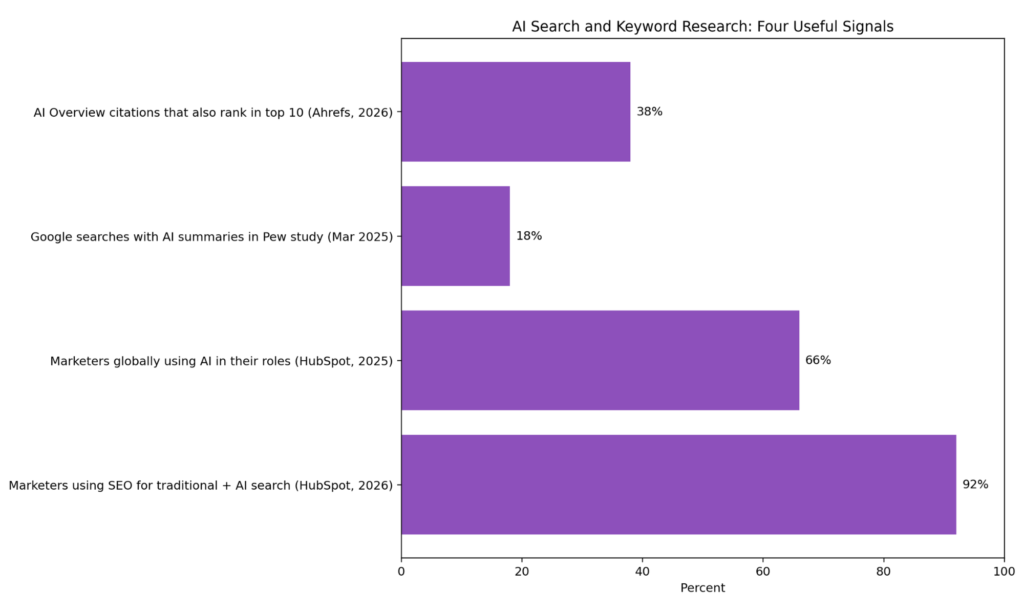
The macro trend is hard to ignore. HubSpot says 66% of marketers globally were already using AI in their roles in 2025, and its 2026 State of Marketing reporting says over 92% of marketers plan on or are already using SEO optimization for both traditional and AI-powered search. Meanwhile, Pew found that 18% of Google searches in its March 2025 study generated an AI summary, and 88% of those summaries cited three or more sources. Ahrefs’ 2026 analysis adds another useful wrinkle: only about 38% of pages cited in AI Overviews also ranked in the top 10, suggesting that visibility in AI-assisted search is not a simple one-to-one copy of classic rankings.
That shift matters for SEO teams. In a classic keyword workflow, many marketers optimized around a head term and a handful of close variants. In an AI-shaped search environment, the winning content often covers a broader decision journey: the definitions, comparisons, use cases, objections, examples, pricing angles, and follow-up questions that a user may not type explicitly in one query but that a model can still fan out behind the scenes. The practical takeaway is simple: keyword research has become less about collecting strings and more about modeling demand.
What AI actually improves in keyword research
The first big upgrade is semantic expansion. AI tools are very good at generating related entities, modifiers, synonyms, subtopics, and question patterns around a seed idea. Semrush’s guidance on AI keyword research notes that chatbots are strong at identifying common terms in written content and understanding keyword meanings and relationships. In practice, this means AI can take a seed phrase like “technical SEO audit” and quickly expand it into clusters such as crawl budget, log file analysis, Core Web Vitals, rendering issues, internal linking, canonicalization, and enterprise workflows. That kind of expansion is much faster than manual brainstorming.
The second upgrade is intent interpretation. Ahrefs defines search intent as the reason behind a search query, and its product now highlights AI-assisted intent identification inside Keywords Explorer. This is crucial because the real value of keyword research is not finding the largest term; it is deciding what type of page deserves to exist for that demand. AI is particularly useful here because it can infer whether a searcher wants a definition, a comparison, a template, a product page, a category page, or a how-to guide, then help sort thousands of phrases into the right buckets much faster.
The third upgrade is clustering and content architecture. Semrush’s Keyword Strategy Builder organizes keyword research into structured plans and can analyze up to 10,000 keywords, grouping them into topics, pillar pages, and subpages. That is a major leap from the old spreadsheet-heavy workflow where marketers manually tried to decide which phrases belonged on one URL and which needed their own page. Ahrefs makes a similar case with Parent Topics and keyword clustering around related themes. AI reduces the mechanical work of sorting and exposes a clearer site architecture faster.
The fourth upgrade is pattern recognition across SERPs. Ahrefs says its Keywords Explorer can use AI to identify search intent, compare SERPs side-by-side, and find ranking gaps. Semrush’s research stack also emphasizes bulk keyword analysis and SERP analysis. This matters because modern keyword research is inseparable from SERP research. You are not just asking, “What do people search?” You are asking, “What kind of result format already wins here, what related questions surround it, what features appear, and where is the gap?” AI helps identify those patterns across many keywords much more quickly than a manual review.
The fifth upgrade is faster prioritization. AI can help score keywords using a blend of relevance, likely intent fit, supporting subtopics, conversion value, and content feasibility. But the scoring only becomes trustworthy when it is blended with actual search data. Google Keyword Planner can provide monthly searches, keyword discovery, category organization, and forecasts refreshed daily based on the last 7–10 days and adjusted for seasonality. Google Trends adds directional interest, regional patterns, and time-series context, though Google also warns that Trends is not a perfect mirror of search activity and should not be cited interchangeably with Google Ads data. In other words, AI helps you think; real search data helps you choose.
Why AI keyword research is deeper than traditional keyword lists
“That does not mean rankings no longer matter. It means content breadth, passage relevance, and coverage of adjacent sub-questions may matter more.”
Traditional keyword research often overemphasized surface metrics. Search volume became the headline number. Difficulty became the gatekeeper. Sometimes CPC was used as a proxy for commercial value. Those metrics are still useful, but alone they flatten the searcher. AI can rebuild the missing context.
Take a keyword like “best crm for startups.” A classic process might pull variants such as “startup crm,” “crm for small business,” and “affordable crm software.” An AI-enhanced process goes further. It asks what the searcher likely cares about: pricing, integrations, onboarding time, migration difficulty, founder-led sales, pipeline visibility, investor reporting, email automation, or compatibility with small teams. Suddenly the keyword set expands from phrase matching into problem mapping. That is a much stronger base for SEO because it produces pages that are more comprehensive, more useful, and more likely to satisfy both classic searchers and AI systems looking for source material. The inference here is strategic, but it follows directly from Google’s description of query fan-out and the wider link sets shown in AI experiences.
This also helps explain why AI-assisted search visibility may diverge from old-school “rank #1 for one term” logic. Ahrefs’ 2026 study found that only about 37.9% of URLs cited in AI Overviews also appeared within the first 10 result blocks, while large shares came from positions 11–100 or outside the top 100 blocks entirely. That does not mean rankings no longer matter. It means content breadth, passage relevance, and coverage of adjacent sub-questions may matter more than many SEO teams assumed. Keyword research, then, must widen from exact-query targeting to journey-level coverage.
The best way to use AI for keyword research
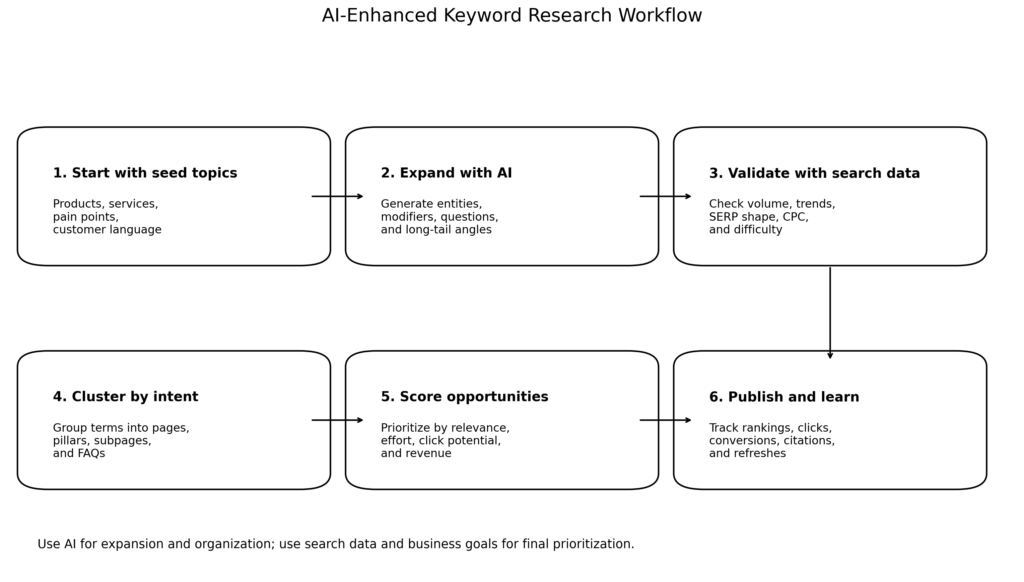
A strong modern workflow has six stages.
1. Start with seed topics rooted in the business
Begin with the real topics your company deserves to win. Use product categories, customer problems, sales objections, use cases, industries served, competitor positioning, and customer language from support tickets, demos, or reviews. AI is not the best first source of strategy; it is the best accelerator once your strategic starting points are clear. Google’s own SEO guidance is still anchored in using the words people would use to look for your content.
2. Use AI to expand the topic universe
Now bring in AI. Ask it to generate synonyms, modifiers, adjacent questions, use cases, comparisons, pain points, entities, and long-tail variations. Semrush’s AI keyword research guide explicitly says chatbots can provide keyword ideas, analyze search intent, and group terms into clusters. It also lists ChatGPT, Claude, Gemini, Perplexity, and Copilot as viable free tools for this kind of brainstorming. The right goal here is not final accuracy. It is directional completeness.
3. Validate with real search and trend data
This is where many teams fail. Chatbots do not know what people actually type into search engines, and Semrush explicitly warns that they do not have direct access to search engine data in the way traditional keyword tools do. So validate every promising theme with Keyword Planner, Trends, or a dedicated SEO platform. Use Keyword Planner for monthly search estimates, keyword discovery, category organization, and forecasts. Use Google Trends for directional movement, geography, and seasonality. Use SEO suites like Semrush or Ahrefs to compare SERPs, look at difficulty proxies, and inspect keyword relationships at scale.
4. Cluster by intent, not just by lexical similarity
This is where AI becomes a serious productivity layer. Instead of grouping terms only because they look alike, group them because they deserve the same page. Semrush’s Keyword Strategy Builder and Keyword Magic Tool are designed for exactly this kind of structure-first workflow, while Ahrefs emphasizes Parent Topics and SERP-side comparisons. In practice, your clusters should map to page types: glossary pages, how-to content, comparison articles, category pages, solution pages, industry pages, and FAQ modules.
5. Score by business value, not volume alone
A strong keyword score blends relevance, likelihood of satisfying intent, realistic ability to compete, click potential, funnel fit, and revenue impact. This is also where AI can help produce a first-pass scoring model. But the final prioritization should stay human-led. Some keywords with modest volume create outsized pipeline because they sit close to buying intent. Others attract traffic but little business value. SEO teams that use AI well do not let the model pick winners blindly; they let it organize the board so humans can make faster, smarter calls. This is an analytical recommendation grounded in the tool capabilities above rather than a direct vendor claim.
6. Refresh continuously as the SERP evolves
Keyword research is no longer a one-time quarterly deliverable. Google’s AI search experiences are dynamic, and the surrounding SERPs shift as formats, sources, and subtopics evolve. Google has said AI experiences are enabling more complex searches and wider source exploration, which means content teams should revisit clusters, refresh supporting sections, expand FAQs, and add missing proof points more frequently than before. AI is especially useful here for detecting new subtopics and finding content gaps across an existing library.
We created a checklist that helps you dominate Google and LLMs in 2026. The checklist has practical SEO tips that the top SEOs use daily. Get it for FREE.
Which AI-powered keyword research tools matter most
For ground-truth demand validation, Google Keyword Planner remains foundational. It is free within Google Ads, helps discover new keywords, shows monthly searches, organizes ideas into categories, and provides forecasts that Google says are refreshed daily and adjusted for seasonality. Even if you never run a paid search campaign, it is still one of the most practical ways to sanity-check whether a topic has measurable search demand.
For trend direction and seasonality, Google Trends is still indispensable. Google lets you export charts as CSVs, embed some charts, and cite the data when reused. But the company also warns that Trends is not a perfect mirror of search activity and is a different data source from Google Ads. That is important. Trends is best used as a comparative signal, not as a substitute for exact volume.
For large-scale clustering and planning, Semrush has become especially strong. Its Keyword Strategy Builder organizes keywords into topics, pillar pages, and subpages, and can analyze up to 10,000 keywords. Its Keyword Magic Tool claims a database of over 27 billion keywords, up to 20 million ideas for a single keyword, and 142 geo databases, alongside AI-powered personalized metrics. That makes it useful for teams that need a structured editorial roadmap instead of another raw export.
For SERP-aware opportunity analysis, Ahrefs is particularly useful. Keywords Explorer now highlights AI-assisted search-intent analysis, SERP comparison, and gap discovery. Ahrefs also makes a persuasive case for thinking in Parent Topics rather than isolated phrases. That mindset is increasingly aligned with how AI-assisted search experiences appear to assemble answers from broader topical coverage instead of narrow exact-match targeting alone.
For fast ideation and question mining, general-purpose chatbots are excellent assistants but poor judges. Semrush’s guidance is blunt on this: chatbots can generate ideas, analyze meanings, and help cluster terms, but they do not reliably know search volume or ranking difficulty because they do not have direct access to search engine keyword datasets the way classic research tools do. The smartest workflow is to use ChatGPT, Claude, Gemini, Perplexity, or Copilot for expansion, then use search tools for validation.
The strategic shift: from keywords to query ecosystems
The deepest change AI brings to keyword research is not speed. It is scope.
Google says AI Overviews and AI Mode may use query fan-out, issuing multiple related searches across subtopics and data sources before developing a response. Pew found that when AI summaries appeared in its study, they usually cited multiple sources. Put those two ideas together and the implication is clear: a page that answers only the literal headline query may be less useful than a page that also addresses the supporting questions around it. Strong keyword research in 2026 is therefore less about “one page, one phrase” and more about “one page, one core job plus the surrounding evidence that completes the job.”
That is also why AI-enhanced keyword research naturally leads to better content briefs. Instead of saying, “Target this keyword and include these secondaries,” the brief becomes richer: what the searcher wants, what the SERP rewards, what adjacent questions must be answered, which comparisons matter, what proof is missing from competitors, what entities to mention, what objections to resolve, and which internal links should support the page. AI is the fastest assistant most teams have ever had for constructing that fuller view.
Common mistakes to avoid
The biggest mistake is treating AI output like search truth. It is not. It is a hypothesis generator. Semrush explicitly warns that chatbots can hallucinate and cannot reliably tell you how popular a keyword is or how difficult it is to rank. That warning alone should shape your workflow. Generate with AI; verify with search data.
Another mistake is over-optimizing for raw volume. Google’s guidance for AI features says the same foundational SEO best practices still apply, especially helpful, reliable, people-first content. Large-volume keywords that do not align with what your site can credibly satisfy are still bad targets. Intent fit and page usefulness beat vanity metrics.
A third mistake is publishing thin, mechanically expanded pages for every cluster. AI can make content production easier, but Google’s guidance remains consistent: what matters is helpfulness, reliability, and whether the page actually serves users. AI should expand your understanding, not flood your site with shallow pages that differ only by wording.
A practical editorial formula for your SEO team
A modern, durable formula looks like this:
Start with a business topic. Use AI to generate the question universe. Validate the promising terms with Keyword Planner, Trends, Ahrefs, or Semrush. Cluster by page intent. Create a brief around the entire query ecosystem, not just the head term. Publish the best answer on the site. Then revisit the page as new subtopics, SERP features, and AI-assisted search behaviors emerge. That is the operating system AI enables for keyword research now. It is faster than the old workflow, but more importantly, it is truer to how search works today.
Conclusion
AI enhances keyword research by turning it from a static list-building task into a dynamic strategy discipline. It helps marketers uncover deeper intent, broaden topical coverage, cluster smarter, map better pages, and refresh content more intelligently. But the winning model is not “AI instead of SEO.” It is “AI for discovery, search data for validation, and editorial judgment for execution.” Teams that combine those three layers will not just find more keywords. They will build better search experiences, better content systems, and better chances of being visible across both classic search and AI-shaped search.