👋
Blog Post
On-Page SEO for the AI Era: A Step-by-Step Guide
The modern guide to on-page SEO in the AI era, covering keyword optimization, title tags, meta descriptions, internal linking, content structure, schema, images, Core Web Vitals, and AI-ready content strategy.
Share

On-Page SEO for the AI Era: A Step-by-Step Guide
Search is no longer just a list of blue links. It is a blended interface of classic organic results, AI Overviews, featured snippets, forum results, videos, images, product modules, and brand mentions. The sites that win now are not the ones that simply “rank.” They are the ones that are easy to crawl, easy to understand, easy to click, and easy to cite.
That is why on-page SEO matters more than ever.
Google’s own guidance is clear: the same foundational SEO practices still apply to AI features, and there are no extra technical requirements for appearing as a supporting source in AI Overviews or AI Mode beyond being indexable and eligible to appear in Search with a snippet. At the same time, Google says AI search experiences reward the same thing classic search has always been chasing: unique, valuable content for people, strong page experience, and content that is easy for its systems to parse across text, images, and video.
The implication is simple:
The AI era has not replaced on-page SEO. It has raised the bar for it.
Today, excellent on-page SEO means you are optimizing for four outcomes at once:
- Relevance — so the page matches the query and intent.
- Packaging — so the title, snippet, image, and page promise earn the click.
- Comprehension — so Google and AI systems can interpret the page quickly and correctly.
- Citation-worthiness — so your content is original and useful enough to be surfaced, summarized, linked, and quoted.
This guide walks through every major on-page SEO factor that matters now: keyword optimization, meta tags, URLs, headings, content structure, internal linking, images, schema, page experience, trust signals, and maintenance. It is designed as a practical, publishable playbook for modern SEO teams, content marketers, founders, agencies, and in-house teams.
Why on-page SEO still matters in the AI era?
A lot of people have started asking the wrong question: “Is SEO dead?”
The better question is: What kind of SEO survives interface change?
The answer is on-page SEO rooted in user value.
Google says AI Overviews show links in multiple formats and expose users to a wider range of sources, while also encouraging more complex and follow-up queries. That means pages do not just need to “contain keywords.” They need to be:
- semantically clear,
- structurally organized,
- original enough to earn citation,
- strong enough in metadata to attract clicks,
- and trustworthy enough to support AI-generated summaries.
Industry data reinforces that shift:
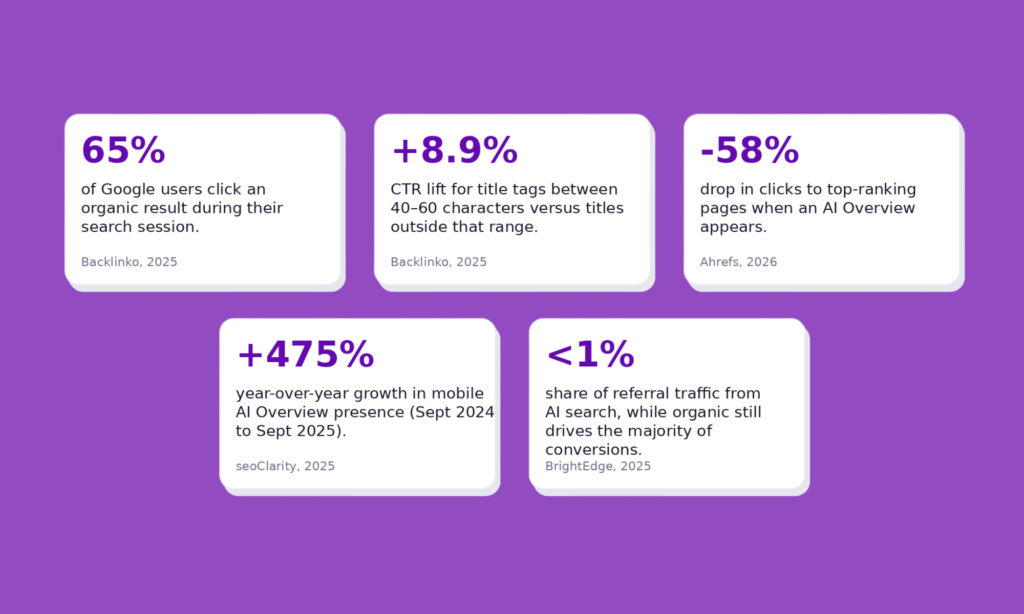
A few numbers matter here:
- Backlinko found that 65% of Google users click an organic result during their search session, which is a reminder that classic organic visibility still matters.
- Backlinko also found that title tags between 40 and 60 characters earned an 8.9% higher average CTR than titles outside that range.
- Ahrefs reported that AI Overviews can reduce clicks to top-ranking pages, and its 2026 update cited a 58% click reduction in its dataset.
- seoClarity found the presence of mobile AI Overviews rose nearly 475% year over year between September 2024 and September 2025.
- BrightEdge reported that AI search is growing quickly, but still contributes less than 1% of referral traffic, while organic search continues to drive the majority of conversions.
The lesson is not “traditional SEO is over.” The lesson is this:
You still need to win the page. But you also need to win the summary, the snippet, the citation, and the confidence layer around the page.
The new rule: optimize for retrieval, ranking, and citation
“Great on-page SEO no longer stops at chasing position one. It includes making the page easy to quote, cite, reuse, and trust.”
In older SEO playbooks, on-page optimization was often treated as a checklist:
- add the keyword to the title,
- add it to the H1,
- sprinkle it into the copy,
- add alt text,
- hit publish.
That approach is no longer enough.
Modern on-page SEO should aim to make a page good at three jobs:
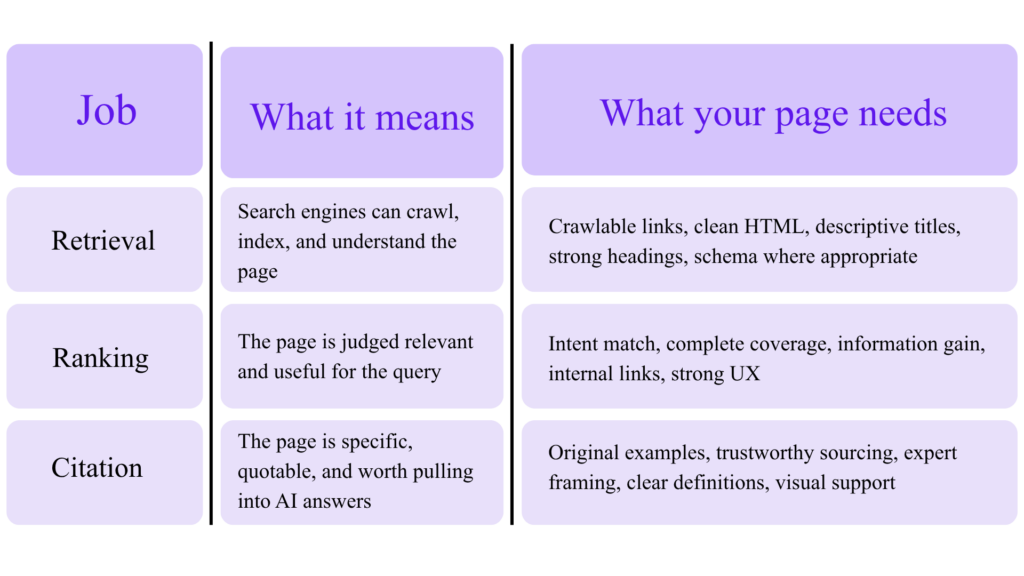
One of the most important AI-era findings from Ahrefs is that AI Overview citations are not limited to top-10 organic pages anymore.
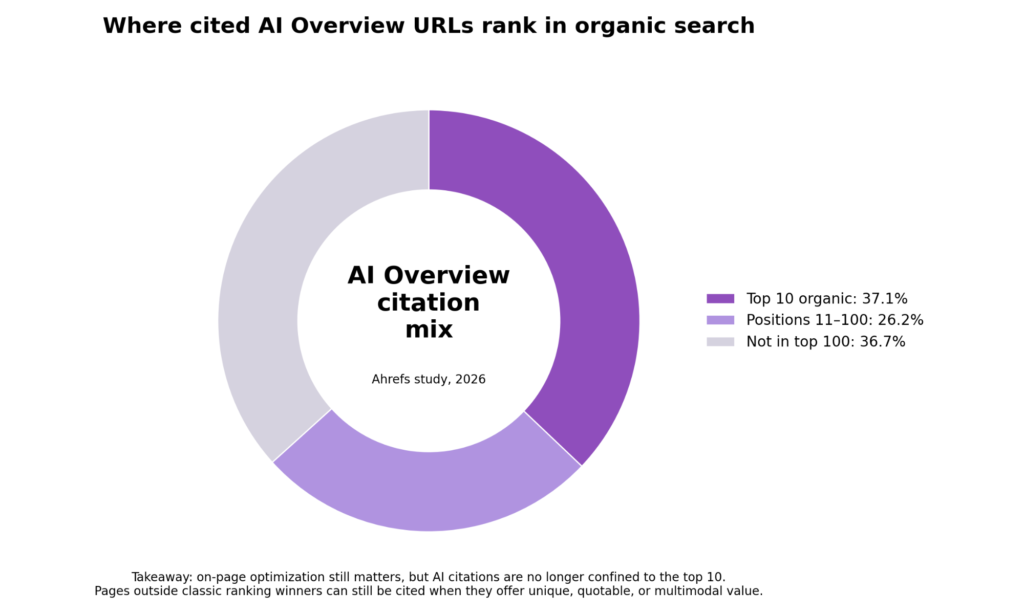
Ahrefs found that in its analysis of standard blue links:
- 37.1% of cited URLs ranked in the top 10,
- 26.2% ranked in positions 11–100,
- and 36.7% did not rank in the top 100 at all for the same query.
That does not mean rankings do not matter. It means this:
Great on-page SEO no longer stops at chasing position one. It includes making the page easy to quote, cite, reuse, and trust.
Step 1: Start with intent and business outcome, not just the keyword
The first mistake in on-page SEO is choosing a term before choosing the job the page has to do.
Ahrefs makes a useful point here: ranking for a keyword is meaningless if it does not help the business. Before you optimize a page, answer three questions:
1) What is the dominant search intent?
Most queries fall into one or more of these buckets:
- Informational: “what is on-page SEO”
- Commercial investigation: “best AI SEO tools”
- Navigational: “Semrush on page checker”
- Transactional: “buy SEO audit software”
- Comparative/problem-solving: “Surfer vs Clearscope” or “why pages lose rankings after AI Overviews”
Semrush’s 2025 AI Overviews study found that AI Overviews began heavily skewed toward informational queries, but gradually expanded into commercial, transactional, and navigational territory over the course of 2025. So intent mapping is more important now, not less.
2) What business action should this page create?
Every page should have a conversion role. Examples:
- newsletter signup,
- demo request,
- product trial,
- internal click to a service page,
- lead magnet download,
- assisted conversion via topical authority.
If a query has traffic but no business relevance, it may still be worth publishing for brand building or audience growth. But make that decision intentionally.
3) What is the current SERP model?
Before writing, inspect the live results and ask:
- Is there an AI Overview?
- Are there featured snippets?
- Do forum threads rank?
- Are videos or YouTube results present?
- Are listicles winning, or deep guides, or tools, or category pages?
The SERP tells you the format Google expects. Your page should respect that format while improving on it.
Step 2: Build a keyword and entity map
Google’s Search Essentials recommends using the words people would use to look for your content, and placing those words in prominent locations such as the title, main heading, alt text, and link text. That is still foundational.
But keyword optimization in 2026 should not be a single-keyword exercise. It should be a topic map.
For each page, define:
Primary keyword
The main query the page is designed to rank for.
Example:
interior designer for houses
Secondary keywords
Close variants and supporting subtopics.
Examples:
– Home furnishing tips
– Living room decor ideas
– New house painting
– interior design cost for house
Entities and concepts
The named things Google expects around the topic.
Examples:
– title tags
– H1
– meta description
– internal links
– structured data
– Core Web Vitals
– AI Overviews
– search intent
Questions to answer
These often become subheadings, FAQ blocks, or in-content definitions.
Examples:
– What is the cost of home furnishing?
– How much time it takes to furnish a home??
– How many days will a complete home makeover take?
– What is included in interior design?
The goal is not to cram all of these into the page. The goal is to use them to make the page comprehensive without becoming bloated.
Step 3: Align the URL, title tag, H1, and opening paragraph
Your page has a promise. That promise should be consistent across the URL, title tag, H1, and the first 100 words.
Google’s title-link guidance says every page should have a `<title>`, and that title should be descriptive, concise, distinct, and free of keyword stuffing or boilerplate repetition. It also notes that Google uses multiple sources when generating title links, including the main visual title and prominent heading text on the page.
URL best practices
Google recommends simple, descriptive URL structures that are understandable to humans.
Better:
`/home-furnishing-guide/`
Worse:
`/blog/post?id=8472&ref=cat23`
Use:
- short slugs,
- readable words,
- hyphens instead of awkward separators,
- language your audience uses.
If you have duplicate versions of the same content, use canonicalization correctly rather than letting Google guess unnecessarily.
Title tag best practices
A strong title tag typically does five things:
- includes the core topic,
- reflects search intent,
- stays concise,
- distinguishes the page from similar pages,
- gives users a reason to click.
Google does not impose a hard length limit on title elements, but search results truncate by device width. Backlinko’s large CTR study found titles between 40 and 60 characters performed best on average.
Weak title:
Interior Design
Better title:
Interior Design for Small Homes: A Step-by-Step Guide
H1 best practices
Your H1 is not the same as your title tag. The title tag is search packaging. The H1 is the visible page headline.
Semrush recommends that each page has one H1 that clearly describes the content. Google’s documentation also notes that the main title should be visually clear and distinct on the page.
Opening paragraph best practices
The best opening paragraphs do three things fast:
- confirm the page is about the user’s query,
- answer the question at a high level,
- tell the reader what they will get next.
In AI-era search, this matters even more because early clarity increases the chance your content will be interpreted correctly for snippets and summaries.
Step 4: Write meta descriptions for clicks, not for stuffing
Google says it may use your meta description when it believes that description gives users a more accurate summary than what it can extract directly from the page. It also says the meta description should inform and interest users and function like a pitch.
There is no hard character limit for meta descriptions, though snippets are truncated by device width. In practice, concise descriptions still work best.
A strong meta description should:
- summarize the page clearly,
- align with user intent,
- include the most relevant benefit,
- avoid sounding generic,
- remain unique to the page.
Weak example:
Learn about interior design, interior design tips, living room interior, kids rom interior, small home interior.
Better example:
Read this complete guide to interior design for small homes that talks about the planning, process and estimated costs involved to furnish a small home.
Semrush notes that clearer, more relevant descriptions reduce the likelihood of search engines rewriting them and give you more control over how the page appears in search results.
Step 5: Structure content so humans can skim and machines can parse it
Google’s SEO Starter Guide says useful content should be easy to read, well organized, broken into sections, and supported by headings that help users navigate the page. That is exactly what AI-ready content needs too.
What good content structure looks like
A strong long-form page usually follows this pattern:
- Clear intro
- Direct answer or summary
- Logical H2 sections
- H3 subpoints where needed
- Lists, tables, examples, and definitions
- Relevant media
- FAQ or objection handling
- Conclusion / next step
The heading myth you should ignore
Google explicitly says that while semantic heading order is great for accessibility, it does not matter to Google Search if headings are technically out of order, and there is no magical ideal number of headings.
That does _not_ mean heading structure does not matter. It means headings matter primarily for clarity, scannability, and content organization, not because there is some secret H2:H3 ratio that boosts rankings.
What to do instead
Use headings to mirror how a real expert would teach the topic:
- define the problem,
- explain the concepts,
- show the process,
- compare alternatives,
- answer objections,
- provide examples.
That structure helps readers, snippets, and AI summarization systems all at once.
Step 6: Optimize the body content for information gain, not just term coverage
“There is no magical minimum or maximum word count for ranking. Depth matters. Fluff does not.“
This is where AI-era on-page SEO really separates winners from commodity content.
Google says its systems prioritize helpful, reliable, people-first content rather than content produced primarily to manipulate rankings. In its AI search guidance, Google tells publishers to focus on unique, non-commodity content that is satisfying and valuable for users asking longer and more specific questions.
What “information gain” means in practice
Your page should add something beyond what already exists. That could be:
- original examples,
- firsthand experience,
- better synthesis,
- clearer frameworks,
- proprietary data,
- screenshots,
- visual models,
- expert commentary,
- decision criteria,
- updated facts.
If ten pages already explain what interior design is, your page needs to do more than define the term. It needs to explain how to do it better in an AI-shaped SERP environment.
Body content rules that still work
- Put the primary keyword naturally in the intro.
- Use close variants in subheads where helpful.
- Cover adjacent entities and questions.
- Cite external sources when making factual claims.
- Add examples that make abstract advice concrete.
- Remove filler transitions that exist only to inflate word count.
Google’s SEO Starter Guide also reminds us there is no magical minimum or maximum word count for ranking. Depth matters. Fluff does not.
AI-generated content: acceptable, but only if it adds value
Google’s guidance on generative AI content is nuanced: AI can be useful for research and structure, but using AI to create many pages without adding value may violate Google’s spam policies on scaled content abuse. It specifically says creators should focus on accuracy, quality, and relevance, including metadata and alt text.
So yes, AI can help you draft. But on-page SEO in the AI era still rewards what AI alone usually struggles to create:
- judgment,
- originality,
- examples,
- evidence,
- prioritization,
- and editorial taste.
Step 7: Make your internal linking strategic, crawlable, and descriptive
Internal linking is one of the most underused on-page levers.
Google says links help it find new pages and determine relevance, and that every page you care about should be linked from at least one other page on your site. It also says anchor text should be descriptive, concise, relevant, and placed in crawlable `<a href>` links.
Ahrefs goes further and calls internal links “super critical” because links help search engines discover pages, understand topical relationships, and distribute authority across the site.
What strong internal linking looks like
1) Use a top-down site structure
Ahrefs recommends a pyramid-like structure, and cites Google guidance that this top-down approach helps Google understand the context of pages within a site.
That usually means:
- homepage
- category/pillar pages
- cluster/supporting pages
- deeper examples or tools
2) Keep internal links contextual
The most valuable links are usually in the main content body, where they make sense to the reader.
3) Use descriptive anchor text
Google explicitly advises against generic anchors like “click here” and says good anchor text should make sense even out of context.
Weak anchor:
click here
Better anchor:
our guide to interior design for small homes
4) Link to pages that matter commercially
Use internal links to send attention and authority toward:
- service pages,
- product pages,
- category pages,
- high-conversion content,
- cornerstone guides.
5) Add breadcrumbs where appropriate
Breadcrumbs help users understand location, and Google can use breadcrumb markup in search results to better categorize a page.
Technical internal link rules
Google says links are most reliably crawlable when they are real `<a>` elements with `href` attributes. If your site relies heavily on JavaScript-based navigation, validate that links are actually rendered and crawlable.
A practical internal linking formula for blog content
For a new article:
- add 3–8 contextual links to relevant older pages,
- update 3–10 older relevant pages to link back to the new article,
- link from at least one high-authority page or pillar page,
- make sure the article is in breadcrumbs or category architecture if relevant.
Step 8: Optimize images, charts, and media as first-class SEO assets
Google’s image SEO documentation makes a point many sites still ignore: images can drive discovery through Google Search, Google Images, and Discover, and their landing-page context strongly influences where and how they appear.
In AI-era content, media does more than improve aesthetics. It can:
- help your page earn image visibility,
- reinforce key arguments,
- increase dwell and comprehension,
- make your page more citable,
- strengthen multimodal relevance.
Google’s AI search guidance explicitly recommends supporting textual content with high-quality images and videos for multimodal success.
Image optimization checklist
Google recommends:
- using standard HTML image elements rather than CSS background images for important images,
- placing images near relevant text,
- using descriptive filenames,
- writing useful alt text rather than stuffing keywords,
- choosing a relevant, representative preferred image in metadata or schema,
- and optimizing image speed and quality.
Example: bad vs. good alt text
Bad alt text:
`seo ai seo search seo marketing ranking content`
Better alt text:
`Workflow showing four stages of Interior Design: Ideate, Planning, Execution, Finishing`
Preferred image metadata matters too
Google says you can influence which image gets selected for previews by specifying a preferred image using metadata such as `og:image` or schema properties like `primaryImageOfPage`. For blog publishers, this is low-effort and high-leverage.
We created a checklist that helps you dominate Google and LLMs in 2026. The checklist has practical SEO tips that the top SEOs use daily. Get it for FREE.
Step 9: Use structured data to improve understanding and eligibility, not to game the SERP
Structured data is not a magic ranking booster. But it does help Google understand the page and can make pages eligible for richer search appearances.
Google says adding `Article` structured data to blog, news, and sports article pages can help it understand the page better and show better title text, images, and date information in search results. It also says structured data must match visible page content and follow its general guidelines to be eligible for rich results.
The most relevant schema types for content sites
For a typical content or SEO blog, the most useful types are often:
- `Article` / `BlogPosting`
- `BreadcrumbList`
- `FAQPage` (only when truly appropriate and eligible)
- `Organization`
- `Product` or `Review` for product-led or comparison content
- `VideoObject` when the page centers on a video
Example: simple Article schema
json
{
“@context”: “https://schema.org”,
“@type”: “BlogPosting”,
“headline”: “Interior Design for Small Homes: A Step-by-Step Guide”,
“author”: {
“@type”: “Person”,
“name”: “Your Author Name”
},
“datePublished”: “2026-04-21”,
“dateModified”: “2026-04-21”,
“image”: “https://example.com/images/interior-small-home-cover.png”,
“mainEntityOfPage”: “https://example.com/interior-small-homes-guide/”
}
Best practices for schema implementation
- Mark up what is actually visible.
- Use JSON-LD when possible; Google recommends it.
- Validate in Rich Results Test.
- Do not assume markup guarantees a rich result.
- Keep dates, authors, and images accurate and updated.
Step 10: Improve page experience, because great content still needs a usable surface
Google says Core Web Vitals measure real-world loading performance, interactivity, and visual stability, and strongly recommends site owners achieve good Core Web Vitals for success in Search and for a better user experience generally.
It also makes an important nuance clear: relevance still matters most, but page experience can contribute to success when many pages offer similar helpful content.
What this means for on-page SEO
Page experience is rarely the reason a bad page becomes great. But it is often the reason two similarly good pages do not perform equally.
Focus on:
- fast-loading above-the-fold content,
- stable layouts,
- responsive design,
- obvious main content,
- restrained ads and popups,
- mobile readability,
- compressed and responsive images.
Google’s AI-search guidance also says even the best content can disappoint users if the page is cluttered, difficult to navigate, or slow.
Core page experience fixes with outsized impact
- compress hero images,
- lazy-load non-critical media,
- reduce layout shift from ads and embeds,
- improve font rendering,
- simplify mobile templates,
- cut intrusive popups,
- move irrelevant elements farther below the fold.
Step 11: Add trust signals that make the page believable to humans and systems
This is one of the most overlooked on-page factors in AI-era SEO.
Google’s SEO Starter Guide says E-E-A-T is not itself a ranking factor, which is an important correction to common SEO folklore. But it also repeatedly emphasizes helpful, reliable, people-first content and expert or experienced sourcing.
So the practical question is not “How do I optimize for E-E-A-T as a score?”
It is: How do I make the page obviously trustworthy?
On-page trust signals that matter
- real author names,
- author bios with relevant expertise,
- published and updated dates,
- citations to credible sources,
- original visuals or data,
- editorial standards or review methodology,
- About / Contact / policy pages,
- clear brand identity,
- external references when claims need corroboration.
Google also says linking out to other sites can help establish trustworthiness when it makes sense, especially when you are citing sources.
Trust is especially important in AI-mode reading
AI systems often summarize and synthesize. When your page looks vague, anonymous, or generic, it becomes less useful as a source. When it looks specific, attributable, and well-supported, it becomes easier to cite.
Step 12: Refresh, consolidate, and improve pages after publishing
On-page SEO is not a one-time activity. It is a maintenance discipline.
Google’s Starter Guide recommends checking previously published content and updating or deleting it if it is no longer relevant. That advice matters even more now because content decay affects both rankings and AI visibility.
Ahrefs has also shown how republishing and refreshing strong content can materially improve performance; one of its examples showed traffic tripling after a major rewrite and republish.
What to monitor after publishing
Use Search Console and analytics to watch:
- impressions,
- clicks,
- CTR,
- average position,
- query drift,
- pages gaining impressions but low CTR,
- pages losing clicks but holding impressions,
- pages with growing long-tail discovery,
- pages attracting the wrong intent.
Content refresh triggers
Refresh a page when:
- stats are outdated,
- search intent shifts,
- competitors add better examples,
- AI Overviews begin appearing for the target query,
- your CTR drops,
- the page earns impressions for adjacent questions you have not answered yet,
- internal linking has not been updated in months.
What a good refresh often includes
- stronger title and snippet copy,
- a sharper introduction,
- new sections for emerging subtopics,
- updated facts and screenshots,
- more internal links,
- better examples,
- original charts or tables,
- improved schema and media.
The complete AI-era on-page SEO workflow
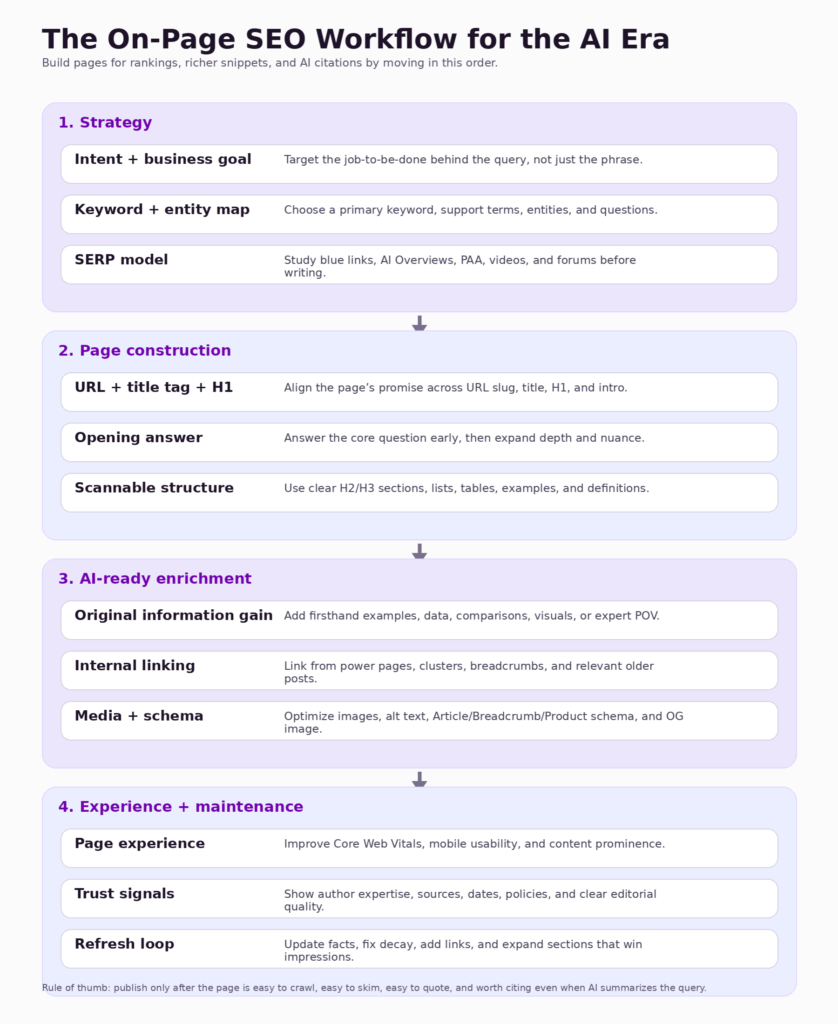
Use this sequence:
- Intent + business goal
- Keyword + entity map
- SERP model analysis
- URL + title + H1 alignment
- Direct opening answer
- Scannable structure
- Original information gain
- Internal linking
- Media + schema
- Page experience
- Trust signals
- Refresh loop
That is the modern on-page stack.
Common on-page SEO mistakes in the AI era
Even strong teams still make these errors.
1) Writing for the keyword instead of the job-to-be-done
This creates pages that rank weakly, convert poorly, and feel generic.
2) Publishing AI-assisted content with no original layer
Google allows AI use, but thin scaled pages without added value are risky and weak.
3) Using vague titles and templated descriptions
Google may rewrite them, and users will not click them.
4) Treating internal linking as an afterthought
Important pages become orphaned or underpowered.
5) Stuffing alt text and anchor text
Google explicitly discourages keyword stuffing in both contexts.
6) Adding schema that does not match visible content
That can make pages ineligible for rich results and can create quality issues.
7) Ignoring page experience because “content is what matters”
Content matters most, but poor UX still wastes strong content.
8) Never updating old winners
Search surfaces change. Queries evolve. Your best pages need active maintenance.
A publish-ready on-page SEO checklist
Use this before you hit publish.
Strategy
- The target query has a clear intent
- The page has a defined business role
- The SERP format has been reviewed
Keyword targeting
- One primary keyword is mapped
- Secondary keywords and entities are identified
- Key questions are built into the outline
Metadata and URL
- URL is short, readable, and descriptive
- Title tag is clear, specific, and compelling
- H1 matches the page promise
- Meta description is unique and click-worthy
Content structure
- The page answers the main question early
- H2/H3 sections follow a logical flow
- Lists, tables, examples, and definitions improve scanability
- There is no filler written only to increase word count
Body optimization
- The page includes original information gain
- Facts are sourced where necessary
- The copy reads naturally
- Search intent is satisfied better than the current average result
Internal linking
- The page links to relevant internal resources
- Older pages have been updated to link back
- Anchor text is descriptive
- The page is reachable through crawlable links
Media and schema
- Images use descriptive filenames and alt text
- Preferred image metadata is set
- Relevant schema is added and validated
- Schema matches visible content
Experience and trust
- Mobile UX is clean
- Core content is prominent above the fold
- Author, date, and source signals are visible
- Page speed issues are checked
Maintenance
- Search Console monitoring is in place
- Refresh criteria are defined
- Duplicate or overlapping pages are accounted for
Final takeaway
The AI era did not kill on-page SEO. It exposed lazy on-page SEO.
Pages that still win are the ones that do the fundamentals exceptionally well:
- they target real intent,
- explain the topic clearly,
- package themselves well in search,
- offer original value,
- connect intelligently across the site,
- and earn trust on the page itself.
That is what Google’s guidance points to.
That is what the best industry studies are showing.
And that is why on-page SEO is still the highest-leverage place to start.
If you want a single rule to remember, make it this:
> Publish pages that are easy to crawl, easy to skim, easy to trust, and worth citing even when AI answers the question first.
That is on-page SEO for the AI era.