👋
Blog Post
Best AI-Powered Keyword Research Tools in 2026
The best AI-powered keyword research tools in 2026, including Ahrefs, Semrush, Surfer SEO, SE Ranking, Moz, and Keyword Insights, with pricing, features, accuracy, and use cases.
Share

Best AI-Powered Keyword Research Tools in 2026
Quick Verdict
The best AI-powered keyword research tool depends on what you are trying to solve:
| Best For | Recommended Tool | Why |
|---|---|---|
Deep keyword data, competitor research, backlink-led SEO |
Ahrefs |
Huge keyword database, strong click/traffic metrics, AI suggestions, clusters, intent, and Brand Radar |
All-in-one SEO + AI visibility reporting |
Semrush |
Keyword Magic Tool, Keyword Strategy Builder, AI Visibility Toolkit, and Semrush One |
Turning keyword research into optimized content |
Surfer SEO |
Content Editor, Topical Map, AI visibility tracking, SERP-based content guidance |
Agency workflows and value-for-money SEO + GEO |
SE Ranking |
Traditional SEO, AI search tracking, prompt tracking, reports, and client-friendly pricing |
SERP-based clustering and topical authority planning |
Keyword Insights |
Live SERP clustering, content briefs, AI writing workflow, competitor visibility |
Beginner-friendly keyword research and classic SEO metrics |
Moz Pro |
Keyword Explorer, Priority Score, simpler UI, strong learning ecosystem |
The core takeaway: AI keyword research is no longer just about finding high-volume keywords. The winning tools now help you understand search intent, topical clusters, content gaps, competitor visibility, and whether your brand appears in AI-generated answers.
Read also: Top AI Tools for SEO 2026
Why AI Keyword Research Matters More in 2026
“the best AI keyword research tools in 2026 are not merely keyword generators.”
Keyword research used to be a spreadsheet exercise: find search volume, check keyword difficulty, group terms, write content, and track rankings. That workflow is not dead, but it is incomplete.
Google now says AI Overviews and AI Mode are part of how people explore complex queries, and that the same SEO fundamentals still apply for appearing in these AI features. Google also notes that AI features may use “query fan-out,” where related searches across subtopics and data sources help generate answers. That means modern keyword research must cover not only one keyword, but the surrounding intent, entities, subtopics, related questions, and evidence sources that search systems may use.
At the same time, Google’s guidance on AI-generated content is clear: generative AI can help with research and structure, but scaled AI pages without added value can violate spam policies. Google recommends focusing on accuracy, quality, relevance, and helpfulness, especially when automation is involved.
So the best AI keyword research tools in 2026 are not merely “keyword generators.” They help you answer five strategic questions:
- What is the real search demand?
- What intent does the user have?
- Which topics should be grouped into one page vs separate pages?
- Which competitors already own the SERP or AI answer?
- Which content should we create, update, consolidate, or avoid?
The New AI Keyword Research Workflow
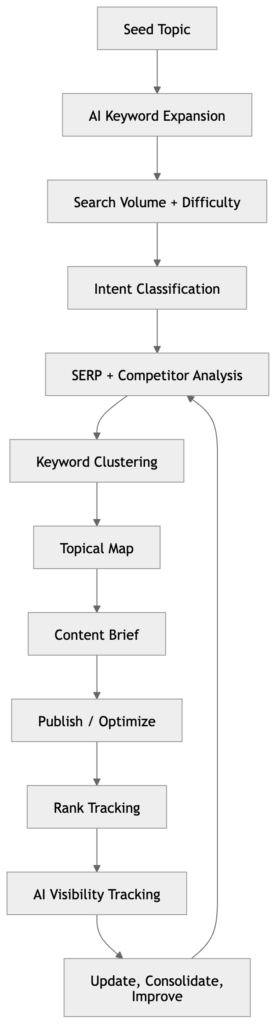
The loop matters. A keyword list is only useful when it becomes a content system: clusters, briefs, pages, internal links, refresh cycles, and measurement.
How We Evaluated the Tools
This review uses public product documentation, current pricing pages, official help pages, and reputable SEO industry reviews. It is not a laboratory benchmark where each tool was tested against the same private keyword set. For “accuracy,” the article uses a practical SEO definition: how useful and directionally reliable the tool is for estimating demand, intent, competition, clustering, and content opportunity.
That distinction matters because no keyword database is perfectly accurate. Ahrefs itself says keyword volume should be treated as directionally accurate, not exact, and its own help documentation says Ahrefs’ search volume estimates were “roughly accurate” for 60% of studied keywords compared with Google Search Console impressions, while Google Keyword Planner was roughly accurate in 45% of cases.
Google Search Console remains the closest thing to first-party organic search performance data for your own site because its Performance report shows clicks, impressions, CTR, average position, and queries bringing visibility to your pages.
Feature Comparison: Best AI Keyword Research Tools
| Tool | Best Use Case | AI/Automation Strength | Keyword Data Strength | Pricing Snapshot |
|---|---|---|---|---|
Ahrefs |
Advanced SEO, competitor research, backlink-led content strategy |
AI keyword suggestions, keyword clusters, search intents, Brand Radar |
Very strong: Keywords Explorer shows 28.7B filtered keywords |
Starter $29/mo; Lite $129/mo; Standard $249/mo; Advanced $449/mo; Enterprise $1,499/mo |
Semrush |
Full-stack SEO, PPC, content, competitor, AI visibility |
AI-powered personalized keyword metrics, Keyword Strategy Builder, AI Visibility Toolkit |
Very strong: Keyword Magic Tool lists 27.8B keywords and 142 geo databases |
SEO Toolkit: $139.95–$499.95/mo; Semrush One: $199–$549/mo |
Surfer SEO |
Content optimization, topical maps, AI search content workflows |
Surfy, Content Editor, Topical Map, AI Tracker |
Strong for content planning; weaker than Ahrefs/Semrush for raw keyword database depth |
Discovery $49/mo; Standard $99/mo; Pro $182/mo; Peace of Mind $299/mo; Enterprise $999/mo |
SE Ranking |
Agencies needing SEO + GEO at controlled cost |
AI search toolkit, AI Overviews, AI Mode, ChatGPT, Gemini, Perplexity tracking |
Strong all-in-one keyword and competitor workflow |
Core $129/mo; Growth $279/mo; annual equivalent $103.20 and $223.20/mo |
Keyword Insights |
SERP-based clustering, topical authority, content briefs |
SERP clustering, NLP topic relationships, briefs, AI writer |
Excellent for clustering uploaded/discovered keyword sets |
Basic $58/mo; Professional $99/mo; Enterprise custom |
Moz Pro |
Beginners, SMBs, classic keyword research |
Moz AI suite, semantic insights, Brand Authority Score |
Good, but less advanced than Ahrefs/Semrush for enterprise keyword workflows |
Starter around $49/mo; Standard $99/mo; Medium $179/mo; Large $299/mo |
Keyword Database Scale
Publicly stated keyword database size:
- Ahrefs Keywords Explorer: 28.7B
- Semrush Keyword Magic Tool: 27.8B
Ahrefs says Keywords Explorer includes 28.7B filtered keywords from 110B discovered in total, including 2.5B keywords in the U.S. alone. Semrush says Keyword Magic Tool uses a database of 27.8B keywords, supports 142 geo databases, and can generate up to 20M ideas for a single keyword.
Starting Price Comparison
Lowest practical paid entry point, monthly billing or listed monthly equivalent
| Tool | Starting Price |
|---|---|
Ahrefs Starter |
$29 |
Surfer Discovery |
$49 |
Moz Pro Starter |
$49 |
Keyword Insights |
$58 |
SE Ranking Core |
$129 |
Ahrefs Lite |
$129 |
Semrush SEO Toolkit |
$139.95 |
Semrush One |
$199 |
Pricing changes frequently, and several platforms discount annual billing. For example, Semrush lists SEO Toolkit monthly prices of Pro at $139.95, Guru at $249.95, and Business at $499.95, while Semrush One starts at $199/mo monthly. Ahrefs lists Starter at $29/mo, Lite at $129/mo, Standard at $249/mo, Advanced at $449/mo, and Enterprise at $1,499/mo. Surfer’s official pricing page lists Discovery at $49/mo, Standard at $99/mo, Pro at $182/mo, Peace of Mind at $299/mo, and Enterprise at $999/mo.
Ahrefs Review: Best for Serious SEO Data, Competitor Research, and Traffic Potential
Overview
Ahrefs is one of the strongest AI-powered keyword research platforms for SEO professionals who want more than simple search volume. Its Keywords Explorer helps users generate keyword ideas, analyze volume and difficulty, identify search intent, review SERPs, and cluster related terms. Ahrefs says Keywords Explorer can generate thousands of keyword ideas, cluster them instantly, and help users pick keywords using reliable metrics.
Ahrefs is especially valuable when your keyword research depends on competitor analysis. Instead of starting only with seed keywords, you can reverse-engineer competitor pages, find keywords they rank for, identify pages getting traffic, and uncover gaps in your own topical coverage.
Key AI and Keyword Research Features
Ahrefs now includes several AI-enhanced features inside keyword workflows, including AI suggestions, keyword clusters, search intents, translations, and SERP updates. These features appear in Ahrefs’ pricing feature breakdown under Keywords Explorer.
Its biggest strength remains data depth. Ahrefs says its Keywords Explorer uses 28.7B filtered keywords from 110B discovered keywords, covering 217 locations. It also describes its broader infrastructure as powered by large-scale web data, including 19B content pages, 35T live backlinks, and 28.7B filtered keywords.
Ahrefs also offers Brand Radar AI, which researches brands across 271M+ organic prompts and tracks custom prompts. This is important because SEO teams are now being asked not only “Are we ranking?” but also “Are we mentioned in AI answers?”
Pricing
Ahrefs’ core plans are:
| Plan | Monthly Price | Best For |
|---|---|---|
Starter |
$29/mo |
Small projects, basic competitive spying |
Lite |
$129/mo |
Small businesses and personal projects |
Standard |
$249/mo |
Freelance SEOs and consultants |
Advanced |
$449/mo |
In-house teams and heavier workflows |
Enterprise |
$1,499/mo |
Large teams, API, security, high limits |
Ahrefs’ pricing page lists Lite, Standard, Advanced, and Enterprise at $129, $249, $449, and $1,499 per month, and also lists a Starter plan at $29 per month.
Accuracy and Data Quality
Ahrefs is one of the few platforms that openly discusses the limitations of keyword volume. Its help center says Ahrefs uses Google Keyword Planner, Google Trends, and third-party sources to estimate monthly search volumes. It also states that its search volume estimates were roughly accurate for 60% of studied keywords compared with Google Search Console impressions.
That does not mean Ahrefs is “perfect.” It means Ahrefs is useful for relative prioritization: comparing one keyword opportunity against another, estimating traffic potential, and understanding whether a topic is worth targeting.
Pros
- Excellent keyword database depth.
- Strong competitor keyword research.
- Useful click and traffic potential metrics.
- Helpful AI suggestions and clustering.
- Strong backlink and authority analysis.
- Good for content gap analysis and topical expansion.
- Brand Radar adds AI search visibility use cases.
Cons
- Premium pricing can be heavy for small businesses.
- Some limits, credits, and add-ons require careful reading.
- Not primarily a content editor like Surfer.
- Search volume is still an estimate, not first-party truth.
Best Ahrefs Workflow
- Enter a seed keyword in Keywords Explorer.
- Review matching terms, questions, related terms, and competitor keywords.
- Filter by intent, keyword difficulty, clicks, and traffic potential.
- Cluster related keywords.
- Check top-ranking pages and backlink profiles.
- Build a content brief based on SERP patterns and missing angles.
- Track rankings and compare actual Google Search Console performance.
Verdict
Ahrefs is the best choice for advanced SEO teams that care about data depth, competitor analysis, backlinks, and traffic potential. It is less ideal if your main need is AI writing or content scoring, but it is one of the strongest platforms for deciding what to target and why.
Read also: SEO Metrics to Track in 2026
Semrush Review: Best All-in-One AI Keyword Research and Visibility Platform
Overview
Semrush is the most complete all-in-one platform in this comparison. Its Keyword Magic Tool is built for large-scale keyword discovery, PPC and SEO planning, intent analysis, and keyword grouping. Semrush says Keyword Magic Tool uses a database of more than 27B keywords and helps users find ranking opportunities with AI-powered personalized metrics.
A major current update: Semrush is now an Adobe company. Adobe announced on April 28, 2026 that it completed its acquisition of Semrush, positioning the combined portfolio around SEO, generative engine optimization, and agentic search optimization. Adobe also said AI traffic to U.S. retail sites increased 269% year over year in March 2026, reinforcing why brand visibility in AI interfaces is becoming a board-level marketing topic.
Key AI and Keyword Research Features
Semrush Keyword Magic Tool is still one of the strongest tools for keyword expansion. It supports keyword groups, search volume, keyword difficulty, CPC, competitive density, intent, and export workflows. Semrush states that the Keyword Magic Tool uses 27.8B keywords, can provide 20M ideas for a single keyword, and includes 142 geo databases.
Semrush’s newer advantage is its AI Visibility Toolkit. The toolkit helps benchmark AI visibility, analyze brand sentiment, discover prompts, track daily AI visibility, audit technical blockers for AI crawlers, and identify competitive gaps. Semrush describes Prompt Research as “keyword research for AI,” with topic-level volume, difficulty, and user intent.
Semrush One bundles traditional SEO with AI visibility. Semrush says Semrush One includes full SEO Toolkit access plus AI visibility tracking across Google AI Overviews, ChatGPT, Gemini, Perplexity, and other AI-powered discovery surfaces.
Pricing
Semrush now has two relevant pricing tracks:
Semrush SEO Toolkit
| Plan | Monthly Price |
|---|---|
Pro |
$139.95/mo |
Guru |
$249.95/mo |
Business |
$499.95/mo |
Semrush One
| Plan | Monthly Price |
|---|---|
Starter |
$199/mo |
Pro+ |
$299/mo |
Advanced |
$549/mo |
Semrush’s own comparison page lists SEO Toolkit Pro, Guru, and Business at $139.95, $249.95, and $499.95 per month. The same page lists Semrush One Starter, Pro+, and Advanced at $199, $299, and $549 per month.
The standalone AI Visibility Toolkit is listed at $99 per month and includes one folder, one domain for Brand Performance analysis, 300 daily AI Analysis queries, 1,000 daily Prompt Research queries, 25 prompt tracking prompts, and AI Search Checks in Site Audit for up to 100 pages.
Accuracy and Data Quality
Semrush is strong for breadth: keyword expansion, PPC data, competitor gap analysis, content planning, and international research. Its advantage is not just raw keyword volume, but the way keyword data connects to other workflows: competitor research, backlink data, site audit, topic planning, content templates, and now AI visibility.
For agencies and in-house teams, Semrush is often easier to justify when multiple departments need the same platform: SEO, content, PPC, social, competitive intelligence, and reporting.
Pros
- Excellent all-in-one SEO toolkit.
- Massive keyword database.
- Strong keyword grouping and filtering.
- Useful for PPC + SEO alignment.
- AI Visibility Toolkit is a major advantage for 2026.
- Semrush One connects classic SEO and AI visibility.
- Strong agency reporting and client presentation workflows.
Cons
- More expensive when adding users, domains, or AI visibility seats.
- Can feel overwhelming for beginners.
- Keyword data is still directional.
- Some AI visibility features may require separate subscriptions or upgraded plans.
Best Semrush Workflow
- Use Keyword Magic Tool for seed expansion.
- Filter by intent, KD, CPC, volume, and SERP features.
- Use Keyword Strategy Builder to turn terms into content plans.
- Run Keyword Gap against competitors.
- Create SEO content briefs or templates.
- Track rankings in Position Tracking.
- Add AI Visibility Toolkit or Semrush One to monitor prompts, mentions, sentiment, and AI citations.
Verdict
Semrush is the best choice for teams that want one platform for keyword research, competitor analysis, content planning, PPC intelligence, technical SEO, and AI visibility. After Adobe’s acquisition, Semrush is likely to become even more central to enterprise brand visibility workflows.
Surfer SEO Review: Best for Turning Keywords Into Optimized Content
Overview
Surfer SEO is not the same kind of tool as Ahrefs or Semrush. It is less about owning the largest keyword database and more about helping you turn keywords into content that can rank. Surfer’s strength is the bridge between keyword research, SERP analysis, topical mapping, content optimization, and AI visibility.
Surfer describes its Keyword Research tool as a core tool for building and organizing content strategy by discovering relevant, traffic-generating keywords based on competitor data.
Key AI and Keyword Research Features
Surfer’s most important keyword-related features include:
- Keyword Research
- Topical Map
- Content Editor
- SERP Analyzer
- Content Audit
- AI SEO Optimization
- Surfy AI assistant
- AI Tracker for AI visibility
Topical Map is particularly useful for planning clusters. Surfer says Topical Map helps research and plan content clusters designed to increase topical authority and improve the chances of being cited and mentioned. It also says AI Tracker helps track visibility score, mention gaps, competitor share of voice, and more.
Surfer’s pricing page also shows AI visibility tracking across ChatGPT, Perplexity, Google AI Mode, Google AI Overview, and Google Gemini.
Pricing
| Plan | Monthly Price | Notes |
|---|---|---|
Discovery |
$49/mo |
Entry plan for drafting and optimization |
Standard |
$99/mo |
Includes AI visibility tracking and 25 AI prompts refreshed weekly |
Pro |
$182/mo |
More AI prompts and brand workspaces |
Peace of Mind |
$299/mo |
Unlimited documents and higher limits |
Enterprise |
$999/mo |
Tailored packages and enterprise controls |
Surfer lists Discovery at $49/mo, Standard at $99/mo, Pro at $182/mo, Peace of Mind at $299/mo, and Enterprise at $999/mo. It also lists document limits, AI prompt tracking limits, AI visibility features, brand workspaces, integrations, internal linking, cannibalization reports, and SERP analysis across higher tiers.
Accuracy and Data Quality
Surfer’s “accuracy” is strongest at the content and SERP level. It helps answer questions like:
- What do top-ranking pages cover?
- What headings, terms, entities, and subtopics appear across competitors?
- Is the page under-optimized or over-optimized?
- Which related topics should support the main page?
- Are there content gaps or cannibalization issues?
It is not the best standalone tool for raw keyword database research. For many teams, the ideal workflow is Ahrefs or Semrush for discovery + Surfer for content optimization.
Pros
- Excellent content optimization workflow.
- Strong SERP-based recommendations.
- Good for topical authority planning.
- AI visibility tracking is increasingly useful.
- Helpful for content teams, writers, and editors.
- Integrates keyword research with briefs and optimization.
Cons
- Not the deepest keyword database.
- Can encourage SERP imitation if editors do not add original insight.
- Pricing can rise quickly for larger content teams.
- Needs human strategy to avoid generic AI-assisted content.
Best Surfer Workflow
- Use Keyword Research or Topical Map to identify clusters.
- Select a primary keyword and supporting terms.
- Analyze top-ranking SERP competitors.
- Build or generate a content brief.
- Write in Content Editor.
- Optimize content score without keyword stuffing.
- Track ranking drops, content gaps, and AI visibility.
Verdict
Surfer SEO is the best choice for content teams that already know what topics they want to target and need to produce optimized pages faster. It is not a replacement for Ahrefs or Semrush, but it is one of the best companions for turning keyword research into publishable content.
SE Ranking Review: Best Value for Agencies Combining SEO and GEO
Overview
SE Ranking has evolved into a strong all-in-one SEO and AI visibility platform. It is especially attractive for agencies because it combines keyword research, rank tracking, competitor analysis, backlink research, website audits, reporting, content marketing, AI search tools, and white-label agency features at a price that can be easier to manage than Semrush or Ahrefs.
SE Ranking’s product navigation highlights both traditional SEO tools and AI Search tools, including AI Overviews Tracker, AI Mode Tracker, ChatGPT Tracker, Gemini Tracker, Perplexity Tracker, SERP Tracker, Keyword Grouper, and SEO Dashboard.
Key AI and Keyword Research Features
SE Ranking’s Core plan includes rank tracking across major search engines, unlimited keyword, competitor, and backlink research, website and on-page audits, and integrations with Looker Studio, Matomo, GA, and Google Search Console.
Its pricing page also lists GEO-related limits, including daily prompts, LLMs to track, AI sources tracking, AI competitive research, and reports. The AI Search add-on tracks and analyzes brand visibility across AI platforms and includes AI Results Tracker for AI Overviews, AI Mode, Perplexity, and ChatGPT.
Pricing
| Plan | Monthly Price | Annual Equivalent |
|---|---|---|
Core |
$129/mo |
$103.20/mo |
Growth |
$279/mo |
$223.20/mo |
Enterprise |
Custom |
Custom |
SE Ranking lists Core at $129/mo and Growth at $279/mo, with annual equivalents of $103.20/mo and $223.20/mo. The Core plan includes 10 projects, one manager seat, 2,000 tracked keywords, 100 prompts tracked daily, and 250,000 audit pages per month. Growth includes 30 projects, three manager seats, 5,000 tracked keywords, 250 daily prompts, and 2M audit pages per month.
Accuracy and Data Quality
SE Ranking’s strongest use case is operational SEO: tracking, reporting, competitor monitoring, audits, and client management. It may not be as dominant as Ahrefs for backlink intelligence or Semrush for total marketing breadth, but it offers a compelling middle ground for agencies that need a reliable SEO platform with AI visibility features.
Pros
- Strong value for agencies.
- Traditional SEO and AI search workflows in one platform.
- Good rank tracking and reporting.
- White-label and agency add-ons.
- AI Search add-on covers emerging visibility needs.
- Useful for multi-client workflows.
Cons
- Less iconic than Ahrefs/Semrush for enterprise SEO data.
- AI Search add-on increases total cost.
- Some workflows may require add-ons.
- Advanced users may still prefer Ahrefs for backlink-heavy research.
Verdict
SE Ranking is the best value option for agencies that need keyword research, rank tracking, site audits, reporting, and AI search visibility without paying top-tier enterprise prices.
Keyword Insights Review: Best for SERP-Based Keyword Clustering Overview
Keyword Insights is built for a specific but very important SEO job: turning messy keyword lists into clusters, briefs, and content plans. It is especially useful when you already have keyword exports from Ahrefs, Semrush, Google Search Console, Google Keyword Planner, or client data.
Keyword Insights says its clustering tool uses live, country-specific SERP data and groups keywords based on similar ranking URLs. It also explains that keyword clusters help determine whether related terms should be targeted on the same page or split into separate content pieces.
Key AI and Keyword Research Features
Keyword Insights offers:
- Keyword discovery
- SERP-based clustering
- Content briefs
- Search intent context
- AI writing assistant
- AI writing agent
- Competitor visibility
- Topical relationship analysis
The most valuable feature is its SERP-based clustering. Keyword Insights says it analyzes Google search results rather than clustering keywords purely with NLP. It checks the top 10 results and, by default, determines a cluster when keywords share 30% or more URLs in common, although users can adjust this overlap.
This is powerful because it answers one of the most expensive SEO questions: Do these keywords need one page or multiple pages?
Pricing
| Plan | Monthly Price | Credits |
|---|---|---|
Basic |
$58/mo |
10,000 credits |
Professional |
$99/mo |
20,000 credits |
Enterprise |
Custom |
Custom |
Keyword Insights lists Basic at $58/mo with 10,000 credits and Professional at $99/mo with 20,000 credits. It also offers a $1 trial for seven days with 5,000 one-time credits.
Accuracy and Data Quality
Keyword Insights is less about search volume accuracy and more about SERP interpretation accuracy. Its clustering method is valuable because it uses what Google is actually ranking, not just semantic similarity. That helps avoid two common SEO mistakes:
- Creating five pages when one page would rank for all related terms.
- Creating one broad page when Google expects separate pages for each intent.
Pros
- Excellent for keyword clustering.
- Helps avoid cannibalization.
- Great for topical authority roadmaps.
- Useful for content briefs and production planning.
- SERP-based clustering is more practical than pure NLP grouping.
- Affordable compared with enterprise platforms.
Cons
- Not a full SEO suite.
- Works best when paired with another keyword source.
- Credit system requires planning.
- Less useful for backlink analysis, technical SEO, and rank tracking.
Verdict
Keyword Insights is the best specialist tool for clustering keywords and building topic maps. It is ideal for SEO teams that already use Ahrefs, Semrush, or Search Console but need a better way to organize content strategy.
Moz Pro Review: Best Beginner-Friendly Classic SEO Platform
Overview
Moz Pro remains a respected SEO platform for keyword research, link analysis, rank tracking, and site audits. It is not as aggressive as Semrush or Ahrefs in AI visibility positioning, but it is useful for teams that want a simpler, more educational SEO workflow.
Recent SEO tool reviews describe Moz Pro as a comprehensive SEO platform with keyword research, site audits, backlink analysis, rank tracking, page optimization, and AI-driven insights under the Moz AI suite. TechRadar also lists Moz Pro pricing from around $49/mo for Starter to $299/mo for Large on monthly billing, with lower annual equivalents.
Key Features
Moz Pro is best known for:
- Keyword Explorer
- Keyword difficulty
- Priority Score
- Domain Authority
- Page Authority
- Link Explorer
- Rank tracking
- Site crawl
- On-page optimization
Moz’s strength is accessibility. It is easier for beginners to understand than Semrush, and it has a long-standing educational ecosystem.
Pricing
| Plan | Monthly Price |
|---|---|
Starter |
Around $49/mo |
Standard |
Around $99/mo |
Medium |
Around $179/mo |
Large |
Around $299/mo |
These figures are based on recent SEO tool pricing summaries, since Moz’s current pricing page was not as easily extractable in public search results during research. Pricing should be verified before purchase.
Pros
- Beginner-friendly interface.
- Strong SEO education and community.
- Useful keyword prioritization.
- Good link metrics for classic SEO.
- Less overwhelming than Semrush.
Cons
- Less advanced for AI visibility.
- Smaller enterprise workflow than Semrush/Ahrefs.
- Not the best choice for high-volume content operations.
- Advanced SEOs may outgrow it.
Verdict
Moz Pro is best for beginners, SMBs, and teams that want reliable classic SEO workflows without the complexity of Semrush or the data-heavy feel of Ahrefs.
We created a checklist that helps you dominate Google and LLMs in 2026. The checklist has practical SEO tips that the top SEOs use daily. Get it for FREE.
Google Keyword Planner + Search Console: The Free Control Layer
“Every SEO team should use Google Search Console as the truth layer for their own site and use paid AI keyword tools for competitive discovery, clustering, and strategy.”
Overview
Google Keyword Planner and Google Search Console are not AI-powered keyword research suites, but they are essential validation tools.
Google Keyword Planner lets users discover new keywords or upload existing keywords to get search volume and forecasts. Google’s help documentation says users can start with keywords or a website to discover keyword ideas.
Google Search Console shows how your own site performs in Google Search, including clicks, impressions, CTR, average position, and queries.
Why They Matter
Paid tools estimate the market. Search Console shows your actual visibility. Keyword Planner shows advertising-oriented search demand. Together, they help you prevent expensive mistakes.
Use them to validate:
- Is the topic getting impressions?
- Are rankings improving?
- Is CTR weak despite visibility?
- Are AI tools suggesting keywords that your audience actually searches?
- Are branded, non-branded, commercial, and informational queries behaving differently?
Verdict
Every SEO team should use Google Search Console as the truth layer for their own site and use paid AI keyword tools for competitive discovery, clustering, and strategy.
Accuracy: Which Tool Has the Most Reliable Keyword Data?
No tool has perfectly accurate keyword volume. The most honest answer is:
- Best for directional search demand: Ahrefs and Semrush.
- Best for competitor keyword discovery: Ahrefs and Semrush.
- Best for SERP-based clustering accuracy: Keyword Insights.
- Best for content optimization accuracy: Surfer SEO.
- Best for rank tracking/reporting operations: SE Ranking.
- Best for first-party actual site performance: Google Search Console.
Ahrefs’ own explanation is useful for the entire industry: search volume, keyword difficulty, and traffic potential are not exact; they are meant to be directionally accurate.
Most useful data source by SEO decision
| Accuracy of | Tool |
|---|---|
Actual site performance |
Google Search Console |
Market demand estimate |
Ahrefs/Semrush/Keyword Planner |
Competitor keyword discovery |
Ahrefs/Semrush/SE Ranking |
SERP intent clustering |
Keyword Insights/Surfer/Semrush/Ahrefs |
Content optimization |
Surfer SEO |
AI answer visibility |
Semrush One/SE Ranking AI Search/Surfer AI Tracker/Ahrefs Brand Radar |
The best SEO teams do not ask, “Which tool is 100% accurate?” They ask, “Which tool is accurate enough for this decision, and how do we validate it?”
Pricing Comparison: Which Tool Offers the Best Value?
| Budget Level | Recommended Stack |
|---|---|
Free/Starter |
Google Search Console + Google Keyword Planner + Ahrefs Starter or free tools |
Small business |
Ahrefs Lite or SE Ranking Core + Surfer Discovery/Standard |
Content team |
Semrush SEO Toolkit or Ahrefs Standard + Surfer Pro |
SEO agency |
Semrush One, SE Ranking Growth, or Ahrefs Advanced depending on workflow |
Topical authority team |
Ahrefs/Semrush + Keyword Insights + Surfer |
Enterprise brand visibility |
Semrush One Advanced/Enterprise, Ahrefs Enterprise, SE Ranking Enterprise, plus AI visibility tools |
For small businesses, the biggest mistake is buying the most expensive platform without a publishing process. For agencies, the biggest mistake is using cheap tools that cannot scale reporting, client segmentation, or competitor tracking. For content teams, the biggest mistake is using keyword tools without an optimization and refresh workflow.
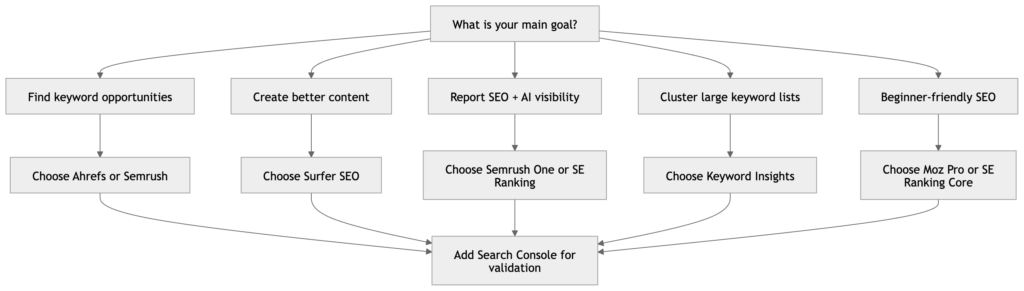
AI Keyword Research Tool Decision Tree
Best Tool by Business Type
For Marketing Agencies
Best picks: Semrush One, SE Ranking Growth, Ahrefs Advanced, Keyword Insights.
Agencies need repeatable workflows, client reporting, competitor benchmarking, and enough limits to handle multiple domains. Semrush One is ideal if clients are asking about AI visibility. SE Ranking is strong if budget control and white-label reporting matter. Ahrefs is excellent for deep SEO research and competitive gap analysis. Keyword Insights is useful when agencies need scalable content roadmaps.
For E-commerce Websites
Best picks: Semrush, Ahrefs, Surfer SEO.
E-commerce SEO requires category keywords, product modifiers, commercial intent, competitor research, and technical SEO. Semrush is strong for PPC + SEO alignment. Ahrefs is excellent for competitor category analysis and backlink research. Surfer helps optimize category and buying-guide content.
For SaaS Companies
Best picks: Ahrefs, Semrush One, Surfer SEO, Keyword Insights.
SaaS SEO depends heavily on comparison keywords, alternative keywords, pain-point keywords, integration keywords, and jobs-to-be-done content. Semrush One is attractive because AI answers increasingly influence product discovery. Ahrefs helps identify competitor traffic pages. Keyword Insights helps plan clusters. Surfer helps optimize long-form product-led content.
For Local Businesses
Best picks: SE Ranking, Semrush, Moz Pro.
Local businesses need keyword research by city, service, and intent. They also need rank tracking, local visibility, reviews, and Google Business Profile monitoring. SE Ranking and Semrush are strong here; Moz Pro is beginner-friendly for smaller teams.
For Bloggers and Affiliate Sites
Best picks: Ahrefs, Keyword Insights, Surfer SEO.
Bloggers need long-tail discovery, low-competition opportunities, affiliate-intent terms, and content refresh workflows. Ahrefs helps uncover competitor traffic. Keyword Insights helps group keywords into content clusters. Surfer helps create and update content.
Recommended AI Keyword Research Stacks
Stack 1: Best Overall SEO Stack
- Ahrefs Standard
- Surfer SEO Standard or Pro
- Google Search Console
- Google Keyword Planner
Why it works: Ahrefs handles discovery and competitor intelligence. Surfer turns research into optimized pages. Search Console validates real performance.
Stack 2: Best Agency Stack
- Semrush One Pro+ or Advanced
- SE Ranking Agency Pack or Growth
- Keyword Insights
- Google Search Console
Why it works: Semrush One covers traditional SEO and AI visibility. SE Ranking adds scalable tracking and reporting. Keyword Insights improves content planning.
Stack 3: Best Budget Stack
- SE Ranking Core
- Keyword Insights Basic
- Google Search Console
- Google Keyword Planner
Why it works: This gives you keyword research, rank tracking, AI search monitoring, clustering, and first-party validation without enterprise pricing.
Stack 4: Best Content Team Stack
- Semrush SEO Toolkit or Ahrefs Standard
- Surfer SEO Pro
- Keyword Insights Professional
- Google Search Console
Why it works: Discovery, clustering, content briefs, content scoring, and performance validation are covered end to end.
How to Choose the Right AI Keyword Research Tool
Use this checklist before buying:
1. Check your main workflow
Do you need keyword discovery, content optimization, rank tracking, AI visibility, or client reporting? Buying a tool without matching it to your workflow leads to wasted budget.
2. Look beyond search volume
Search volume is only one signal. Prioritize intent, business value, ranking difficulty, SERP features, traffic potential, topical relevance, and conversion likelihood.
3. Validate with Google Search Console
For existing websites, Search Console should guide refresh opportunities. Look for pages with impressions but low CTR, queries ranking positions 4–20, and pages losing impressions over time.
4. Use clustering before writing
Keyword clustering prevents cannibalization. It helps decide whether related terms belong on one page or separate pages.
5. Evaluate AI visibility separately
Traditional rankings and AI mentions are different visibility layers. A page can rank well but not be cited in AI answers. A brand can appear in AI answers even when clicks are limited.
6. Watch total cost, not sticker price
Many SEO tools charge for additional users, domains, projects, prompts, exports, credits, AI features, or API access. Always calculate the real monthly cost for your team.
Common Mistakes When Using AI Keyword Research Tools
Mistake 1: Publishing AI-generated articles without original value
Google says generative AI can help with research and structure, but scaled AI content without added value can violate spam policies. Use AI to accelerate research, not to replace expertise.
Mistake 2: Choosing keywords only by search volume
High-volume keywords are often broad, competitive, and low-converting. A lower-volume keyword with strong purchase intent can produce better ROI.
Mistake 3: Ignoring SERP intent
A keyword may look relevant, but the SERP may show that Google prefers product pages, listicles, local packs, videos, forums, or comparison pages.
Mistake 4: Creating one page per keyword
Modern SEO is topic-led. Many pages rank for hundreds or thousands of related keywords, so clustering and topical mapping matter more than exact-match keyword targeting.
Mistake 5: Not measuring refresh opportunities
The fastest SEO wins often come from existing pages with impressions, average positions below the top three, or declining CTR. Search Console is essential for this workflow.
Final Rankings
Best Overall: Semrush
Semrush wins overall because it combines keyword research, competitor analysis, content planning, rank tracking, PPC insights, and AI visibility in one ecosystem. The Adobe acquisition also strengthens its positioning for enterprise brand visibility in AI search.
Best for Data-Driven SEO: Ahrefs
Ahrefs is the strongest choice for advanced SEO professionals who care about competitor research, backlinks, traffic potential, and keyword data depth. Its 28.7B-keyword database and AI-enhanced keyword workflows make it one of the most powerful research tools available.
Best for Content Optimization: Surfer SEO
Surfer is the best tool for turning a keyword into an optimized page. It is especially useful for content teams that need SERP-based guidance, content scoring, topical maps, and AI visibility tracking.
Best Value for Agencies: SE Ranking
SE Ranking offers a strong balance of keyword research, rank tracking, audits, reporting, and AI search visibility at a comparatively accessible price point.
Best Specialist Tool for Clustering: Keyword Insights
Keyword Insights is the best choice when your biggest problem is turning thousands of keywords into clean clusters, briefs, and content plans. Its SERP-based clustering method is especially useful for preventing cannibalization.
Best Beginner-Friendly Platform: Moz Pro
Moz Pro is best for smaller teams and beginners who want classic SEO keyword research, simpler workflows, and trusted SEO metrics without the complexity of larger enterprise platforms.
Final Recommendation
For most serious SEO teams in 2026, the best setup is not one tool. It is a stack:
Ahrefs or Semrush for discovery → Keyword Insights for clustering → Surfer SEO for content optimization → Google Search Console for validation → Semrush One, SE Ranking, Surfer AI Tracker, or Ahrefs Brand Radar for AI visibility.
That stack reflects how search works now. Users do not search in one way. They use Google, AI Overviews, AI Mode, ChatGPT, Perplexity, Gemini, Reddit, YouTube, and comparison content. The brands that win will not be the ones with the biggest keyword spreadsheet. They will be the ones that understand topics deeply, answer intent clearly, build authority across the web, and measure visibility wherever decisions happen.

Frequently Asked Questions
01
Semrush is the best all-in-one AI keyword research platform, Ahrefs is best for advanced SEO data and competitor research, and Surfer SEO is best for turning keywords into optimized content.
02
Ahrefs is often better for backlink-led SEO, competitor page research, and traffic potential analysis. Semrush is better for all-in-one marketing workflows, PPC + SEO research, reporting, and AI visibility through Semrush One.
03
Yes, but Surfer SEO is more of a content optimization and topical planning platform than a pure keyword database tool. It works best when paired with Ahrefs, Semrush, SE Ranking, or Search Console.
04
They are directionally useful, not perfectly accurate. Search volume, keyword difficulty, traffic potential, and AI visibility metrics should be validated with Google Search Console, analytics, ranking data, and conversions.
05
Ahrefs publicly lists 28.7B filtered keywords, while Semrush lists 27.8B keywords in Keyword Magic Tool. Both are among the largest keyword databases available.
06
SE Ranking and Keyword Insights offer strong value. SE Ranking is better for all-in-one SEO and tracking, while Keyword Insights is better for clustering and content planning.
07
Yes, but not alone. Keyword Planner is useful for discovering ideas and search volume ranges, but it is built around Google Ads workflows. For SEO, combine it with Search Console, Ahrefs, Semrush, SE Ranking, or another SEO-specific tool.
08
AI visibility measures whether your brand, website, or content appears in AI-generated answers across platforms such as Google AI Overviews, AI Mode, ChatGPT, Perplexity, Gemini, and similar systems. Semrush describes this as a new layer of visibility beyond traditional search.