👋
Blog Post
Off-Page SEO for the AI Era: A Step-by-Step Guide
A deep, practical guide to off-page SEO in the AI era, covering white-hat link building, guest blogging, digital PR, and influencer outreach for stronger rankings, mentions, and AI-era visibility.
Share

Off-Page SEO for the AI Era: A Step-by-Step Guide
The old version of off-page SEO was simple: get more backlinks than the sites around you and you would usually gain ground. The AI-era version is more demanding. Google says the same SEO fundamentals still apply to AI features like AI Overviews and AI Mode, but those systems can use query fan-out, pull from a wider set of sources, and surface a more diverse range of links than classic search alone. In other words, off-page SEO is no longer just about building links. It is about becoming the source the web wants to reference.
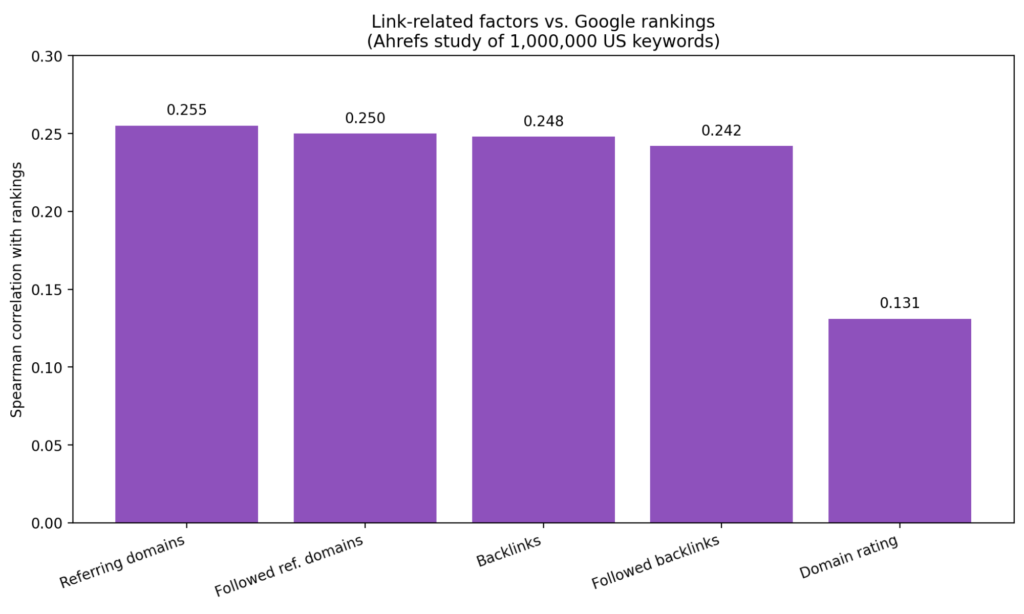
That shift matters because links still correlate strongly with rankings, yet rankings alone no longer explain visibility in AI search. Ahrefs’ 1,000,000-keyword study found that referring domains, followed referring domains, backlinks, and followed backlinks all had stronger correlation with rankings than Domain Rating in that dataset, while Semrush reports that pages ranking #1 average more than 200 referring domains and pages at #10 average fewer than 80. Backlinko’s larger 11.8 million-result analysis also found that the #1 result has 3.8x more backlinks than positions 2 through 10, and about 3x more referring domains.
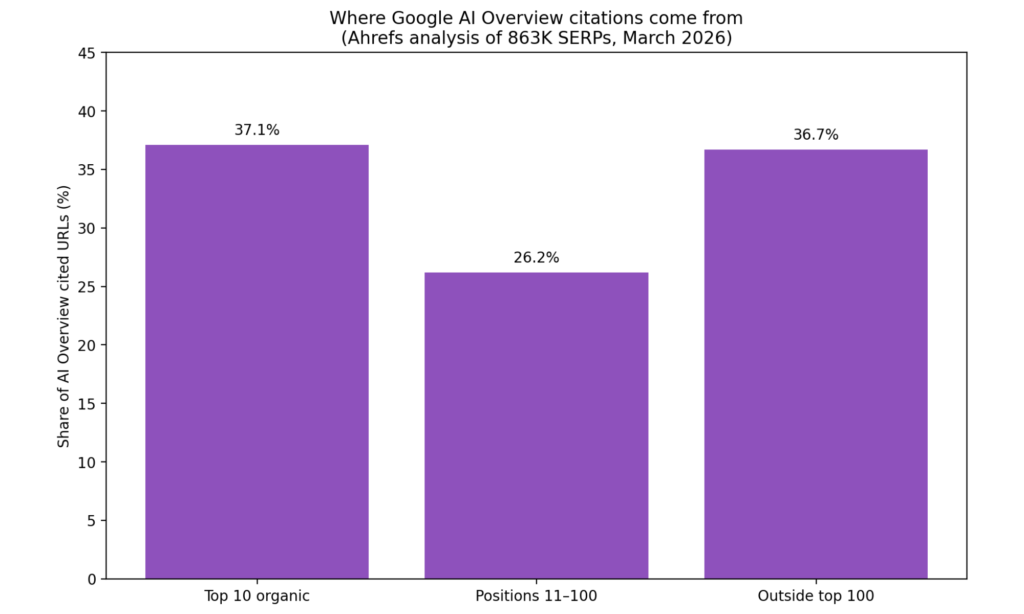
At the same time, Ahrefs’ March 2026 analysis found that only 37.1% of URLs cited in AI Overviews were ranking in the top 10 organic positions for the same query, while 26.2% came from positions 11 to 100 and 36.7% did not rank in the top 100 at all. A separate Ahrefs analysis of 17 million citations found that AI-cited content is 25.7% fresher than organic Google results on average. That is the clearest evidence I have seen that off-page SEO in 2026 has to optimize for both traditional ranking strength and broader citation readiness.
So the modern goal is not “build as many links as possible.” The goal is “earn authoritative mentions, links, and citations from places your audience and search systems already trust.” Google explicitly says there are no special technical tricks or AI-only schema needed to appear in AI Overviews or AI Mode. What still matters is foundational SEO, helpful content, and pages strong enough to be surfaced as supporting links.
What off-page SEO means in the AI era
Off-page SEO now sits at the intersection of link equity, publisher trust, entity recognition, creator amplification, and brand evidence. Semrush’s digital PR guidance gets this mostly right: digital PR is broader than link building because it aims to generate media coverage, high-quality backlinks, and positive mentions across digital channels. In the AI era, that broader framing is much closer to reality than the old “email 500 webmasters for guest posts” model.
That is also why your strategy should prioritize reference-worthy assets over raw outreach volume. Google’s guidance for AI search success is to focus on unique, non-commodity content that fulfills real user needs, while Semrush’s link-building playbook shows that journalists and publishers are most likely to link when your asset actually improves their page, whether that is a better statistic, a useful tool, a more complete resource, or a compelling visual.
Step 1: Build assets that deserve links and citations
If you want better off-page results, stop starting with outreach. Start with assets. The highest-leverage assets in 2026 are original research studies, benchmark reports, free tools, calculators, downloadable templates, expert commentary pages, and visual explainers that other sites can cite without friction. Google’s own AI-search advice is to make unique, helpful content; Semrush’s digital PR guidance specifically points to original research and data-led stories as strong media magnets; and its link-building guide notes that publishers often add links when doing so makes a page more useful or complete.
For an SEO and AI SEO website, that means your best linkable assets are not generic blog posts. They are things like an annual “AI Overview Visibility Study,” a benchmark database of citation patterns by industry, an interactive prompt-to-SERP comparison tool, a glossary of AI search terms with expert definitions, or a quarterly report on how Google AI Mode changes click behavior. Those formats are naturally cited in articles, newsletters, podcasts, webinars, and industry roundups because they reduce research effort for everyone else. That is the core principle of modern off-page SEO: make something others would feel incomplete publishing without mentioning.
Step 2: Make digital PR the engine, not the add-on
In traditional SEO teams, digital PR is often treated as a side project for “big campaigns.” That is backwards now. Digital PR should be the operating system for off-page SEO because it creates three things at once: links, branded mentions, and reputation. Semrush defines digital PR as building visibility and reputation through media coverage, high-quality backlinks, and positive mentions, and notes that its benefits compound over time through SEO, referral traffic, and stronger brand authority.
The best digital PR campaigns for AI-era SEO share four characteristics. First, they are backed by original data. Second, they connect to an active industry conversation. Third, they package the story in multiple formats, such as a report, a press-friendly summary, charts, quotes, and social cutdowns. Fourth, they are promoted to the right journalists, newsletter writers, analysts, and creators instead of blasted to a giant generic list. That last part matters because AI-era off-page SEO rewards source quality and topical fit far more than sheer outreach volume.
A practical formula for your niche would be: publish a data story, create a one-page media brief, build three exclusive angles for different publication types, then pitch the asset to search journalists, SaaS writers, agency newsletters, AI tool reviewers, and creators who cover Google updates. One strong campaign can produce high-authority editorial links, unlinked brand mentions, podcast appearances, LinkedIn discussion, YouTube coverage, and future citation opportunities across the open web. That is exactly the kind of diversified signal mix AI-era discovery seems to reward.
Step 3: Use link-building tactics that still create real value
“Replication without differentiation is just commodity outreach, and commodity outreach is increasingly easy for publishers to ignore.”
White-hat link building still works, but the winning tactics are the ones that solve a publisher’s problem. Semrush’s current guidance highlights three especially useful approaches: adding value to an existing article, broken-link replacement, and reclaiming unlinked brand mentions. All three work because they begin with usefulness, not manipulation.
Unlinked mention reclamation is one of the cleanest tactics in modern SEO. If a site already mentioned your brand, quote, tool, or research, you are not asking for a favor from scratch. You are asking for proper attribution. Semrush recommends filtering mentions without backlinks and contacting publishers with a polite request that explains where the attribution link should sit and which URL to use. On a site like yours, this works especially well for research studies, definitions, frameworks, and original charts.
Broken-link building is still effective when you have the best replacement. The mistake most teams make is creating a mediocre copycat page and expecting results. The better move is to find broken links that once pointed to stats pages, reports, templates, or resource hubs, then publish the most current, citation-ready replacement. That aligns nicely with the freshness bias Ahrefs found in AI citations.
Competitor backlink replication also works, but it should be selective. If a publication interviewed a competitor’s founder, quoted their research, or included their tool in a roundup, that is a signal of editorial appetite, not an invitation to clone the page and spam the editor. The right move is to bring a better angle, a newer data point, a stronger expert, or a more useful asset. Replication without differentiation is just commodity outreach, and commodity outreach is increasingly easy for publishers to ignore.
Step 4: Treat guest blogging as editorial reputation-building, not link farming
Guest blogging is not dead. Scaled guest-post abuse is. Google’s guidance is very clear here. It does not discourage contributor, guest, partner, or syndicated posts when they inform users, educate another site’s audience, or build awareness. What violates policy is using them primarily to build links at scale. Google specifically flags keyword-stuffed links, wide article distribution across many sites, using writers who are not knowledgeable on the topic, duplicate content, and questionable links that are not nofollowed or otherwise qualified.
Google’s broader spam policies go even further. They classify buying or selling links for ranking purposes, excessive link exchanges, automated link creation, advertorials or native advertising that pass ranking credit, and optimized anchor text in guest posts or press releases as link spam. Google also says paid or sponsored links are fine for advertising purposes as long as they are qualified with rel="nofollow" or, preferably, rel="sponsored".
That means the safe way to use guest blogging in 2026 is simple: write fewer pieces, place them on sites your actual audience reads, publish unique arguments or original data, link sparingly and naturally, and be fully comfortable if a post drives reputation more than direct ranking equity. The moment a guest-post program becomes a scaled anchor-text machine, it stops being content marketing and starts looking like spam.
There is one more AI-era wrinkle here: site reputation abuse. Google now explicitly warns against third-party content being published on a host site mainly to exploit that host’s established ranking signals. So even if a big site is willing to host your content, publishing there mainly because its authority may rank your third-party page better is a dangerous game. Editorial relevance, audience fit, and real reader value have to come first.
Step 5: Use influencer outreach to earn trust, not just impressions
Influencer outreach matters more in the AI era than many SEO teams realize, but the goal should not be vanity exposure. The goal is to trigger trusted discussion, branded search, secondary coverage, and naturally earned links. Deloitte’s 2025 State of Social Research found that 83% of consumers see the creators they follow as trusted sources of information. Sprout Social also found that among B2B brands using influencer marketing, 67% prioritize brand awareness and 54% prioritize credibility and trust. That is exactly why creator relationships belong inside your off-page SEO plan, not outside it.
For an SEO and AI SEO brand, “influencer” should be interpreted broadly. It includes newsletter operators, search journalists, YouTube educators, conference speakers, agency founders, AI product reviewers, and respected consultants with niche authority. These people may never place a followed backlink, but they can do something just as valuable: seed your research into the ecosystem that journalists, marketers, podcasters, and AI systems later draw from. In a query fan-out world, those distributed references matter.
The best influencer outreach is asset-led. Do not email creators asking them to “share your latest article.” Give them something they can use: exclusive data, a quote pack, a chart they can embed, early access to a tool, a contrarian finding, or a short expert brief tailored to their audience. That makes your pitch editorially useful instead of promotional, which is the difference between being ignored and being cited.
We created a checklist that helps you dominate Google and LLMs in 2026. The checklist has practical SEO tips that the top SEOs use daily. Get it for FREE.
Step 6: Build entity authority, not just page authority
One of the biggest mistakes in off-page SEO is treating authority as something that belongs only to URLs. In the AI era, authority also belongs to entities: your brand, your authors, your experts, your products, and your recurring topics. Google says AI features can surface a wider and more diverse set of helpful links, and they may issue multiple related searches across subtopics and sources to build a response. That means your reputation is being assembled from many fragments, not just your ranking page.
That is why your off-page work should reinforce the same entity signals everywhere: consistent author bios, repeatable expert positioning, cited research, analyst commentary, review visibility, conference appearances, podcast mentions, and press coverage aligned to the same core themes. The job is to make it obvious, across the web, what your brand is known for. The stronger that thematic consistency becomes, the easier it is for third parties to cite you and for search systems to understand why you are a relevant supporting source.
Step 7: Measure off-page SEO with a wider scoreboard
If you still judge off-page SEO only by link count, you will under-measure the channel. Google says AI feature traffic is included in Search Console’s overall web reporting, and it notes that clicks coming from AI Overviews tend to be higher quality, meaning users are more likely to spend more time on site. That alone is a reminder that fewer clicks can still be better clicks.
So your KPI stack should include at least six layers: referring domains earned, quality of linking sites, branded mentions, referral traffic, assisted conversions, and visibility in AI-era discovery surfaces. If your brand is appearing more often in roundups, creator videos, newsletter summaries, podcasts, and editorial citations, your off-page SEO is improving even before every one of those mentions becomes a followed link. In practice, the healthiest programs create a mix of direct links and broader reference signals that compound over time.
A simple dashboard for your site would track: new referring domains by topical relevance, unlinked mentions by sentiment, brand-search lift after campaigns, referral sessions from press and creator coverage, assisted conversions from those sessions, and citations or appearances in AI-driven search experiences where you can measure them. That gives you a much truer view of off-page momentum than “we built 25 links this month.”
What to stop doing right now
“The safest competitive advantage is not volume. It is distinctiveness.“
Stop buying links that pass ranking credit. Stop excessive reciprocal linking. Stop using automated link-building services. Stop placing optimized anchor text in paid guest posts or distributed press releases. Stop publishing third-party pages on big sites mainly to exploit their authority. Google lists all of those patterns as spam or abuse, and repeated use can lead to ranking suppression or manual action.
Also stop treating scale as proof of quality. In 2026, scaled sameness is a liability. Google’s AI-search guidance keeps coming back to unique, helpful, people-first content, and its spam policies explicitly warn against scaled content abuse created primarily to manipulate rankings. The safest competitive advantage is not volume. It is distinctiveness.
A practical 90-day off-page SEO plan
Days 1–15:
Audit your current footprint. Pull your top-linked pages, your unlinked brand mentions, your lost links, your highest-converting referral sources, and the topics where competitors are repeatedly cited. Then choose one core authority theme for the next quarter, such as “AI Overviews research,” “AI SEO benchmarks,” or “technical SEO for AI search.” This narrows your outreach and helps entity signals accumulate instead of fragmenting.
Days 16–35:
Build one flagship citation asset and three derivative assets. For example, produce an original study, a journalist summary, a visual chart pack, and a newsletter-friendly angle. This is the stage most brands skip, which is why their outreach later feels weak. Strong off-page performance usually begins with a strong object to promote.
Days 36–60:
Run focused outreach across three lanes: journalists and publishers, creators and newsletter writers, and mention-reclamation prospects. Keep lists tight. Personalize every pitch around audience fit and utility. Your objective here is not maximum email volume. It is maximum editorial relevance.
Days 61–90:
Publish two or three expert guest contributions on high-fit sites, but only if they add genuine value and do not rely on manipulative anchors or scaled templates. At the same time, repurpose every earned placement into social proof on your own site: press logos, quoted-in sections, expert bios, updated about pages, and “as featured in” trust elements. Off-page SEO works best when earned authority is looped back into on-site trust.
Final word
Off-page SEO in the AI era is not smaller than before. It is broader and stricter. Broader, because visibility now flows through links, mentions, creators, experts, and cross-source citations. Stricter, because the cheap shortcuts are easier for Google to classify as spam, and because generic outreach has less editorial value in a web flooded with AI-assisted content. The winners will be the brands that publish genuinely reference-worthy assets, promote them intelligently, and earn their reputation across the web instead of trying to manufacture it.
Bonus: Quick outreach templates
Unlinked mention reclamation
Subject: Quick attribution request for your recent mention
Hi [Name],
Thanks for mentioning [Brand/Study] in your piece on [Topic]. Since you referenced [specific point], would you be open to linking that mention to [URL] so readers can access the original source/data? I think it would make the reference more useful for your audience.
Best,
[Your Name]

Guest contribution pitch
Subject: Data-backed guest article idea for [Site]
Hi [Name],
I’d love to contribute a piece for [Site] on [specific angle]. It would be original to your publication, based on [new data / client trends / experiment], and written specifically for your audience of [audience]. No recycled content, and I’m happy to keep links minimal and purely editorial.
Best,
[Your Name]
Creator/influencer pitch
Subject: Exclusive chart or data point for your audience
Hi [Name],
We’ve just finished a new dataset on [topic], and one finding stood out: [insight]. I thought of your audience because you’ve covered [related topic] recently. If useful, I can send over an exclusive chart, three takeaways, and a short commentary quote you can use however you want.
Best,
[Your Name]