👋
Blog Post
The Future of SEO: AI vs. Traditional SEO
See what changes, what still matters, and how smart brands are combining AI with SEO fundamentals to win more organic traffic.
Share
SEO vs AI SEO: The Future of SEO
For years, SEO was often treated like a repeatable playbook: find keywords, optimize pages, publish content, build links, improve technical health, and wait for rankings to compound. That playbook still matters. But it no longer describes the full field.
Search itself is already deeply AI-powered. Google openly documents that its ranking systems include AI systems such as RankBrain, BERT, Neural matching, and passage ranking, each helping it understand meaning, concepts, intent, and relevance more effectively than simple keyword matching ever could. In other words, the argument is no longer “Will AI affect SEO?” It already does.
At the same time, SEO workflows are being reshaped by generative AI and machine-learning-assisted tooling. Teams can now cluster search intent at scale, draft content briefs in minutes, identify internal linking opportunities automatically, summarize crawl issues, detect anomalies faster, and produce optimization recommendations that used to require hours of manual work. Google’s own guidance is clear on the bigger principle: the best practices for SEO remain relevant for AI features, and there are no special technical requirements or special markup needed to appear in AI Overviews or AI Mode.
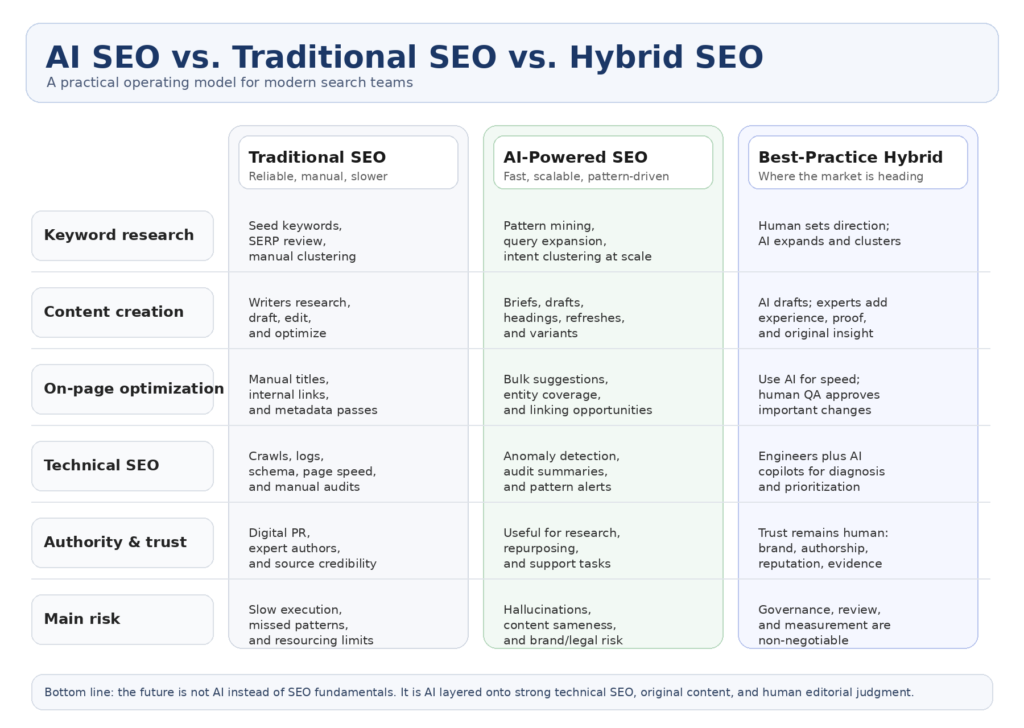
That single point matters more than most marketers realize. It means AI-powered SEO is not a separate discipline replacing SEO. It is an acceleration layer on top of SEO. Fundamentals still decide who deserves visibility. AI changes how efficiently you can discover opportunities, prioritize work, and scale execution.
This is why the “AI vs. traditional SEO” framing is useful only up to a point. As a debate, it is too simple. As a strategic comparison, however, it is valuable because it reveals where each approach is strong, where it breaks, and how a mature search team should combine them.
Why this debate matters now?
The search landscape has changed fast. Google launched AI Overviews widely in 2024 and later expanded them to more than 100 countries, saying the feature would reach more than 1 billion global users every month. Google’s current public AI Overviews page says the experience is available in more than 120 countries and territories and 11 languages.
In 2025, Google also introduced AI Mode as a more advanced search experience for exploration, comparisons, and reasoning-heavy queries. Google says people using AI experiences on Search are asking new and more complex questions, using Search more often, and reporting higher satisfaction.
At the same time, BrightEdge reported that while AI search traffic is growing quickly, it still accounts for less than 1% of referral traffic, while organic search remains the main driver and delivers the majority of conversions. So the mature conclusion is not “traditional SEO is dead.” It is “the search interface is evolving faster than traffic mix is changing.”
What traditional SEO actually means?
“Traditional SEO is therefore not obsolete. It remains the architecture of discoverability.”
Traditional SEO is often dismissed as “old SEO,” but that is sloppy thinking. At its best, traditional SEO is simply the disciplined practice of improving a site so search engines can crawl it, understand it, trust it, and rank it for relevant demand.
Its core components are still sound: technical accessibility, keyword research, on-page optimization, internal linking, information architecture, people-first content, authority building, and disciplined measurement.
Google still emphasizes helpful, reliable, people-first content and explicitly says its ranking systems aim to reward content demonstrating experience, expertise, authoritativeness, and trustworthiness (E-E-A-T) regardless of how that content was produced.
Traditional SEO is therefore not obsolete. It remains the architecture of discoverability.
Why traditional SEO still matters?
First, technical SEO still determines whether a page is even eligible. Google states that pages shown as supporting links in AI Overviews or AI Mode must already be indexed and eligible to appear in Search with a snippet. There are no additional technical requirements beyond normal Search requirements.
Second, originality matters more in an AI-saturated web. As draft generation gets cheaper, content that includes first-hand experience, clear evidence, expert commentary, proprietary data, and authentic point of view becomes more valuable, not less.
Third, authority and trust remain stubbornly human. Reputation, expert authorship, product quality, citations, reviews, and references from other trusted sources are not replaced by faster text generation.
What AI-powered SEO actually is
AI-powered SEO is not just using a chatbot to write blog posts. A better definition is the use of machine learning and generative AI to increase the speed, scale, depth, and adaptability of SEO work across research, planning, creation, optimization, and analysis.
In practice, that includes large-scale keyword clustering, intent mapping, content brief generation, SERP summarization, draft creation, refresh recommendations, internal-link suggestions, technical issue summarization, anomaly detection, and faster reporting.
Google’s own documentation adds an important layer here: AI Overviews and AI Mode may use a query fan-out technique, issuing multiple related searches across subtopics and data sources to construct a response. That means modern SEO increasingly rewards topical depth, entity clarity, and supporting answer coverage rather than rigid one-keyword-one-page thinking alone.
The strongest case for AI-powered SEO
The biggest advantage of AI-powered SEO is not merely writing faster. It is increasing strategic throughput.
AI compresses the time between question and action. It is especially useful when the problem is volume: large content libraries, ecommerce catalogs, multilingual expansion, templated sites, massive query sets, or enterprise technical audits.
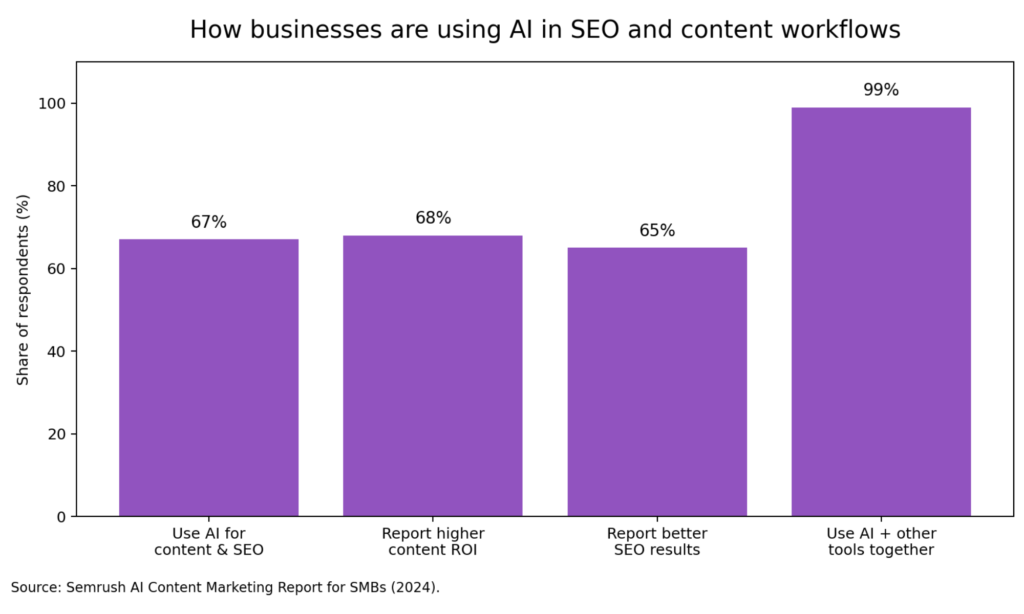
Semrush reports that 67% of small businesses already use AI for content and SEO, 68% report increased content marketing ROI, and 65% say they achieve better SEO results thanks to AI. It also reports that 99% of AI users still rely on other tools in addition to AI, which reinforces the idea that AI works best as part of a broader stack, not as a one-tool replacement.
The strongest case for traditional SEO
If AI-powered SEO is about leverage, traditional SEO is about quality control and compounding trust.
Traditional SEO still has the edge in judgment, originality, brand voice, risk management, subject-matter depth, and authority creation. AI can propose, summarize, and accelerate. It should not own accountability.
This is especially true in high-stakes sectors such as health, finance, legal, and other YMYL categories, where Google says signals of reliability are weighted even more heavily.
Compare and contrast: where each model wins
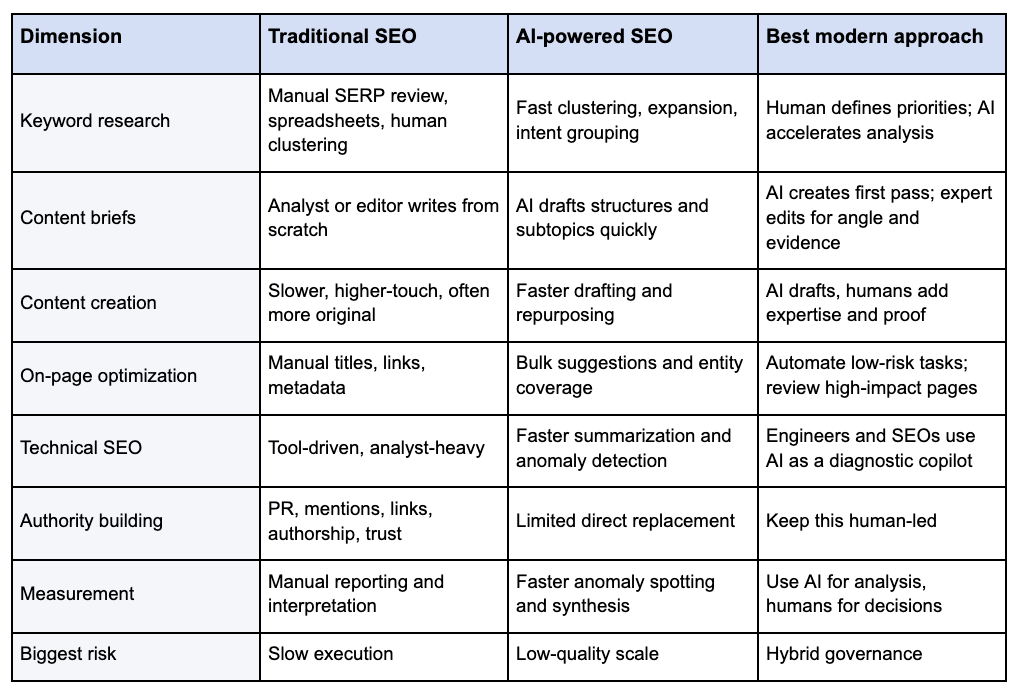
The cleanest way to think about the difference is this: traditional SEO is better at judgment and trust; AI-powered SEO is better at speed and scale; the winning model combines both.
What the data says about AI content itself
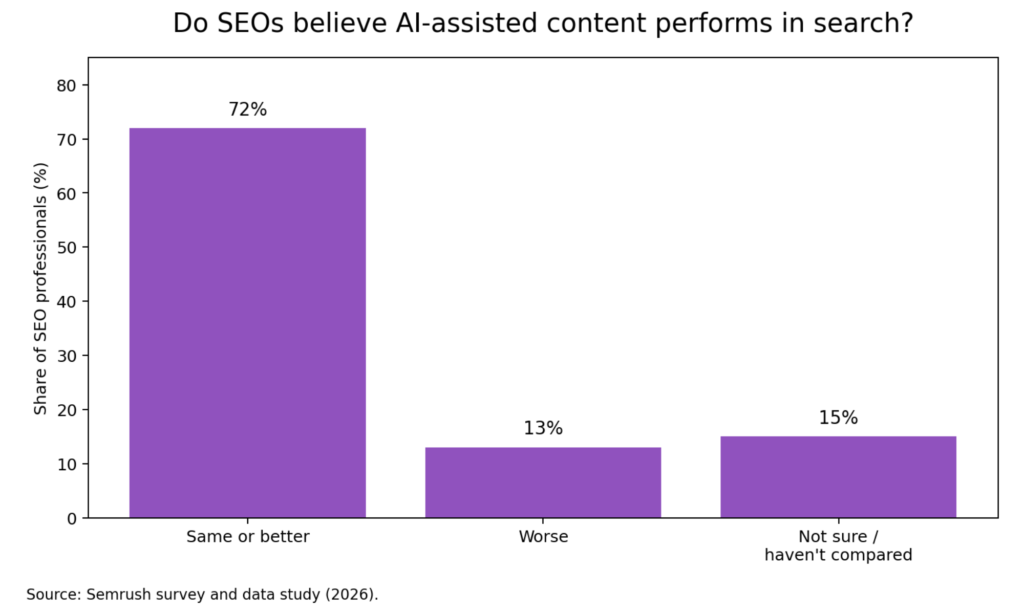
One of the most argued-over questions in modern SEO is whether AI-assisted content can rank. Google’s answer remains the right starting point: using AI gives content no special advantage. It is judged like any other content. If it is useful, helpful, original, and aligned with E-E-A-T, it may perform well. If it is not, it will not.
Semrush reports that 72% of SEO professionals who use AI content believe it performs just as well or better than human-written content in search rankings, while 13% say it performs worse and 15% are unsure or have not compared.
The important conclusion is not “AI content wins.” It is that AI-assisted content can compete when the workflow is strong: reviewed facts, original insight, real editorial quality, clear differentiation, and genuine usefulness.
We created a checklist that helps you dominate Google and LLMs in 2026. The checklist has practical SEO tips that the top SEOs use daily. Get it for FREE.
How AI search experiences change SEO strategy
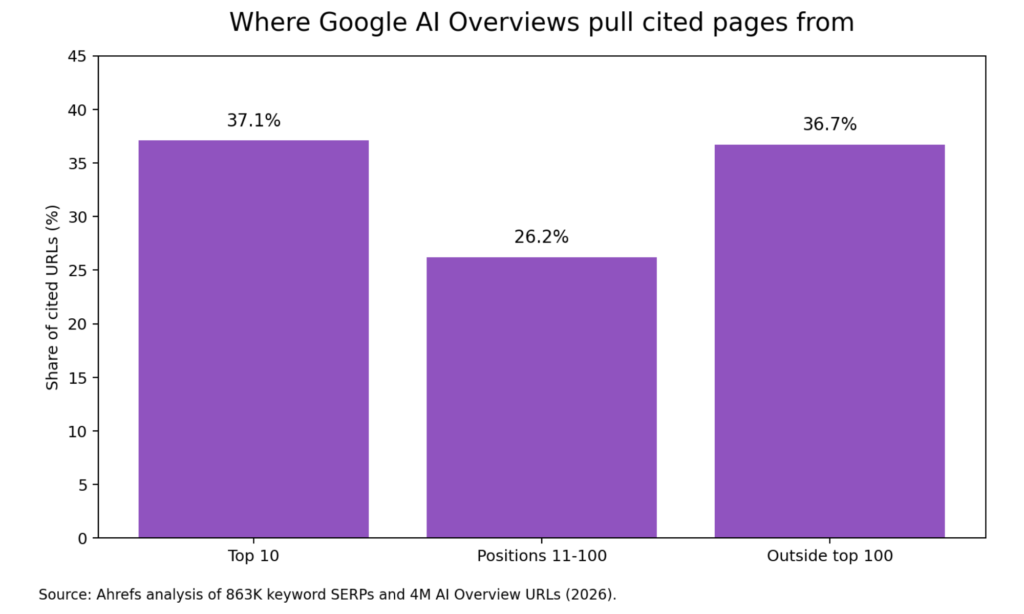
Google’s documentation on AI features says that AI Overviews and AI Mode may use query fan-out, meaning one user query may expand into multiple related searches across subtopics and sources.
That implies at least four strategic shifts: topical depth matters more than exact-match targeting, supporting assets matter more, mid-ranking or even non-ranking pages can still matter, and search visibility becomes more distributed across blue links, citations, media, and supporting pages.
Ahrefs analyzed 863,000 keyword SERPs and 4 million AI Overview URLs and found that only 37.1% of cited pages ranked in the top 10 organic results for the same keyword. Another 26.2% ranked between positions 11 and 100, and 36.7% did not rank in the top 100 at all.
The challenges of integrating AI into SEO
This is the part too many AI SEO articles rush past. Integration is not just an efficiency project. It is an operating-model design problem.
The biggest challenges are hallucinations, factual drift, content sameness, brand flattening, false confidence from output speed, measurement blind spots, workflow debt, and legal or compliance risk.
Google also notes that AI Overviews and AI Mode are counted within Search Console’s overall Web search traffic rather than as a separate search type, which means teams often need better landing-page analysis and conversion measurement to understand what is actually changing.
A practical framework for integrating AI into SEO
The most effective model today is not full automation. It is governed augmentation.
Use AI where mistakes are relatively cheap and speed matters: clustering, first-pass briefs, FAQ expansion, title ideation, internal-link suggestions, refresh recommendations, and technical summarization.
Keep humans in control where trust, nuance, or accountability matter most: fact-checking, expert commentary, original research, YMYL review, strategy, prioritization, and final approval for high-value pages.
Then formalize governance. Define approved tools, source rules, review requirements, prompt standards, red-flag topics that require subject-matter review, and the KPIs that matter in an AI-era search program.
The future of SEO: what is likely to happen next
“Human judgment becomes more valuable, not less. The more execution gets automated, the more scarce judgment becomes.”
First, SEO becomes more multidisciplinary. The best search programs will sit closer to editorial, product marketing, analytics, UX, and engineering.
Second, commodity content loses relative value. As generation gets cheaper, trust signals, originality, and true expertise become stronger differentiators.
Third, search optimization expands beyond blue links. Teams will increasingly optimize for classic rankings, AI citations, media assets, brand presence, entity clarity, and supporting content ecosystems.
Fourth, technical SEO remains foundational because AI search experiences still depend on crawlable, indexable, readable pages that are eligible to appear in Search at all.
Fifth, human judgment becomes more valuable, not less. The more execution gets automated, the more scarce judgment becomes.
Final verdict
The future of SEO is not a war between AI and traditional methods. It is a quality test disguised as a tooling shift.
Traditional SEO still provides the architecture of success. AI provides leverage.
Use traditional SEO to decide what deserves to rank. Use AI to accelerate how fast you can build and improve it. Use human judgment to decide what should never be automated blindly.
That is the future. And for search teams willing to operate this way, it is a very good one.